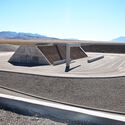
Artists are frequently inspired by land — be it painter Robert S. Duncanson’s renditions of American landscapes, or William Kentridge’s subversions of colonial-era British paintings depicting African vistas. Some artists, though, have preferred to work directly with the land, creating structures that sit on landscapes, or carving into the land itself. This art style — formally termed as Land Art — gained prominence in 1960s and 70s United States, in the context of the rise of the environmental movement amidst civil rights and antiwar protests, and as artists looked to separate themselves from the art market.


Large conceptual gestures were made by sculpting into the landscape one way or another, by artists such as Walter De Maria — whose 1977 Lightning Field featured 400 stainless steel poles installed in a grid in a New Mexico desert; or by Nancy Holt, who positioned four hollow concrete cylinders to frame the sun in the northwestern American state of Utah. These works, as much as they are artistic explorations, can also be viewed as architectural experiments. With Land Art, the contested line that determines what is “art” and what is “architecture” can get extremely blurred.