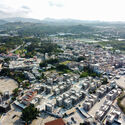
Amid the rapid build-out of data centres and AI economies across the Greater Bay Area—and alongside the celebration of AI as a tool and "author," as featured in 2025 Hong Kong–Shenzhen Bi-City Biennale of Urbanism\Architecture (Hong Kong)—a parallel question becomes unavoidable: how do the planning and construction of AI infrastructure actually begin to shape everyday life? Many of the facilities already built remain intentionally distant from daily experience. The "cloud" may be marketed as immaterial, but its architecture is profoundly physical: high-power, high-heat, service-heavy environments that are often sited in remote or low-density areas to take advantage of lower land costs and to minimize friction with nearby communities. Security and risk management further reinforce this logic. Data centres hold sensitive, privileged information—corporate assets, legal records, government and institutional data—and remoteness becomes part of their operating model, keeping the infrastructures of AI both spatially and socially out of sight.

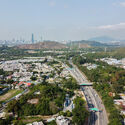
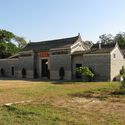
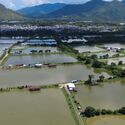
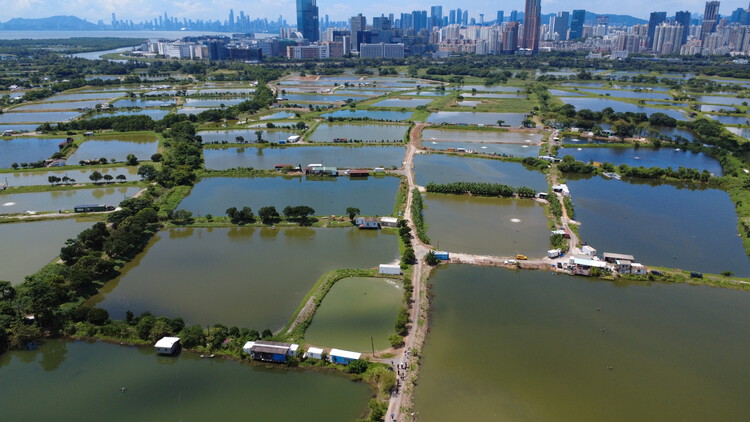
Yet Hong Kong's current development trajectory suggests that this separation may not hold. San Tin is being positioned as one of the next I&T hubs of Hong Kong SAR and the Greater Bay Area, anchoring a major redevelopment agenda. While often described as "on the outskirts" or reduced to a border zone adjacent to Shenzhen, San Tin is also a living landscape—shaped by long histories of village settlement, lineage-based stewardship, and locally sustained economies. Its geographic conditions, particularly extensive low-lying tidal land, have supported a durable ecology of fishponds and tidal ponds, including shrimp cultivation, forming not only livelihoods but also a distinctive wetland fabric that has structured the region's spatial and environmental identity. Even if one argues that fishpond and shrimp economies have become less commercially competitive—gradually losing ground to larger-scale agricultural systems across the border—this does not diminish the significance of the landscape itself, nor the cultural practices and forms of knowledge embedded in its maintenance over time.

Current planning, however, indicates that significant portions of this pond landscape may be erased—solidified into foundations and replaced by curtain-wall glazed or cladded developments that perform a familiar image of "success," "wealth," and "progress," now coupled with the rhetoric of technology and AI. The issue is not simply environmental loss, but a broader recalibration of what the city chooses to value: when AI infrastructure becomes a new engine of urbanization, what kinds of landscapes—and what forms of everyday life—are treated as expendable? The cost of AI, in other words, is increasingly physical, material, and architectural—and it is arriving not in abstraction, but on the ground, in places that have long been inhabited, cultivated, and managed — and will now engage in the parallel development of everyday life of civilians, right next door to fish ponds and tidal farms.

San Tin Before the Technopole: Farms, Villages, and an Ad-Hoc Land Economy
Historically, the San Tin area was used primarily for farming and agricultural activity. Over time, however, as these industries lost their competitive edge within Hong Kong—pressured by higher local costs and the availability of low-cost produce and supply chains across the border—many of these farmlands were gradually, and often temporarily, converted into ad hoc uses: parking lots, logistics and storage yards, or light-industrial holding spaces. Alongside this shifting land economy, the settlement landscape has remained substantial: there are around 20 government-registered villages in San Tin, with additional settlements that may not be formally recognized, yet still contribute to the area's lived geography.


The tidal pond landscape is also uniquely positioned in immediate proximity to Shenzhen. Standing at the border, the contrast can feel almost abrupt: two territories separated by a narrow river, yet operating under entirely different spatial logics. On the Shenzhen side, near-tidal lands are framed by high-rise skylines, commercial intensification, and the radiating image of "successful development." On the Hong Kong side, the tidal ponds produce a markedly different atmosphere—quiet, low, and ecological—an expanse that can feel uncannily "not Hong Kong," precisely because it contradicts the city's dominant image of density and continuous urbanization. The unsettling realization is not only that such landscapes exist, but that they sit so close to the border, awaiting a future that may soon overwrite the historical character of the land.
AI Urbanism Arrives: Zoning the Technopole Against Wetland Fabric
At the policy level, with its emphasis on economic growth and the "efficient" use of land, the zoning and planned development of the San Tin Technopole can read as a logical next step. Yet the abrupt juxtaposition it produces—high-tech laboratories, AI data centers, and information infrastructure set against tidal ponds, wetland ecologies, and long-established villages—has not yet been sufficiently analyzed, tested, or spatially resolved. What happens, for instance, to the defining edges of the pond landscape, and what governs the transitions from border to tidal ponds to new development? How should thresholds be negotiated where architectural ambition and infrastructural necessity meet ecological systems and everyday settlement?
These questions become even more charged when the operational realities of AI infrastructure are taken seriously. Data centers and supercomputing facilities bring intense heat loads, high energy demand, and substantial water requirements—conditions that cannot remain abstract if these buildings move closer to lived communities. Beyond the physical, there is also a cultural and historical register at stake: will this transition be treated as a clean slate—wiping away existing landscapes and practices—while designating a few protected fragments that are preserved in name yet neglected in experience? As data-center urbanism is drawn nearer to the fabric of daily life, the urgency shifts from whether such systems will arrive to how they will be integrated—environmentally, socially, and architecturally—without reducing the territory to a set of segregated zones that merely coexist without meaningful relationships.
Data Centers and Tidal Fishponds: Can the AI City Share the Ground?
In its early planning materials and illustrative masterplans, San Tin is drawn through a set of abrupt, hard-edged zones—echoing the zoning diagram itself—where new development parcels, existing and historical villages, and the tidal-pond landscape are cleanly separated. The conceptual renderings do suggest an intention to mediate these boundaries: strategies that "thicken" the line of demarcation through landscape and water elements, alongside recreational tracks and facilities, gesture toward a transitional belt rather than a single cut. Yet beyond this thickened edge, deeper questions of parallel existence remain largely unresolved at this stage. The visualizations repeatedly default to a generic image of future urbanism—terraced green roofs, overwhelmingly glazed façades, and densely populated parks, plazas, and public spaces—presented as if they could be anywhere. Set against San Tin's existing ecological and settlement fabric, the disconnect is striking; one could easily fail to recognize that these images are meant to describe San Tin at all. And with that comes the more fundamental question: must supercomputing centers and AI data centers arrive with the default assumption of wiping away what was once there, or can development be more attuned—spatially and typologically—to the landscapes and practices already in place?

At the scale of everyday life, the risk is not only erasure but segregation. A band of data-center-oriented development could easily become a new infrastructural corridor that severs villages from their historical relationship to the ponds—turning what was once a gradual transition into a series of disconnected zones. As San Tin evolves, it will be telling to see whether the integration of AI infrastructure into the fabric of daily life proceeds with friction, or whether it can be shaped toward mutual benefit. Could the high-tech systems that power data centers—sensing, monitoring, energy management—be leveraged to support agricultural knowledge, ecological stewardship, or a renewed public relationship with the fishpond landscape? Could the proposal shift toward a more nuanced, calibrated approach to inserting facilities—one that brings people back to the ponds rather than neglecting them? For now, the images leave that possibility open. Only time will tell whether data centers can truly coexist with tidal ponds—in the case of San Tin, and whether their coexistence can be designed, rather than merely declared.

This article is part of the ArchDaily Topic: The Technosphere: Architecture at the Intersection of Technology, Ecology, and Planetary Systems. Every month we explore a topic in-depth through articles, interviews, news, and architecture projects. We invite you to learn more about our ArchDaily Topics. And, as always, at ArchDaily we welcome the contributions of our readers; if you want to submit an article or project, contact us.