With last year’s opening of the 9/11 Memorial at Ground Zero and the near-completion of the World Trade Center One, Daniel Libeskind’s vision for the World Trade Center site is close to presenting the future of NYC’s downtown financial center, 11 years after the attacks. Studio Daniel Libeskind was selected to develop the master plan for the site in 2003, and since has been coordinating with NYC’s numerous agencies and individual architects to rebuild the site. The project, in Libeskind’s words, is a “healing of New York”, a “site of memory” and “a space to witness the resilience of America”.
Follow us after the break for more on the elements and progress of the master plan.
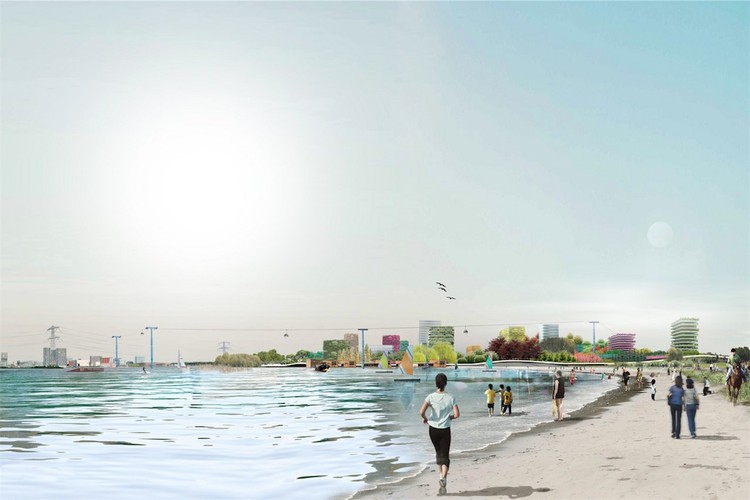
As part of the masterplan, ‘Bassin a Flots’ designed by ANMA/Nicolas Michelin, Barcode Architects and Habiter Autrement recently presented the Pôle de Compétences (Center for New Businesses). The 7,000m2 project will be a part of the masterplan, which aims on a phased transformation of the present introvert industrial harbor area into a new lively precinct with an urban mixture of living, working, and recreation. The slender 90 meter long and 21 meter tall building presents itself as a pure monolith volume stretching out over the entire length of the site. More images and architects’ description after the break.
The architecture firms of Kunckel Associates and Stefan Gzyl joined forces under the Glocalstudio platform to develop their entry to the recently completed ideas competition for La Carlota park in Caracas, Venezuela. They propose that the new park is an opportunity for a lot more than supplying a quantifiable amount of park space: they understand it as an opportunity for the (re)foundation of the city. The park will become the city’s new vital nucleus, a space from which to (re)conquest and (re)claim a preexisting and often hostile territory. In a city in which nature is in constant decline and hardly available as public space, the 100 hectare military airfield site constitutes a unique chance for a metropolitan-scale park in the very heart of the city. More images and architects’ description after the break.
Our friends at Design Observer’s Places Journal have shared with us two fascinating articles, written by architects Jonathan Massey and Brett Snyder, that explore the physical and virtual evolution of Occupy Wall Street (#OWS) as it transformed from the privately owned public space of Zuccotti Park into the bustling micro-city of Liberty Plaza sustained by online media.
To learn how OWS has influenced architecture and urbanism, Massey and Snyder asks the following questions: What’s the layout of this place? What are its rules, and who owns it? How does its design shape possibilities for individual and collective action?
The Research and Documentation Centre in Technology, Architecture and City in Developing Countries (CRD-PVS) at the Politecnico di Torino (Italy) has launched an international Student Design Competition tur(i)ntogreen – Farms in A Town. Sponsored by the UN-HABITAT within the “I’m a City Changer” campaign, participants are invited to apply their creative talents in developing new multidisciplinary solutions for a sustainable and inclusive city reflecting new forms of urban management and regeneration through agro-housing and urban-farming models.
By invitation of Director David Chipperfield, MVRDV and The Why Factorywill participate in the 2012 Venice Biennale. The main contribution consists of the collaborative project ‘Freeland’ forming part of the single exhibition in the Central Pavilion at the Giardini. Further contribution is made by Winy Maas and The Why Factory with ‘Porous City’ to the EU CITY Program, initiated by the European Forum for Architectural Policies (EFAP) representing Europe for the first time at the Venice Architecture Biennale.
More details on the two exhibitions after the break.
The disruptive minds series is in partnership with smartwater. smartwater, simplicity is delicious. Click here to learn more.
Usually when one studies architecture, one does architecture. But that’s just not enough for some people. James Ramsey, most famous for the sci-fi-like renderings of the Low Line, an underground park which has captured the imagination of thousands, is one of those people. An architecture grad from Yale University, Ramsey went on to be a satellite engineer for NASA, before coming back to architecture and starting up his own design studio, Raad Studio. Oh yeah, and along the way he came up with a fiberoptic technology that would allow you to bring natural light (and thus grow plants) underground.
Designed by MIRO architects, the starting point for their Klaksvik City Center proposal kept with the language of the genesis of urban nuclei: the form is inherited from the land, shaped by the surroundings as well as the needs and functions that are to be hosted in its nest. This also involved morphing to fit its context as well as accommodate for a plenitude of public spaces. The shape of the new core is based off of a landfill on the bottom of the bay. Even if it is possibly a random shape, it represents a fundamental step in the history of the town: the creation of the tunnel to southern islands. More images and architects’ description after the break.
This year the Cleveland Design Competition is calling for a re-imagining of the Detroit Superior Bridge – a 19th century bridge rich with history and value to Cleveland’s downtown area and industrial zones. Professional, students, firms and designers are all invited to propose a dynamic public space, performance venue and pedestrian experience along the abandoned lower streetcar level of the bridge. Registration for this competition closes on September 24th. The competition deadline is October 5th. This is an awarded competition for first, second and third prize winners. A free public reception and exhibition will takes place on October 26th to announce the winners. To register, visit the official competition website.
For a brief on the competition, join us after the break.
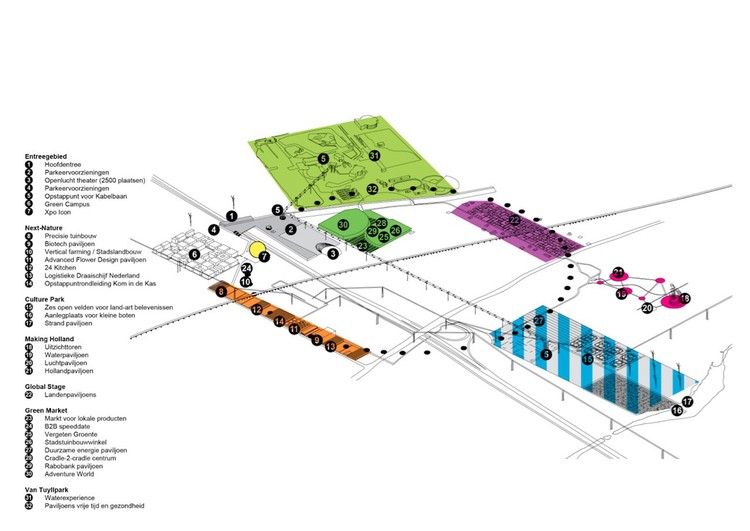
OMA has released their 60-hectare master plan proposal for Floriade 2022 – the next occurrence of Europe’s largest horticultural expo that attracts an average of two million international visitors every ten years since it was established in 1960, which is currently open in Venlo. As part of a team that includes the province of South Holland, eight local municipalities and ARCADIS, OMA is helping Holland Central compete against three other cities within the Netherlands to become the next Floriade host.
The City of Almere has revealed it’s MVRDV-designed proposal for the Floriade 2022 candidature! Almere is one of four Dutch cities competing to be the next location of the prestigious horticultural Expo, which takes place once every ten years in the Netherlands and is currently open in Venlo.
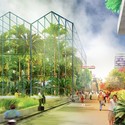
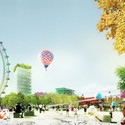
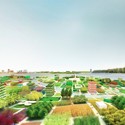
Rather than creating a temporary expo site, MVRDV has designed a lasting Cité Idéale, which would serve as a green extension to Almere’s city center. Drawing upon research from the radical DIY urbanism plan for Almere Oosterwold and the Almere 2030 master plan, MVRDV has designed an ambitious sustainable city that strives to be a 300% greener exhibition than the current standard.
Continue reading for more on this potential, exemplary green city!
Designed by Peter Ruge Architekten, the ‘Bambooline Berlin’ project, exhibited at Gallery DEN in Berline, explores the city’s urban development and proposes a new approach for the temporary, interim use of sustainable urban wasteland. This new, imaginary band complements the historically developed lines of the Berlin cityscape. More images and architects’ description after the break.
The proposal for the Klaksvìk City Center by studio wok starts from a thorough study of the natural elements of the place and from a study of the context. The two qualities of the bay and the natural character of the isthmus are key factors in the project. The new masterplan for Klaksvík strives to build a new way of living in the open public spaces through “spatial ecology”: the project wants to restore continuity to residential space at all scales of the project, from the design of the sidewalk up to design of urban systems on a regional scale. More images and architects’ description after the break.
The New York Economic Development Corporation and Mayor Bloomberg of NYC announced the completion of the final plan for Willets Point - a peninsula on the Flushing River in Northern Queens, New York. The development of Willets Point is part of the urban renewal project associated with Citi Field – the Mets’ new stadium. Nicknamed the Iron Triangle, the project will include housing for mixed incomes, retail and entertainment amenities, a hotel, a convention center, office space, parks and open space, and a new public school, all of which falls under the umbrella of LEED-certified buildings and infrastructure. As with every redevelopment plan, there are positives and negatives to restructuring the community.
The Green Carceri, designed by TARQUITECTOS, arises as a natural extension of the High Line Park, connecting himself with the High Line and flying over the river, thus enabling a continuation of the public space underneath with the neighborhood to the height of the street and the docks. Winding around a series of vertical communication cores, the building allows both internal transit users and visitors to descend to the level of the street without having to enter the building. More images and architects’ description after the break.
The design proposal of the Badel Block Complex by Popular Architecture is a combination of polyvalent and stable, both a massing inviting interpretation and detailed development by others, and an anchor seeking to re-channel the site’s positive qualities. Conceptually, the project begins with making a direct link between the former distillery building and the preserved façade of the Gorica Factory — two features required to be kept. Treating the factory façade as a gateway, the plan pulls in the existing context of an active street market — into the heart of a site cut-off from the city for decades — while also avoiding direct replication of the area’s pervasive perimeter block typology. More images and architects’ description after the break.




_(Copiar).jpg?1436801757&format=webp&width=640&height=580)
_(Copiar).jpg "© Stéphane Chalmeau")
_(Copiar).jpg "© Stéphane Chalmeau")
_(Copiar).jpg "© Stéphane Chalmeau")
_(Copiar).jpg "© Stéphane Chalmeau")
_(Copiar).jpg)