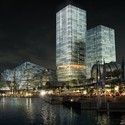
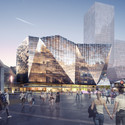
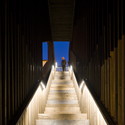
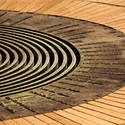
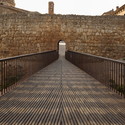
Synthesis Design + Architecture Inc. and Shenzhen General Institute of Architectural Design and Research Co. Ltd have been awarded first place in the invited international design competition for the Shanghai Wuzhou International Plaza. Their scheme, entitled “Urban Canyon”, embodies the energy and vibrancy of the cities distinct urban environment. Inspired by traditional Chinese concepts of Yin and Yang, the project is organized as two nested rock-like volumes which have been broken apart to reveal a flowing canyon condition which connects the project to the urban fabric of the city. More images and architects’ description after the break.
With much awaited anticipation, Steven Holl‘s Sliced Porosity Block in Chengdu, China has just been completed. Forming giant public plazas with a mix of various functions, the group of five towers is intended to be seen as more of a public area despite its towering design as already witnessed in the site. Its sun sliced geometry results from required minimum daylight exposures to the surrounding urban fabric prescribed by code and calculated by the precise geometry of sun angles. The large public space framed by the block is formed into three valleys inspired by a poem of Du Fu (713-770). In some of the porous openings chunks of different buildings are inserted.
We have already brought you images of the project as it was under way, but the latest images from Hufton + Crow truly capture this inviting public realm in the heart of this metropolis like no one else!
Check out all the latest images of Steven Holl’s Sliced Porosity Block after the break.
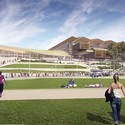
Located in Latrobe Valley in South East Australia, the ‘Fields on Synergy’ proposal is an integral brown field strategy which aims at providing a unique opportunity to create outstanding future by combining, re-cycling, and cascading transiting territories. Designed by PUPA (Public Urbanism Personal Architecture), their concept received honorable mention in the Transiting Cities international design ideas competition in Australia. More images and architects’ description after the break.
New York’s Garment District, consisting of 18 blocks in the west side of midtown, was the city’s most well known industries in the boom of the 1920s through the early 50s. The influx of immigrants and the geography of New York City made it a natural hub for manufacturing and trading activity. The work began in small workshops and at home in crowded tenements and eventually grew out of these crammed space into factories and warehouses. The industry inadvertently transformed Seventh Avenue into rows of skyscraper factories that faithfully abided to New York City’s zoning regulations. The 125 loft buildings all shared the pyramidal forms due to step-back laws governing design.
Now, The Skyscraper Museum in New York City is celebrating this neighborhood and its influential development of business, industry and architecture and the mark that it left on the city with an exhibition called URBAN FABRIC. It is curated by Andrew S Dolkart, the Director of the Historic Preservation Program, and will be running through February 17th.
Learn more and watch the curator’s lecture after the break.
Designed by architecture students, Margaux Leycuras, Marion Ottmann, and Anne-Hina Mallette, from the architecture school of Nantes, they recently won a prize in a competition organized by the Foundation Jacques Rougerie. Their ‘Hydropolis’ proposal answers to this competition, in the category rising waters, by a project located in the Nile Valley which aims to exploit the phenomenon of rising waters instead of suffering the consequences. More images and the students’ description after the break.
Hyuntek Yoon and Soobum You of Team Atelier Why shared with us their first prize winning proposal in the Detroit Riverfront competition. Their ‘Forest’ concept, which aims at being a fairy tale between the city and the forest by ‘filling’, is the focus of the urban development. Currently, the site is filled with voids, such as trees and the knoll, but the forest creates rich stories with the city. Providing spaces that are more secure and for smaller activities, people will have the chance to experience nature. More images and architects’ description after the break.
In Bangladesh, where rising sea levels are having profound effects on the landscape, one nonprofit organization called Shidhulai Swanirvar Sangstha run by architect Mohammed Rezwan is fighting back by adapting, a true quality of resilience. Rising water levels and the tumultuous climate is displacing people by the thousands; a projected 20% of Bangladesh is expected to be covered in water within twenty years. For a country that is one of the densest populated state on the planet, this figure has disastrous consequences for a population that has limited access to fresh water, food, and medicine. In response to these conditions, Shidhulai has focused on providing education, training and care against the odds of climate change by adapting to the altered landscape: moving schools and community centers onto the water – on boats.
The main objective for the Detroit River Front proposal is to create a new image of the city, an exclusive and unique landmark that glances to a future Detroit involved in its nature that it forgot for a long time. Designed by Architetto Matteo Ascani (AMA), the project for the redevelopment of Hart Plaza is divided in major guide lines: water, nature, history. They provide a new landscape system, where water enters inside the plaza by canals that redesign the cost line, as the river comes closer to the downtown. More images and architects’ description after the break.
With produce coming from the Imperial Valley, Central California Valley, neighboring states and other countries the 30,000 plus residents of San Diego’s central urban context consume 21,231,000 pounds of produce each year. Where will we get our food? Transparency in the food industry needs to occur and enlighten blinded consumers. Our city needs to handle this critical issue with an architecture that responds. A new type of residential tower needs to come forth. Utilizing vertical farming, Brandon Martella’s “Live Share Grow’ proposal is a new model of living can be tested and resolved in a dense vertical community. More images and architects’ description after the break.
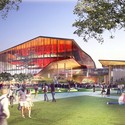
Australian firm HASSELL Studio, OMA and Populous have been announced as the winners for the redevelopment of Sydney’s new convention, exhibition and entertainment precinct (SICEEP) at Darling Harbour.
The 20-hectare, billion (Australian) dollar project, which will stretch from Cockle Bay to Haymarket and Ultimo, will include Australia's largest convention and exhibition facilities, Sydney’s largest red carpet entertainment venue, a hotel complex with up to 900 rooms, and a new urban neighborhood in Haymarket.
The project, known as "The Lens," has hit speed-bumps due to local dissidents, who have been vocally wary of the new Pier's price-tag/design and have called for a voter referendum. However, the architects have been sensitive to the process; since first winning the competition in January (beating out both BIG and West 8), the firm has taken part in local workshops in order to get community input, making some significant changes to the original design.
After receiving local criticism that the Pier include more things "to do" and more shading, the firm has adjusted the design to include two restaurants, shaded balconies, and - in order to improve access - a road that can support service vehicles and a tram. Most noticeably, the plan for an underwater reef garden, the signature feature which gave the project its name, has had to be scratched: scientists have determined that a reef garden would be unrealistic with Tampa Bay's dark water.
Last night's 7-1 vote determined that the project will now receive funding in smaller, pre-approved increments in order to safeguard against potential legal complications. However, no mater the outcome, the closure and the demolition of the current St. Petersburg Pier will take place between May and August 2013; if all goes to plan for Michael Maltzan Architecture, "The Lens" will open in summer 2015.
See updated Renderings for "The Lens," and a really cool video, after the break...
With China’s ‘Ring of Fire’ being one of the latest pieces of landmark architecture to hit the media, one must begin to wonder how many of these so called ‘landmarks’ will be constructed until they become an everyday sight in their major cities. With the rapid rise of the construction of these icons, it almost seems as though new cities of the rapid urbanization process think they need to build landmarks in order to be complete. As a consequence of this drive toward an urban identity, what may their impact be in a world where these icons are turning into generic structures? Let us know your thoughts!
Designed for the market square cover competition, the ‘flying carpet’ proposal by Michael Labory & Bertrand Schippan is a modular and sustainable cover with the goal for the efficient arrangement of the functional facilities. This is attained by putting them along the site border thus maximizing the space to be used for market. They revive the dull facade of the neighboring building by bringing the volume of the facilities into the shape of its skyline. Among all other things, it contributes to the increase in urban density as windowless facade becomes a part of lively market place. More images and architects’ description after the break.
The proposal for an urban itinerary, designed by Comac Architects, presents an urban path to extend “Marseilles 2013″ European Capital of Culture throughout the entire city. A total of 13 key-districts will be connected by the path and interspersed with urban pavilions, each focused on a famous artist from Marseilles. Each unit will offer a certain perspective of Marseilles, and will offer tourists a new way to discover our city and its emblematic districts. More images and architects’ description after the break.
The west side of midtown Manhattan is probably one of the more unexplored areas of New York City by residents and tourists alike. Aside from the Jacob Javits Center, and the different programs off of the Hudson River Parkway that runs parallel to the waterfront, there is very little reason to walk through this industry – and infrastructure – dominated expanse of land full of manufacturers, body shops, parking facilities and vacant lots. The NYC government and various agencies, aware of the lost potential of this area, began hatching plans in 2001 to develop this 48-block, 26-acre section, bound by 43rd Street to the North, 8th Ave to the East, 30th Street to the South and the West Side Highway to the West.
The new Hudson Yards, NYC’s largest development, will be a feat of collaboration between many agencies and designers. The result will be 26 million square feet of new office development, 20,000 units of housing, 2 million square feet of retail, and 3 million square feet of hotel space, mixed use development featuring cultural and parking uses, 12 acres of public open space, a new public school and an extension of a subway line the 7 that currently terminates at Times Square-42nd Street, reintroducing the otherwise infrastructurally isolated portion of the city back into the life of midtown Manhattan. All this for $800 million with up to $3 billion in public money.
Erik Giudice Architects were recently announced as the H+ Bredgatan Winner of the WAN Awards 2012 Urban Regeneration for their innovative solution in Helsingborg, Sweden. The ‘social atmosphere and ability to encourage residents’ integration reconnects the city with a central spine around a canal theme, creating a number of public spaces that are servicing the scheme but also connecting with the key movement around the site,’ according to WAN jury members. More images and architects’ description after the break.