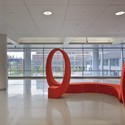
Designed by MIRO architects, the starting point for their Klaksvik City Center proposal kept with the language of the genesis of urban nuclei: the form is inherited from the land, shaped by the surroundings as well as the needs and functions that are to be hosted in its nest. This also involved morphing to fit its context as well as accommodate for a plenitude of public spaces. The shape of the new core is based off of a landfill on the bottom of the bay. Even if it is possibly a random shape, it represents a fundamental step in the history of the town: the creation of the tunnel to southern islands. More images and architects’ description after the break.
This year the Cleveland Design Competition is calling for a re-imagining of the Detroit Superior Bridge – a 19th century bridge rich with history and value to Cleveland’s downtown area and industrial zones. Professional, students, firms and designers are all invited to propose a dynamic public space, performance venue and pedestrian experience along the abandoned lower streetcar level of the bridge. Registration for this competition closes on September 24th. The competition deadline is October 5th. This is an awarded competition for first, second and third prize winners. A free public reception and exhibition will takes place on October 26th to announce the winners. To register, visit the official competition website.
For a brief on the competition, join us after the break.
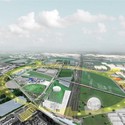
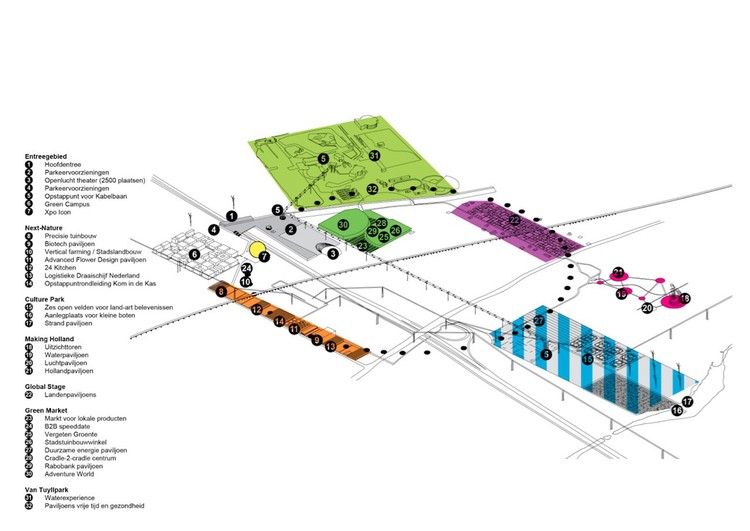
OMA has released their 60-hectare master plan proposal for Floriade 2022 – the next occurrence of Europe’s largest horticultural expo that attracts an average of two million international visitors every ten years since it was established in 1960, which is currently open in Venlo. As part of a team that includes the province of South Holland, eight local municipalities and ARCADIS, OMA is helping Holland Central compete against three other cities within the Netherlands to become the next Floriade host.
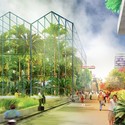
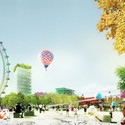
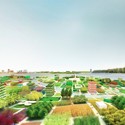
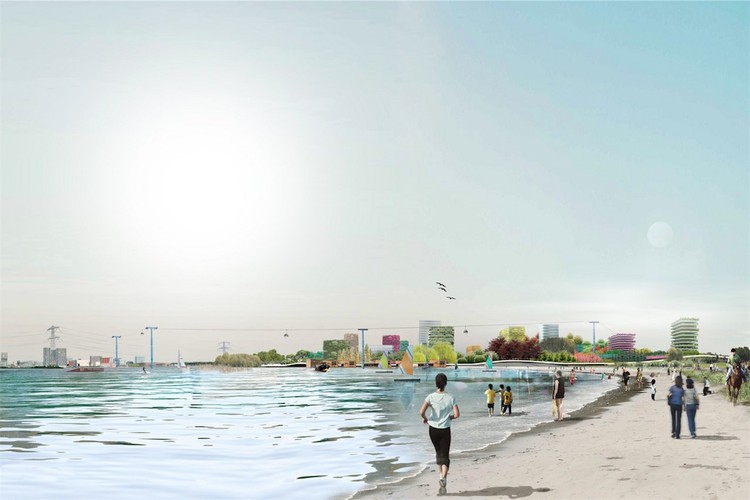
The City of Almere has revealed it’s MVRDV-designed proposal for the Floriade 2022 candidature! Almere is one of four Dutch cities competing to be the next location of the prestigious horticultural Expo, which takes place once every ten years in the Netherlands and is currently open in Venlo.
Rather than creating a temporary expo site, MVRDV has designed a lasting Cité Idéale, which would serve as a green extension to Almere’s city center. Drawing upon research from the radical DIY urbanism plan for Almere Oosterwold and the Almere 2030 master plan, MVRDV has designed an ambitious sustainable city that strives to be a 300% greener exhibition than the current standard.
Continue reading for more on this potential, exemplary green city!
Designed by Peter Ruge Architekten, the ‘Bambooline Berlin’ project, exhibited at Gallery DEN in Berline, explores the city’s urban development and proposes a new approach for the temporary, interim use of sustainable urban wasteland. This new, imaginary band complements the historically developed lines of the Berlin cityscape. More images and architects’ description after the break.
The proposal for the Klaksvìk City Center by studio wok starts from a thorough study of the natural elements of the place and from a study of the context. The two qualities of the bay and the natural character of the isthmus are key factors in the project. The new masterplan for Klaksvík strives to build a new way of living in the open public spaces through “spatial ecology”: the project wants to restore continuity to residential space at all scales of the project, from the design of the sidewalk up to design of urban systems on a regional scale. More images and architects’ description after the break.
The New York Economic Development Corporation and Mayor Bloomberg of NYC announced the completion of the final plan for Willets Point - a peninsula on the Flushing River in Northern Queens, New York. The development of Willets Point is part of the urban renewal project associated with Citi Field – the Mets’ new stadium. Nicknamed the Iron Triangle, the project will include housing for mixed incomes, retail and entertainment amenities, a hotel, a convention center, office space, parks and open space, and a new public school, all of which falls under the umbrella of LEED-certified buildings and infrastructure. As with every redevelopment plan, there are positives and negatives to restructuring the community.
The Green Carceri, designed by TARQUITECTOS, arises as a natural extension of the High Line Park, connecting himself with the High Line and flying over the river, thus enabling a continuation of the public space underneath with the neighborhood to the height of the street and the docks. Winding around a series of vertical communication cores, the building allows both internal transit users and visitors to descend to the level of the street without having to enter the building. More images and architects’ description after the break.
The design proposal of the Badel Block Complex by Popular Architecture is a combination of polyvalent and stable, both a massing inviting interpretation and detailed development by others, and an anchor seeking to re-channel the site’s positive qualities. Conceptually, the project begins with making a direct link between the former distillery building and the preserved façade of the Gorica Factory — two features required to be kept. Treating the factory façade as a gateway, the plan pulls in the existing context of an active street market — into the heart of a site cut-off from the city for decades — while also avoiding direct replication of the area’s pervasive perimeter block typology. More images and architects’ description after the break.
The proposal by reSET Architecture for the Klaksvík city center unites the two town halves and acts as a place of meeting, relaxation and celebration. Their design creates a place that represents the new born heart of Klaksvík. The architects believe that the city should be attractive to more than just the people of Klaksvík itself, a place that attracts people from the Faroer and abroad. More images and architects’ description after the break.
With a challenge to make a series of random ephemeral public spaces using a simple structure in the Seattle Center, the intervention by Hoshino Architects proposes areas of such spaces to be transformed to voids and purely leave the circulation spaces on the ground level. In contrast, the public contents circles are randomly scattered on the field level. As normal urban spaces, the circulation spaces sometimes change to unexpected functions, such as a viewing gallery for the event staged at the field level. This dual layer structure intertwines and creates the complex ‘Porous-scape’. More images and architects’ description after the break.
Organized by Europan Europe, 2:pm Architectures & CUAC Arquitectura met for a 4-days long international workshop to explore how agriculture and architectural development are in symbiotic relationship. In analyzing the growth of Vienna and Oberlaa, they can easily understand how architecture born on agricultural results in footprints so they offered a system to develop Oberlaa. It’s a system which is able to offer countryside qualities within contemporary city density. More images and architects’ description after the break.
Despite all of the preconceived notions about New York City being overpopulated, noisy and constantly bustling, there are numerous pockets within the five boroughs that offer respite from the city. This design strives to be one such pocket – or island. Governors Island has a long military history that dates back to 1776. It was controlled by the U.S. Government first for the U.S. Army and later for the Coast Guard. In 2002 the island was “sold” to the people of New York and declared a national monument. In 2010, Mayor Bloomberg and Governor Paterson agreed on the future operations, planning and redevelopment of the island through the Trust for Governors Island. Since then, the island has been open during the summer months for visitors to enjoy the unique seclusion offered by the the old military grounds. But the Trust had bigger plans. Choosing a team of architects, urban planners, designers and landscape architects that include Rogers Marvel Architects, Diller Scofidio + Renfro, Mathews Nielsen and led by West 8, plans began to unfold that would reimagine the island as a getaway for New Yorkers. Playing up to its isolation, its abundance of lawns and trees, and the views that it offers, the first phase of the plans have officially broken ground and are scheduled for completion in Fall 2013.
The main objective of the project for the Ödemis New City Center by Onat Öktem is to integrate urban functions to ensure the continuity of the pedestrian and green axis while creating a new structure. In this context, defined and undefined urban spaces have been reorganized to increase the physical, social and cultural wealth of the citizens. Green axis, squares and spaces in the city have been evaluated as an advantage for the social, cultural and physical development. More images and architects’ description after the break.
The proposal for the new city center of Klaksvik by Group 8 aims to become a model of design that is environmentally, economically and socially sustainable; a place synonymous with modern ideals for living, working, being. The design is inspired by a dense and controlled scale of intervention, based on a strong network where each part of the town will be interconnected through sustainable methods of moving, thus providing a green means of living to all inhabitants. The inter-connected city enhances the close relationship between the actors within and is ready to answer to the new ambitions of the town, while maintaining strong traditions. More images and architects’ description after the break.
In the proposal for the Badel Block competition, WAU Design considered the site and its position as an opportunity to create a new center for the locals as well as a new entrance for the city through the ‘Communities of a Single Roof’ design. Considering the relative lack of public space and facilities in the neighborhood, they propose to extend the square and the market inside the Badel block and enlarge the space devoted to culture and leisure in order to strengthen the sense of community and centrality. More images and architects’ description after the break.
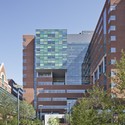
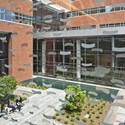
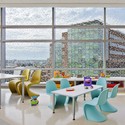
The new facility designed by Perkins+Willfor the John Hopkins Hospital in Baltimore, Maryland approaches the design as a total experience of healing that includes architecture and urban design. The project proposes to redefine the hospital experience with The Charlotte R. Bloomberg Children’s Center and the Sheikh Zayed Tower, whose goal is to emphasize transformative patient-centric care.




_(Copiar).jpg?1436801757&format=webp&width=640&height=580)
_(Copiar).jpg "© Stéphane Chalmeau")
_(Copiar).jpg "© Stéphane Chalmeau")
_(Copiar).jpg "© Stéphane Chalmeau")
_(Copiar).jpg "© Stéphane Chalmeau")
_(Copiar).jpg)