George III, Sketch of a palace floor plan, 1785-9. British Library Maps 7.TAB.17. Image Courtesy of British Library
Not sure if “manic” can be classified as an architectural style, but that is what some are choosing to describe the newly discovered, hand-drawn floor plans of a grand place envisioned by King George III. According to the British Library, the King was “passionately interested” about architecture and drew plans for a future living quarters in Kew - now a district in West London - during a time when he was suffering from severe mental illness in the late 1780s. Learn more about the King’s vision for a grand palace, here.
"the architectural establishment continues to ignore indigenous building cultures and the human value of what they represent. For example, traditional building and urban geometry in sub-Saharan Africa is now revealed to be essentially fractal, thus revising our customary (and totally erroneous) conception of those cultures as mathematically under-developed." Image of El Molo Hut, Lake Turkana, Kenya.. Image Courtesy of shutterstock.com
As you may have seen, ArchDaily has been publishing UNIFIED ARCHITECTURAL THEORY, by the urbanist and controversial theorist Nikos A. Salingaros, in serial form. However, in order to explain certain concepts in greater detail, we have decided to pause this serialization and publish three excerpts from another of Salingaros’ books: A THEORY OF ARCHITECTURE. The first excerpt explained the difference between “Pattern Language” and “Form Language,” while the second established how these languages can combine to form the “Adaptive Design Method.” The following, final, excerpt distinguishes between viable, complex form languages that have evolved over time and primitive, “non-languages” that have come to dominate the 20th century due to their iconic simplicity (and despite their non-adaptive characteristics).
Independently of their technological achievements, all groups of human beings have developed a richly complex spoken language. Differences arise in specificities, in the breadth of vocabulary for concepts important to that culture, and in their transition to a written language, but those do not affect the general richness of the language. Every language’s internal structure has to obey general principles that are common to all languages. A primitive language or non-language, by contrast, is characterized by the reduction or absence of such internal complexity and structure. The complexity of human thought sets a rather high threshold for the complexity that any language has to be able to express through combinatoric groupings.
Turning now to architecture, a viable form language is also characterized by its high degree of internal complexity. Furthermore, the complexity of different form languages has to be comparable, because each form language shares a commonality with other form languages on a general meta-linguistic level. A primitive form language severely limits architectonic expression to crude or inarticulate statements.
As you may have seen, ArchDaily has been publishing UNIFIED ARCHITECTURAL THEORY, by the urbanist and controversial theorist Nikos A. Salingaros, in serial form. However, in order to explain certain concepts in greater detail, we have decided to pause this serialization and publish three excerpts from another of Salingaros’ books: A THEORY OF ARCHITECTURE. The previous excerpt explained the difference between “Pattern Language” and “Form Language.” The following excerpt will establish how these languages can combine to form the “Adaptive Design Method.”
Proposition: An adaptive design method arises out of a complementary pair consisting of a pattern language and a form language.
I have indicated very briefly what a pattern language and a form language are; we still need to understand what an adaptive design method refers to. Out of many contemporary approaches to design, there are very few that result in structures and environments that are adapted both to physical human use, as well as to human sensibilities. In the past, the opposite was true. Human use is straightforward to understand: the physical dimensions and geometry have to accommodate the human body and its movement.
By accommodating human sensibilities, I mean that environments should make human beings feel at ease; make them feel psychologically comfortable so that persons can carry out whatever functions they have to unselfconsciously, without being disturbed by the built environment in any way. This imposes a strong constraint on the design process to adapt to the many factors (both known and unknown) that will influence the user on many levels, including emotion. An adaptive design method should accommodate all these criteria, and this Chapter shows how this may be accomplished.
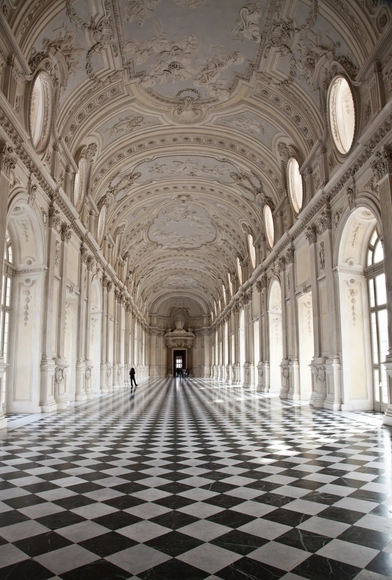
Galleria di Diana in Venaria Royal Palace, an example of Classical architecture. The Classical Language is an example of an "extremely successful form language". Image Courtesy of shutterstock.com
As you may have seen, ArchDaily has been publishing UNIFIED ARCHITECTURAL THEORY, by the urbanist and controversial theorist Nikos A. Salingaros, in serial form. However, in order to explain certain concepts in greater detail, we have decided to pause this serialization and publish three excerpts from another of Salingaros’ books: A THEORY OF ARCHITECTURE. The following excerpt, the first, explains the terms “Pattern Language” (as well as“antipatterns") and “Form Language.”
Design in architecture and urbanism is guided by two distinct complementary languages: a pattern language, and a form language.
The pattern language contains rules for how human beings interact with built forms — a pattern language codifies practical solutions developed over millennia, which are appropriate to local customs, society, and climate.
A form language, on the other hand, consists of geometrical rules for putting matter together. It is visual and tectonic, traditionally arising from available materials and their human uses rather than from images. Different form languages correspond to different architectural traditions, or styles. The problem is that not all form languages are adaptive to human sensibilities. Those that are not adaptive can never connect to a pattern language. Every adaptive design method combines a pattern language with a viable form language, otherwise it inevitably creates alien environments.
Architectural design is a highly complex undertaking. Heretofore, the processes at its base have not been made clear. There have been many attempts to clarify the design process, yet we still don’t have a design method that can be used by students and novices to achieve practical, meaningful, nourishing, human results.
In the absence of a design method and accompanying criteria for judging a design, things have become very subjective, and therefore what is built today appears to be influenced largely by fashion, forced tastes, and an individual’s desire to garner attention through novel and sometimes shocking expressions.
This Chapter puts forward a theory of architecture and urbanism based on two distinct languages: the pattern language, and the form language.
Using Australia as her focus, Marissa Looby, in a recent article for the Australian Design Review, argues that the disappearance of architectural styles, combined with the proliferation of various guidelines and building codes, has created a new breed of architect: The New Radical Pragmatist. Her article "The New Radical Pragmatist (On Validation)" is reprinted here.
The Architectural Review (December, 1955) first published Reyner Banham’s epochal and pivotal article, ‘The New Brutalism’, in which the critic pointed to the rise of a new architectural style. He also described an influx of -isms that were becoming increasingly conspicuous to the discipline, stemming from the then contemporary model of an art historian and their influence on the architectural historian-as-observer of the architectural profession. Banham incisively suggested that any proposition of the term ‘new’ has an unequivocal relationship to the past, so much so that in advocating for a new -ism an architectural theoretician must defend their claim with historic fact. Ironically, Banham acknowledged that even ‘The New Brutalism’ title derived from The Architectural Review’s analysis of the International Style in the postwar article, ‘The New Empiricism’. He stated: “[the] ability to deal with such fine shades of historical meaning is in itself a measure of our handiness with the historical method today, and the use of phrases of the form ‘The New X-ism’ – where X equals any adjectival root – became commonplace in the early 1950s in fourth year studios and other places where architecture is discussed, rather than practised.”
Ten of Los Angeles’ Case Study Homes have been deemed historically significant an worthy of being included on US’s National Register of Historic Places. Despite the Los Angeles Conservancy’s belief that all of them deserve “equal preservation protections,” the 11th home was not included due to “owner objection.”
The Case Study Houses spawned from a post-WWII residential experiment, presented by the Arts & Architecture magazine in 1945, which introduced modern movement ideas for affordable and efficient housing. The homes - designed by the likes of Richard Neutra, Charles and Ray Eames, Pierre Koenig, Eero Saarinen and others - redefined the modern home. And, with the help of Julius Shulman, placed Los Angeles as an epicenter for mid-century modernism.
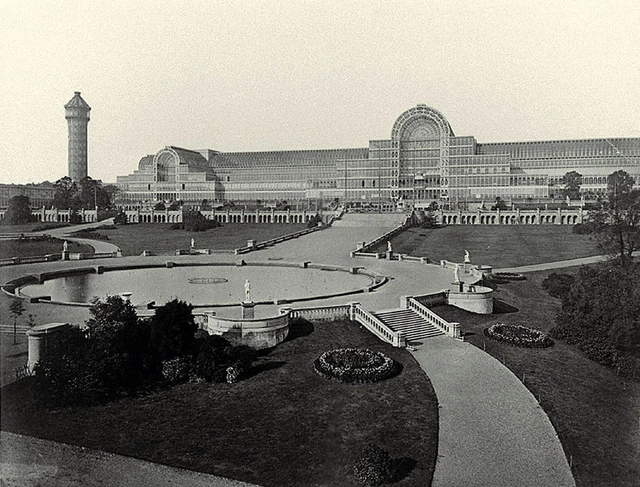
Shanghai-based developer ZhongRong Holdings is working with Arup on an ambitious proposal to reconstruct Joseph Paxton’s Crystal Palace in London. Originally built to house the Great Exhibition of 1851, the 80,000 square-meter cast iron and glass structure was relocated from Hyde Park to south-east London in 1854 where it was ultimately destroyed by fire in 1936.
After years of extensive research that unearthed countless untold stories and hundreds of beautiful unbuilt designs, curators Sam Lubell and Greg Goldin will be celebrating the opening of their highly anticipated exhibition - Never Built: Los Angeles- today at the Architecture and Design Museum in Los Angeles.
"The Community" might be the most frequently used term over the last 50 years of Architectural and Urban discourse. For decades, "the community" has served as a legitimization for anything from Team X to New Urbanism, from Celebration to "vancouverism". But what is "the community"? Where should we look for the proper definition? How did communities appear in the past and how do they form today? Can 'the community" influence the design of its own space, territoiry or context? If yes, what could be the relationship between the community and architecture in the future?
In his Strelka talk Reinier de Graaf is trying to answer these and other, even more complex questions.
In this fascinating conversation, critic and theorist Jeffrey Kipnis and architect Steven Holl discuss modern architecture, from competitions to cantilevers, courtesy of our friends at 32BNY.
It has become increasingly fashionable to trumpet the death of criticism. Barely a week goes by that there isn’t a new blog declaring the end of architectural critique, the slipping of standards, the domination of our screens by an unmediated slew of images.
“Criticism is in crisis,” wail the critics, seeing their traditional role threatened by a torrential tide of websites that funnel an incontinent splurge of unadulterated visual stimulation. From Dezeen to ArchDaily, Designboom to Architizer, we are bombarded with a never-ending deluge of projects, freed from any sense of context or meaning. It is easy to believe the cries that architectural culture is being flattened into a homogenous soup of saturated colours and oblique geometries – a cascade of effortlessly digested eye-candy to be liked, retweeted, pinned and shared across the infinite social media network.
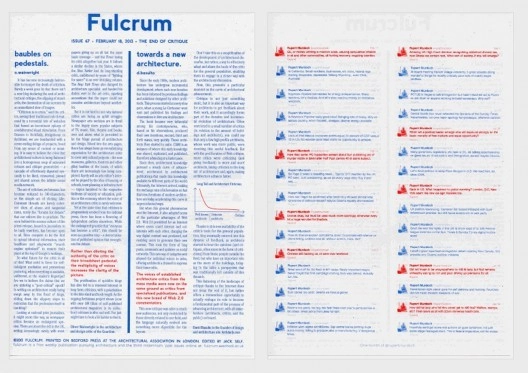
The following article was featured on Fulcrum #67 "The End of Critique" and includes texts by Oliver "Olly" Wainwright (Architecture critic at The Guardian) and me, David Basulto (Founder and Editor in Chief of ArchDaily). Thanks to Jack Self for the invitation and for his thorough editing.
Towards a new architecture
Since the early 1900s, modern architecture has undergone incremental development, where each new iteration has been informed by previous findings and solutions designed by other architects. This process started at a very slow pace, when a young Le Corbusier went east and published his findings and observations in Vers une Architecture.
The book became very influential among his contemporaries, who, based on his observations, produced their own iterations, second, third and forth waves, very quickly. These architects then started to unite. CIAM is an instance of where this early knowledge was shared, replicated, and published, therefore advancing at a faster pace.
Since then, architectural knowledge pursued a steady curve of advancement, accelerated by architectural publications that made this knowledge available to different parts of the world. Ultimately, the Internet arrived, making the exchange rate of information so fast that new iterations of modern architecture are today accelerating this curve in unprecedented ways.
Founder of Amateur Architecture Studio and Head of Architecture at the China Academy of Art, Wang Shu was the first Chinese architect to hold Harvards Graduate School of Design (GSD) Kenzo Tange professorship. The Harvard lecture honors architect Kenzo Tange by bringing distinguished architects from around the globe to the GSD.
The experts at studio/216 have shared with us the Culture of Craft – a pilot for an AIA Committee On Design (COD) series about The Value of Design. The non-profit AIA committee spent this past year discussing this topic, hosting two conferences in Seattle and Japan. In this film, architects Tom Kundig FAIA, Bob Hull FAIA, Annie Han, Prentis Hale and Roy McMakin discuss the value of craft and design in theory and in practice.
“Of all things that are man-made, bridges are, with dams, the most “structural,” single-minded, and imposing. As connectors at a breaking point, they have a heroic force that is aided by a challenging structuralism. As a strand of continuity in a non-continuum, the bridge is full of implied meanings. It is the opposite of devisiveness, separation, isolation, irretrievability, loss, segregation, abandonment. To bridge is as cogent in the psychic realm as it is in the physical world. The bridge is a symbol of confidence and trust. It is a communications medium as much as a connector.”
-Paolo Soleri, 1970, from “The Sketchbooks of Paolo Soleri”, published by MIT Press, 1971
In this earnest and insightful video, NAi director Ole Bouman lectures on our shared need to “celebrate architecture’s glory.” The lecture was recorded in June 2011 at the International Architecture Festival (“FESTARCH“).