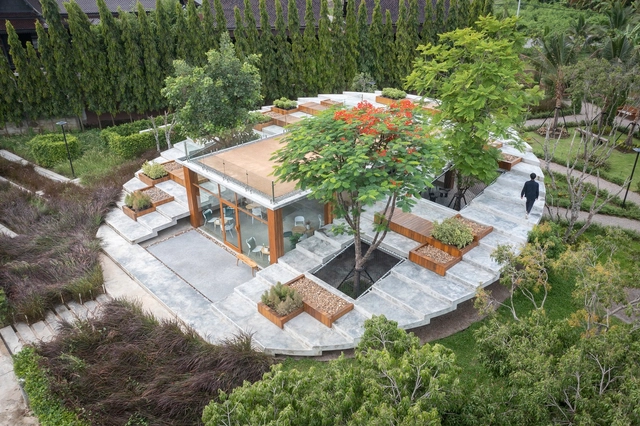
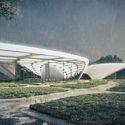
Pitched roofs and terraced lots or hillsides are some of the oldest, yet still highly functional, solutions for rainwater dispersal, redirection, and erosion management. While most constructions today still opt for traditional pitched or flat roofs, advancements in construction materials and techniques are leading to greater design exploration and layout variations. This has resulted in a rise in green roofs, passive insulation solutions, and more innovative uses of rooftops. One particular case has been the recurrence of the staircase or terraced roofs that often bring about a smooth continuity with the site and provide additional functional spaces to the project.
Currently working on 45 simultaneous projects, including India’s largest bio-diversity park in India and the second largest in the world, Amit Gupta has been leading Studio Simbiosis for the past 12 years with a special focus on sustainability where performance follows experience more than form following function.
In this 2022 version of the World Architecture Festival, in Lisbon, ArchDaily had the opportunity to talk with Amit Gupta and discuss the main philosophy behind Studio Simbiosis, the challenges of building in India’s low-tech context, and the future of artificial intelligence and the metaverse in architectural design.
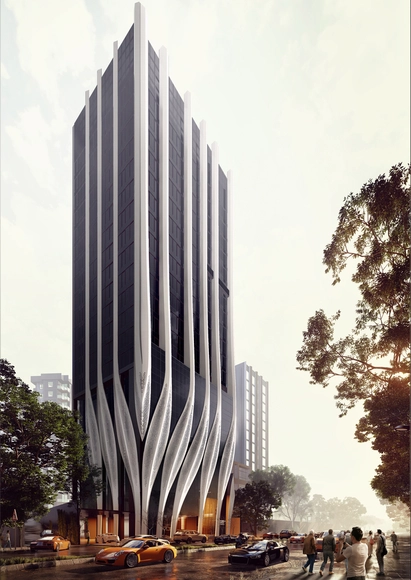
In the dense urban fabric of India’s Mumbai, Studio Symbiosis upgraded the ID Origins Headquarters into a new visual marker of the city, using organic strokes to merge old and new into one revitalized project. The HQ has been under construction since October 2019 and is a historic landmark for the company, as it was where the owners first initiated their business in the 1980s. The 18,750 sqm project was awarded the WA World Architecture Community Awards for its unique design approach.
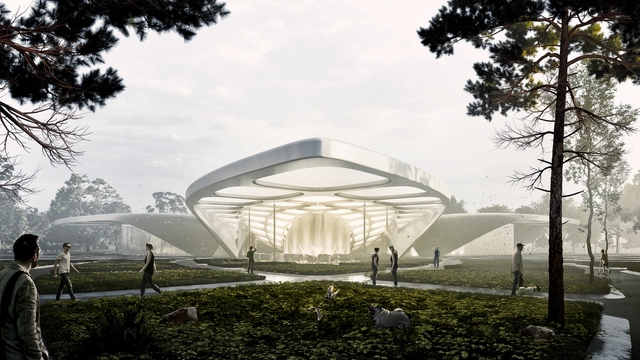
Located in Kannauj the perfume capital of India, the Perfume Park and Museum is designed by Studio Symbiosis. Under construction, the project will host a museum, shops, a cafe, a skill development center to exchange knowledge between experts and distilleries to produce the fragrances on site.
Studio Symbiosis Architects is amidst the construction process for Punjab Kesari Headquarters, an 18,000 square meter office space in Delhi NCR, India.
Designed as a fusion of traditional Indian architecture and contemporary office space, the main objective of the project is “to reduce heat gain and optimize façade opening ratio, ensuing no artificial lighting is required on a typical day.”
Spread across 1156 acres, the proposal for the Trans Ganga Masterplan by Studio Symbiosis is envisioned as an iconic city on the banks of Ganga, aimed at being a self sufficient sustainable city. Developed as a mixed use project, this will provide the most influential and dominant context for the master plan. More images and architects’ description after the break.
Designed as an iconic building in Ahmedabad, the hotel proposal by Studio Symbiosis focuses on interweaving the concepts of waves in nature. Using fold lines as movement trajectories and perception along with programmatic requirements, the project’s form demonstrates a sense of elegance with soft, subtle touches. Seamless waves flowing on the landscape and flowing on the façade are the focal point for this full service five star property. More images and architects’ description after the break.
The proposal for Rethinking Khan Market by Vandana Sehgal animates a typical model town type market into an experience of ultimate recreation. It will not consume energy as much as a regular shopping mall, but will have the ambiance and synergy of one, hybridized with the openness of an Indian bazaar. More images and architects’ description after the break.