Studio Gang has released images of the firm’s Strategic Master Plan for the National Aquarium in Baltimore. The driving force of this initiative is to identify opportunities for sustained growth, improvements to the visitor experience, and to reinforce the organization’s commitment to conservation and education at all scales.
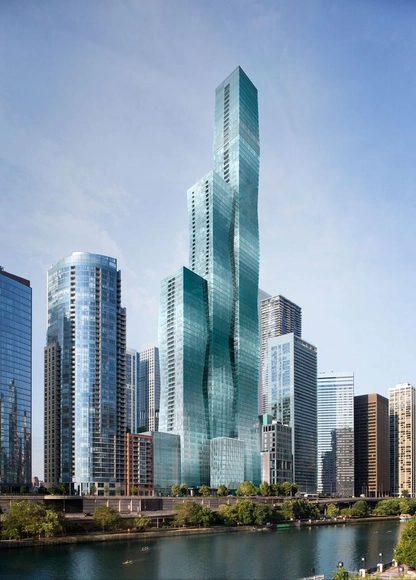
New interior images have been released of Studio Gang's's Vista Tower, a 95-story luxury residential high rise located in Chicago. Upon completion, Vista Tower will become the third tallest tower in the city.
Studio Gang Architects has been chosen by the Department of State to design the new US Embassy compound in BrasíliaBrazil's federal capital. Selected from a shortlist of six, the Jeanne Gang-led practice won the commission with their "strong and cohesive team approach with more than 20 years of collaborative experience executing projects with complex constraints at challenging sites," says the report.
Eleven women are being considered for the Moira Gemmill Prize for Emerging Architecture prize for their "use of innovative architecture to effect positive social change." Read on to see them all.
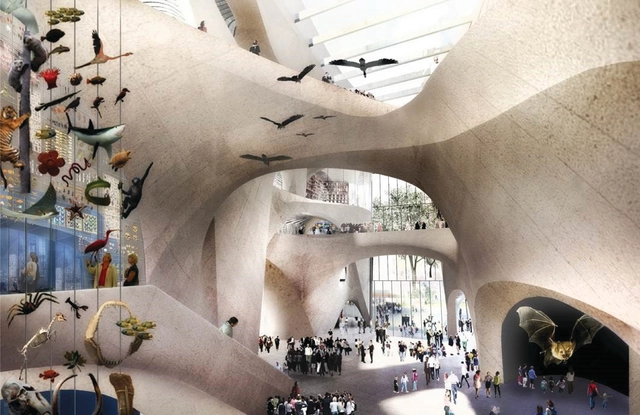
A conceptual design by Studio Gang was unveiled today as the preferred expansion to the American Museum of Natural History (AMNH) in New York. The proposed building, named the Richard Gilder Center for Science, Education, and Innovation, aims to host an array of public exhibition space as well as become a premier "active scientific and educational institution" that enhances connections with the existing Museum and encourages exploration amongst its users.
“We uncovered a way to vastly improve visitor circulation and Museum functionality, while tapping into the desire for exploration and discovery that are emblematic of science and also part of being human,” said Jeanne Gang, founder of Studio Gang. “Upon entering the space, natural daylight from above and sightlines to various activities inside invite movement through the Central Exhibition Hall on a journey towards deeper understanding. The architectural design grew out of the Museum’s mission.”
Studio Gang has been selected to design a 60,000 square-foot campus for the Academy for Global Citizenship (AGC) in Chicago. Aimed to be the city's greenest campus, the net positive energy scheme will be designed as a space for learning that will "break down barriers between kids." The campus will include classrooms, an international learning laboratory, a teacher professional development center, an early childhood center, and an urban food production center.
The building itself will be designed by MAD Architects, chosen "because of its innovative approach to design and the firm’s philosophy of connecting urban spaces to natural landscapes." In this case, that landscape will be designed by Studio Gang, who will also add a bridge to Northerly Island, an area which they have worked on turning into an ecologically diverse urban park.
Though few details have emerged, developers Tishman Speyer have confirmed that they have selected Chicago-based architects Studio Gang to design a skyscraper in San Francisco. Gang's tower will be one of three Tishman Speyer projects in the city. We'll be sure to update you as more information becomes available. Via SFGate.
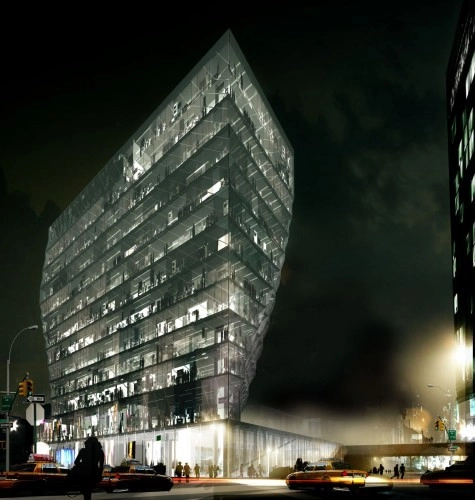
The developers behind Studio Gang's Solar Carve have withdrawn their request for a zoning variance that would have allowed for an increase in the tower's rentable space. The Board of Standards and Appeals rejected the solicited exception, despite the developer's claim that the expensive pilings necessary for the sandy, non-bedrock site adjacent to New York's High Line posed a "financial hardship."
Studio Gang's 213 foot tower was slated for completion in 2015. Although "the bid for additional floor has been dropped from the application," said the project's land use attorney, a hearing for special permitting that will allow for a modified setback is scheduled for March.
Beloit College has chosen Studio Gang Architects to convert a century old power-plant into a campus recreation and activity center. The project was born out of an ongoing partnership with Alliant Energy Wisconsin, the local utility company that currently holds the space, who has been in talks within the college for over a year.
“The Studio Gang team is very excited to partner with Beloit College,” stated Jeanne Gang. “Together we can transform this historic structure into a new hub for wellness, green power, and great architecture. By reflecting Beloit’s core values in the design, values shared by our team, we will create a model that will bring many benefits to the college, city, and region. This is a project that has the potential to inspire other communities around the globe.”
https://www.archdaily.com/436239/studio-gang-chosen-to-convert-power-plant-to-rec-centerKatherine Allen
Jeanne Gang, principal and founder of Studio Gang Architects, has been named as one of this years prestigious MacArthur Fellows. The second female recipient in architecture selected for the grant (Elizabeth Diller from Diller Scofidio + Renfro was named a MacArthur Fellow in 1999), Gang is among a total of 22 recipients who will receive $500,000 in no-strings-attached support over the next five years. The recipients fields are quite broad ranging anywhere from biologist to radio producer, but regardless of their chosen profession all were selected for their ‘creativity, originality, and potential to make important contributions in the future’.
“This has been a year of great change and extraordinary challenge, and we are once again reminded of the potential individuals have to make a difference in the world and shape our future,” said Robert Gallucci, President of the MacArthur Foundation. “The MacArthur Fellows exemplify how individual creativity and talent can spark new insights and ideas in every imaginable field of human endeavor.”
This weekend, we had the opportunity to attend the Open Studio event at MoMA’s PS1. As we mentioned earlier, this project posed the daunting question of how to re-think, re-organize and re-energize the concept of an American suburb in the wake of the foreclosure crisis. As MoMA’s Philip Johnson Chief Curator of Architecture and Design, Barry Bergdoll explains, “Projects will aim to challenge cultural assumptions concerning home ownership and associated settlement patterns, such as suburban sprawl, and assist the public in contemplating a potentially different future for housing and cities. The workshop and exhibition are premised on reframing the current crisis as an opportunity, an approach that is in keeping with the fundamental American ethos where challenging circumstances engender innovation and out-of-the-box thinking. It is our hope that new paradigms of architecture and regional and transportation planning become the silver lining in the crisis of home ownership.” The five multidisciplinary teams chose five different American suburbs to explore, and this Saturday, we jumped from Oregon to Florida, to Illinois, to California and New Jersey, to observe their five quite different solutions.
Check out our preview of the teams’ work-in-progress projects which will be exhibited at the MoMA this February.


.jpg?1463764310&format=webp&width=640&height=580)
.jpg?1463764390 "Conceptual rendering of proposed architectural interventions with the urban wetland at the center. The design of the urban wetland is based on the geometry of Chesapeake Bay tidal meanders.. Image © Studio Gang")
.jpg?1463764377 "Conceptual rendering. The proposed Pier 4 addition unites existing and new building volumes. Visitors arriving from Pier 3 walk toward a covered entrance with views of a theater, restaurant, and the Pier 4 exhibit.. Image © Studio Gang")
.jpg?1463764367 "Conceptual rendering. Attracting wildlife and increasing biodiversity, the urban wetland offers a new physical center for the National Aquarium campus.. Image © Studio Gang")
.jpg?1463764332 "Conceptual rendering. A hub-like space within the Chesapeake exhibit on Pier 4 provides a lounge space in which to relax and engage with the exhibit's local ecology. Exhibit developed in collaboration with Thinc Design.. Image © Studio Gang")
.jpg?1463764310)
.jpg?1457466632&format=webp&width=640&height=580)


_Sally_Ryan_Photography.jpg?1393871858&format=webp&width=640&height=580)