1. ArchDaily
  2. Robotics

Robotics: The Latest Architecture and News

Carlo Ratti's Writing Robot Transforms Your Wall into an Artistic Canvas

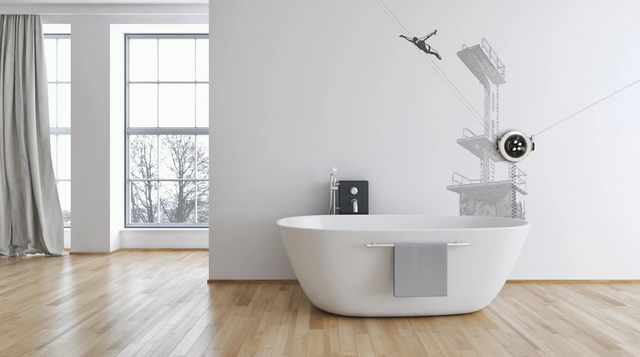
Carlo Ratti Associati (CRA) has unveiled Scribit, a “writing robot” which draws images and text on any wall surface, turning office, living, and bathroom walls into a blank canvas for artistic expression. Using in-built engines, Scribit can draw, cancel, and re-draw new content an infinite number of times, allowing users to print different images, messages, or feeds every day.

Scribit is always connected to the internet, allowing users to download, upload or source any online content. Operating in real time, Scribit immediately reproduces any data sent to it by the user, be it a restaurant posting the day’s menu, a financial firm posting stock market updates in its lobby, or an art enthusiast projecting their own content on the living room wall.

 Carlo Ratti's Writing Robot Transforms Your Wall into an Artistic Canvas - Image 1 of 4 Carlo Ratti's Writing Robot Transforms Your Wall into an Artistic Canvas - Image 2 of 4 Carlo Ratti's Writing Robot Transforms Your Wall into an Artistic Canvas - Image 3 of 4 Carlo Ratti's Writing Robot Transforms Your Wall into an Artistic Canvas - Image 4 of 4 Carlo Ratti's Writing Robot Transforms Your Wall into an Artistic Canvas - More Images+ 3

Local Computations

This issue of dearq seeks to shed light on a spectrum of spatial, material, and research practices intertwining architecture, design, and computation. We welcome contributions that address these from critical, de-colonial, and local perspectives, with a non-exclusive focus on Latin America and the rest of the “Global South”.

Recent debates on the role of computation in architectural practice and education tend to be framed within theoretical armatures that originate in the global centers of knowledge and economy. Likewise, dominant discourses on computation in architecture and design often normalize technologies
as autonomous forces that trigger inextricable historical ‘turns.’ It is thus tempting, but

Towards a Robotic Architecture

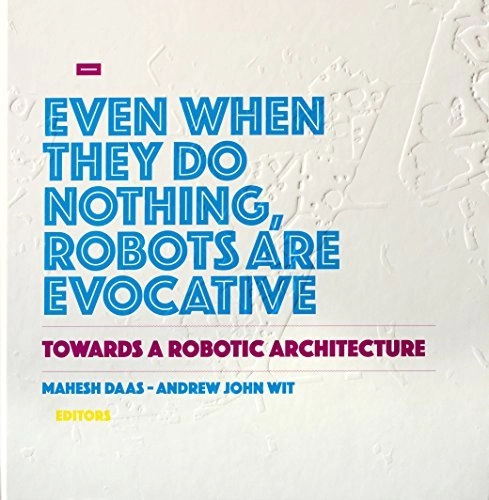
The field of robotics is coming of age. Robotics and artificial intelligence represent the next cutting edge technology to transform the fields of architecture and design. The past decade's surge towards more computationally defined building systems and highly adaptable open-source design software has left the field ripe for the integration of robotics wither through large-scale building fabrication or through more intelligent/adaptive building systems. Through this surge, architecture has not only been greatly influenced by these emerging technologies, but has also begun influencing other disciplines in unexpected ways. The purpose of this book is to provide systems of classification, categorization and

Will Automation Affect Architects?

According to The Economist, 47% of the work done by humans will have been replaced by robots by 2037, even those traditionally associated with university education. While the World Economic Forum estimates that between 2015 and 2020, 7.1 million jobs will be lost around the world, as "artificial intelligence, robotics, nanotechnology and other socio-economic factors replace the need for human employees."

It's not science fiction: the MIT Technology Review warns that the current debate over raising the minimum wage for fast food employees in the United States would accelerate their own automation. On the other hand, Silicon Valley personalities and millionaires like Elon Musk and Richard Branson warned that the impact of automation will force the creation of a universal basic income to compensate not only the massive unemployment that would generate these new technologies but also the hyper-concentration of the global wealth.

One advocate of this idea is the British economist Guy Standing who wrote at the Davos Forum that it "would be a sensible precaution against the possibility of mass displacement by robotization and artificial intelligence," but will automation affect architects? Will we really be replaced by robots?

5 Passive Cooling Alternatives Using Robotics and Smart Materials

The IAAC (Institute for Advanced Architecture of Catalonia) has developed a series of advanced materials and systems for air conditioning and passive ventilation, allowing homes to reduce interior temperatures up to 5 degrees lower while saving the electricity consumption caused by the traditional air-conditioning. The systems are made from long-lifespan materials, which lower the costs of maintenance in the long-term and can be used as low-cost alternative building technologies.
The projects highlighted are the Breathing Skin, Hydroceramics, Hydromembrane, Morphluid and Soft Robotics - all developed by students of the IAAC's Digital Matter Intelligent Constructions (conducted by Areti Markopoulou). The passive air-conditioning of spaces is investigated using a combination of new materials that mimic organic processes, adaptive structures and Robotics that help regulate temperature and create sustainable micro climates.

This Complex Concrete Column Was Made Using 3D-Printed Formwork

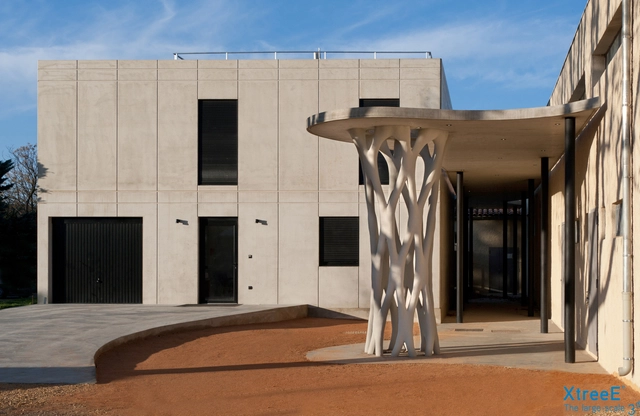
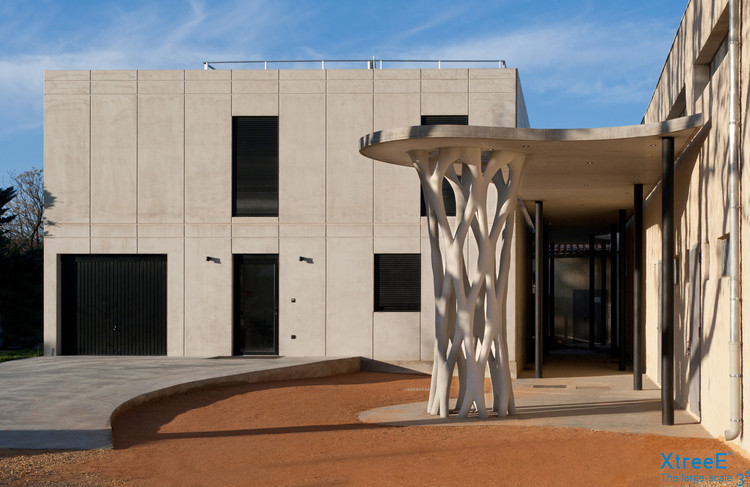
While large-scale 3D printing for architecture continues to be a busy area of research, France-based company XtreeE has been using 3D printed concrete in projects since 2015. Their latest creation is an organic truss-style support structure for a preschool playground in Aix-en-Provence.

This Complex Concrete Column Was Made Using 3D-Printed Formwork - Image 1 of 4This Complex Concrete Column Was Made Using 3D-Printed Formwork - Image 2 of 4This Complex Concrete Column Was Made Using 3D-Printed Formwork - Image 3 of 4This Complex Concrete Column Was Made Using 3D-Printed Formwork - Image 4 of 4This Complex Concrete Column Was Made Using 3D-Printed Formwork - More Images+ 6

Why Wolf Prix Is Pushing For New Methods of Robotic Construction

Subscriber Access | 

This article was originally published on Autodesk's Redshift publication as "Wolf Prix on Robotic Construction and the Safe Side of Adventurous Architecture."

In response to a conservative and sometimes fragmented building industry, some architects believe that improving and automating the construction process calls for a two-front war: first, using experimental materials and components, and second, assembling them in experimental ways. Extra-innovative examples include self-directed insect-like robots that huddle together to form the shape of a building and materials that snap into place in response to temperature or kinetic energy.

The automation battle has already been fought (and won) in other industries. With whirring gears and hissing pneumatics, rows and rows of Ford-ist mechanical robot arms make cars, aircraft, and submarines in a cascade of soldering sparks. So why shouldn’t robotic construction become commonplace for buildings, too?

This Brick-Laying Robot Can Construct an Entire House in Just 2 Days

Subscriber Access | 

Thanks to a new robot named Hadrian X, we made soon be able to construct an entire brick house in just 2 days. Developed by the appropriately named Australian firm Fastbrick Robotics, the giant truck-mounted robot has the ability to lay up to 1,000 bricks an hour. Its innovation comes via the machine’s 30-meter telescopic boom, which allows the base to remain in a single position throughout the brick-laying process.

New Autodesk System Streamlines 3D Printing of Large, Complex Objects

A team of engineers at Autodesk have been pushing the limitations of conventional 3D printing -- not by redesigning the machines themselves, but by creating a network to harness their collective power. Autodesk's "Project Escher" is a new printing system that utilizes the power of several 3D printers at once to fabricate complex parts in unison, reports FastCoDesign. The new system can increase production speed by up to 90%.

Conference: Parallelism in Architecture, Environment And Computing Techniques, (PACT)

The theme of Parallelism in Architecture, Environment and Computing Techniques (PACT) 2016 explores the relations between computational design in architecture, organizational and global, ever-changing and pervasive contexts. PACT 2016 aims to gather practitioners and researchers interested in investigating and improving the state of practice of computational design software in the architectural discourse, where practicing design computing experts can explain the challenges they face in their day-to-day practices, and collectively induce an impact on the future of the field.

5 Ways Architects Are Redefining Craftsmanship For a Postdigital Age

Subscriber Access | 

Craftsmanship is one of those topics which it seems almost everyone has a strong opinion. But while many lament the fact that traditional craft practices have been in decline since the industrial revolution, today a new generation of architects and designers have set about redefining and updating the notion of craft to include the most modern design and fabrication techniques around. In this article, originally published on Autodesk's Redshift publication as "5 Ways Architects and Postdigital Artisans Are Modernizing Craftsmanship," Jeff Link explores some of the traits that connect these pioneers to the craftsmen and women of a bygone era.

Craftsmanship in the digital age is hard to define. For some, craftsmanship evokes a purity of style, a preference for the handmade over the machine. For others, it recalls the Craftsman architecture of early-20th-century homes: overhung gabled rooflines, wide sheltered porches, detailed handiwork, and an ineffable Norman Rockwell sense of bygone Americana.

But regardless of one’s intuitive understanding of the term, the notion of craftmanship is evolving. Increasingly, the age-old knowledge of woodcarvers, masons, and other craftspeople is embedded in an intelligent design process using geometric computer models and machine fabrication to develop new crafts and architectural métiers—from gravity-defying furniture assemblies to complex workflows for robotic automatons. These innovations have helped place architects alongside craftsmen at the center of a revival in “maker” culture, which, for example, is in vivid display in handmade marketplaces such as Folksy and Etsy.

So what exactly is digital craft? And what does it look like in the work of top designers? Here, innovative architects identify five things postdigital artisans are doing to transform craftsmanship.

Achim Menges to Create Robotic Pavilion for V&A

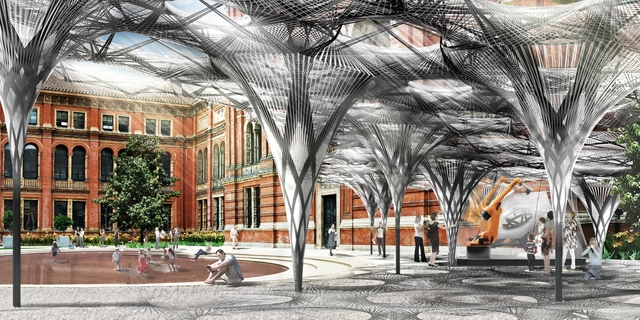
Stuttgart experimental architect Achim Menges has been commissioned to kickstart the V&A's first ever Engineering Season with a site specific, nature-inspired installation fabricated by robots. Complemented by Ove Arup's first major retrospective, Engineering the World: Ove Arup and the Philosophy of Total Design, the Elytra Filament Pavilion will be Menges' first public commission in the UK. He will work with Moritz Dörstelmann, structural engineer Jan Knippers and climate engineer Thomas Auer to complete the project.

"Elytra Filament Pavilion will explore the impact of emerging robotic technologies on architectural design, engineering and making," says the V&A. "Inspired by a lightweight construction principle found in nature, the fibrous structures of the forewing shells of flying beetles known as elytra, the Pavilion will be an undulating canopy of tightly-woven carbon fibre cells created using a novel robotic production process."

New Construction Robot Lays Bricks 3 Times as Fast as Human Workers

A new construction worker has been lending high-efficiency help to job sites, laying bricks at almost three times the speed of a human worker. SAM (short for Semi-Automated Mason) is a robotic bricklayer that handles the repetitive tasks of basic brick laying, MIT Technology Review reports. While SAM handles picking up bricks, applying mortar and placing them at designated locations, its human partner handles worksite setup, laying bricks in specific areas (e.g. corners) and improving the aesthetic quality of the masonry.

Bone-Like Plastic Structures Form Biodegradeable Temporary Pavilions With "Osteobotics"

Subscriber Access | 

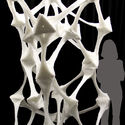
Architecture can be built with compressive elements and with tensile elements, but few materials have the ability to be stretched and also retain compressive strength. In a new project from Architectural Association DRL students Soulaf Aburas, Maria Velasquez, Giannis Nikas, and Mattia Santi, one of those materials, Polycaprolactone, a biodegradable polyester, is used to create framework from temporary pavilions and installations. Constructed using programmable robotic arms, the resulting product is a joint-less, self-supporting mono-material that shares a visual similarity to the structure of bones - giving the project its name, Osteobotics.

Bone-Like Plastic Structures Form Biodegradeable Temporary Pavilions With "Osteobotics" - Image 1 of 4Bone-Like Plastic Structures Form Biodegradeable Temporary Pavilions With "Osteobotics" - Image 2 of 4Bone-Like Plastic Structures Form Biodegradeable Temporary Pavilions With "Osteobotics" - Image 3 of 4Bone-Like Plastic Structures Form Biodegradeable Temporary Pavilions With "Osteobotics" - Image 4 of 4Bone-Like Plastic Structures Form Biodegradeable Temporary Pavilions With Osteobotics - More Images+ 16

4 Experiments in Robot and Drone 3D Printing that Could Shape Architecture's Future

Subscriber Access | 

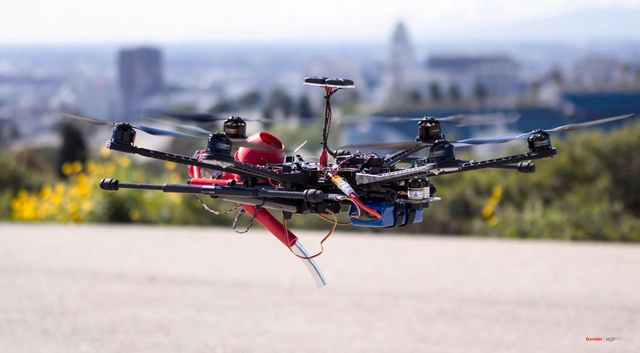
In manufacturing, the dramatic recent expansion in the capabilities of 3D printing has threatened to revolutionize the way that things are made. In architecture though, while 3D printing has been received with enthusiasm its translation to the increased scale of buildings has been challenging. Most solutions to this problem have focused on increasingly large printers and the incorporation of existing principles of prefabrication - however there is another way. In this article, originally published on Autodesk’s Redshift publication as "4 Ways a Robot or Drone 3D Printer Will Change Architecture and Construction," Zach Mortice looks at four examples of cutting-edge research into 3D printing that utilize robots or drones to navigate architecture's challenging scale.

Buildings simply aren’t made like anything else—that goes for sunglasses, furniture, appliances, and fighter jets. No other production process brings massive amounts of material to one place, constructs one item, and then hauls away the garbage. The inefficiencies are monumental.

Modular construction has promised a great deal of potential to reduce waste. But what if one answer is to do more intricate construction on-site, not less? 3D printers attached to robots and drones are demonstrating that they might have the versatility to finally bring the unruly building process to heel.

This 3D Printed Pavilion Provides Shade During the Day and Illuminates at Night

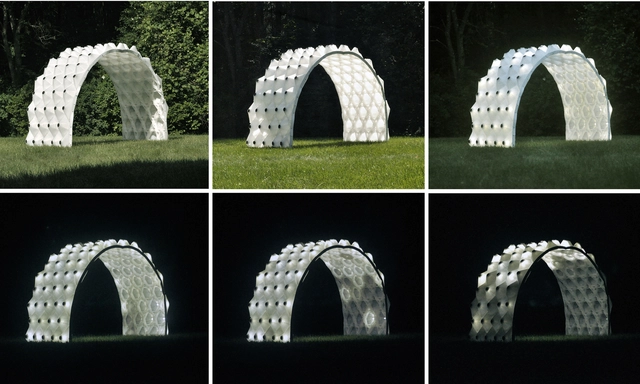
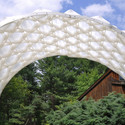
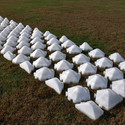
The Solar Bytes pavilion, designed by assistant professor at Kent State University Brian Peters, is a temporary structure which highlights the potential of new techniques available to architecture: robotic arms, 3D printing, smart technologies such as lighting sensors, and solar energy.

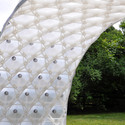
Leveraging the strength and range of motion of a robotic arm, the pavilion was printed in three dimensions with an experimental extruder, resulting in a structure composed of 94 unique modules that capture energy during the day, and shine at night. After their initial function, the plastic modules making up the pavilion will be completely crushed and reused in a new structure.

This 3D Printed Pavilion Provides Shade During the Day and Illuminates at Night - SustainabilityThis 3D Printed Pavilion Provides Shade During the Day and Illuminates at Night - SustainabilityThis 3D Printed Pavilion Provides Shade During the Day and Illuminates at Night - SustainabilityThis 3D Printed Pavilion Provides Shade During the Day and Illuminates at Night - SustainabilityThis 3D Printed Pavilion Provides Shade During the Day and Illuminates at Night - More Images+ 10

BIG and Heatherwick's Google HQ to be Built with Robots

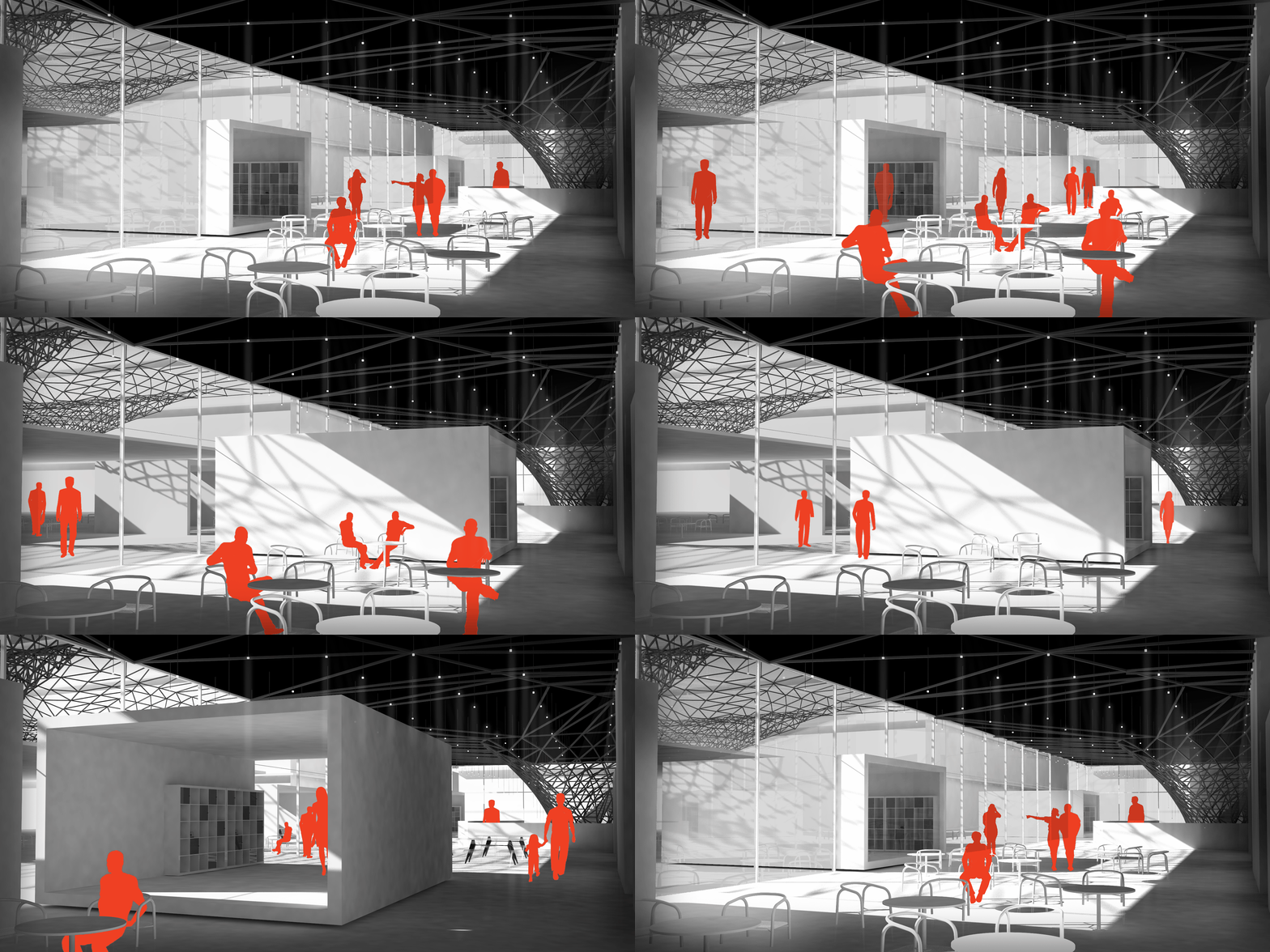
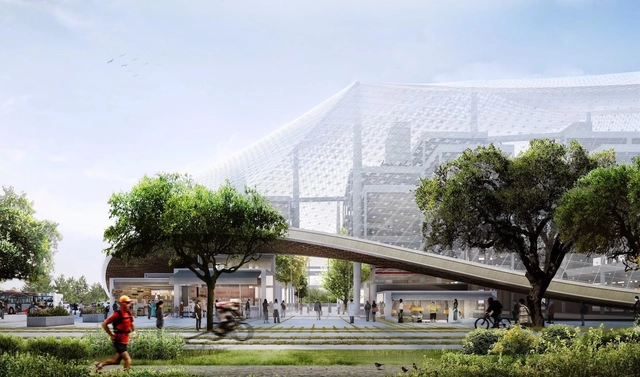
Google's proposed California headquarters will be built with robots, according to the most recent planning documents received by the City of Mountain View Council. As the Architects' Journal reported first, the documents detail BIG and Heatherwick Studio's plan to construct the canopy-like structure's interiors with a team of robotic-crane hybrids known as "crabots."

These crabots would, in theory, establish a "'hackable' system for the building of the interior structures," says the documents, that would allow for limitless, easy, and affordable reconfiguration of space throughout the building's life. 

Skanska and Foster + Partners Collaborate on World’s First 3D Concrete Printing Robot

Global construction company Skanska is teaming up with Foster + Partners and the engineers at Loughborough University (LU) to create the world’s first commercial 3D concrete printing robot. The company has signed an agreement with LU, who has been working on the project since 2007, to partake in an 18-month initiative with a consortium of partners focused on developing a robot capable of printing complex structural components with concrete.

A video about LU's research on 3D concrete printing and Foster + Partner's involvement, after the break.