Ten of Los Angeles’ Case Study Homes have been deemed historically significant an worthy of being included on US’s National Register of Historic Places. Despite the Los Angeles Conservancy’s belief that all of them deserve “equal preservation protections,” the 11th home was not included due to “owner objection.”
The Case Study Houses spawned from a post-WWII residential experiment, presented by the Arts & Architecture magazine in 1945, which introduced modern movement ideas for affordable and efficient housing. The homes - designed by the likes of Richard Neutra, Charles and Ray Eames, Pierre Koenig, Eero Saarinen and others - redefined the modern home. And, with the help of Julius Shulman, placed Los Angeles as an epicenter for mid-century modernism.
This article was written by Seattle-based designer and critic Evan Chakroff.
Lexington Kentucky’s Miller House is a built manifesto: an ambitious proposal for the future of suburbia in an age of unprecedented urbanization. Despite its pedigree – designed and built by Le Corbusier protégé José Oubrerie – and despite its (appropriate) selection as a “masterwork” by Kenneth Frampton, the project remains somewhat unknown and the architect underappreciated.
The house should absolutely occupy a place in the canon of great residential architecture. The complex composition alone should inspire myriad formal readings, but more importantly the house represents a model for communal life amid continuously-shifting family structures. It’s a radical rejection of a suburban lifestyle that has become socially, economically, and culturally unsustainable.
Midtown West; Courtesy of Flickr User David Boeke, Licensed via Creative Commons
A recent study by the Real Estate Board of New York (REBNY) concluded that by preserving 27.7% of buildings in Manhattan, “the city is landmarking away its economic future.” REBNY is challenging the Landmarks Preservation Commission, arguing it has too much power when it comes to planning decisions, and that by making business so difficult for developers it is stifling the growth of the city.
Yet not three days before releasing this study, president of REBNY Steve Spinola said in an interview with WNYC that “if you ask my members, they will tell you [the twelve years of Mayor Bloomberg's tenure] has been a great period of time for them”. The conclusion of WNYC is that the past decade has actually been a period of increased growth for developers, rather than a period of stagnation.
It would be easy to echo the opinion of Simeon Bankoff, executive director of the Historic Districts Council, who believes the actions of REBNY come down to greed, even comparing its members to Gordon Gekko, the anti-hero of the film Wall Street. But is greed really what’s behind this attack on the Landmarks Preservation Commission? Find out after the break.
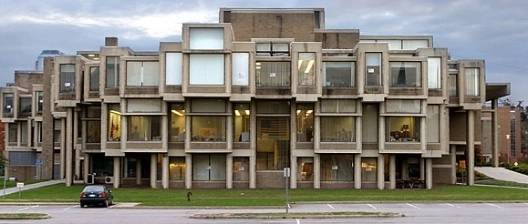
Despite a 15-6 Legislature vote in February that ruled in favor of preserving Paul Rudolph’s brutalist landmark in Goshen, reports indicate that demolition is still being considered as an option. According to the Times Herald-Record, an ad hoc panel led by pro-demolition County Executive Ed Diana selected a team of architects and engineers to develop three options in 90 days for “renovating and replacing” sections of the 43-year-old complex. Though many thought the 18-month-long campaign ended with February's ruling, it is apparent that the heated debate is far from over. Ultimately, lawmakers must vote again on the project to authorize bonding for construction.
Shortly after confirming the demise of Bertrand Goldberg’s beloved Prentice Women’s Hospital in Chicago, Northwestern has released a shortlist of three firms competing to design the school’s new biomedical research facility. This comes with the support of Chicago Mayor Rahm Emanuel and despite strong backlash from architects and preservationists worldwide.
Paul Goldberger weighs in on the shaky future of the architectural gems at JFK (which includes Eero Saarinen’s TWA Terminal), saying, “Like the Worldport, TWA is unworkable as a modern airport terminal. Both buildings are tiny by today’s standards, and there’s no place for security equipment except in the middle of the space, where it obliterates any sense of the architecture. But their small size also means that they don’t take up all that much real estate, and they ought to be usable as something other than as places where people get on and off airplanes—as restaurants and shops, say, or as a museum.” What do you think? Save or scrap?
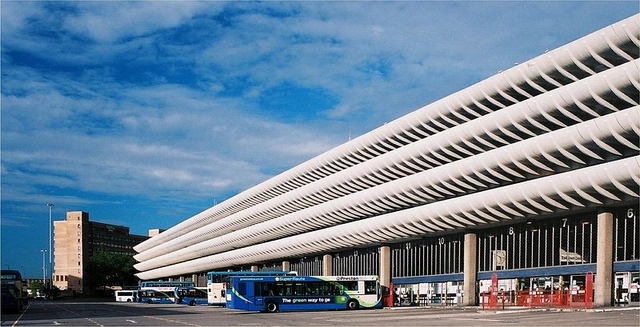
As reported by BDOnline, Richard Rogers of Rogers Stirk Harbour & Partners has announced his support in the long-standing battle to save England’s Preston Bus Station from demolition. In a letter to the English Heritage, Rogers described the 1969 brutalist landmark as “truly a major modern building and an outstanding piece of 20th century architecture” that is in dire need of refurbishment.
“Preston Bus Station is not only admired internationally, but it also continues to be fully functioning. It is a critical transport hub,” he stated. “I would encourage you to consider listing the bus station and support a much-needed refurbishment.”
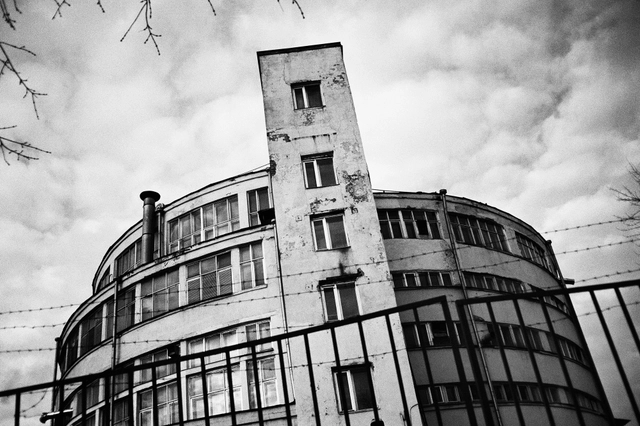
In Russia, hundreds upon hundreds of buildings are endangered. The work of making sure they don't become extinct? That's in the hands of a tireless few.
One of these crusaders is Natalia Melikova, the author of The Constructivist Project, an on-line web site that seeks to preserve the memory - and hopefully inspire the protection of - Russia's avant-garde architecture. Although it began as her thesis project, it's steadily become one of her life passions. In Melikova's words, "By sharing photographs (my own and others), articles, events, exhibitions, and other resources on the topic of the avant-garde, The Constructivist Project unites common interest and appreciation of Russian art and history and makes it accessible to an international English-speaking audience. This is a way to initiate discussion not only of the perilous situation of Russian avant-garde architecture but also of cultural preservation and urban development in general."
See 10 of Melikova's images, snapshots into a part of Russian history quickly being forgotten, with her descriptions, after the break.
After years of disconcerting reports that the historic David and Gladys Wright House by Frank Lloyd Wright was under threat of demolition by developers, we announced that a generous benefactor saved it from its fate by providing funds to buy back the property. It seems that this particular story is not unique. An article on ArchRecord by Frank A. Bernstein lists several other modern architecture treasures that may soon fall under the same threat as they hit the real estate market.
Videos
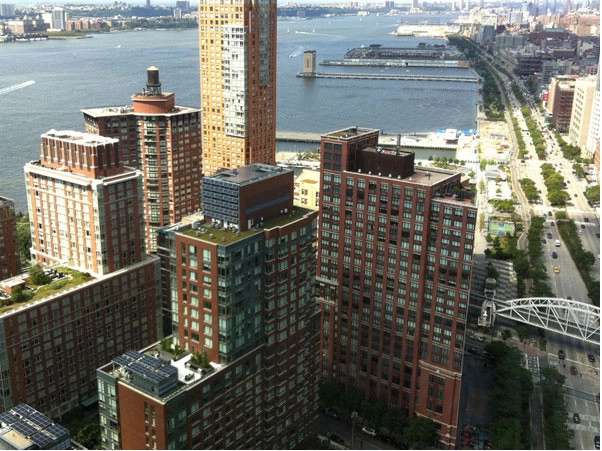
NYC Department of City Planning, Zone Green Courtesy of APA
The American Planning Association has released its list of 2013 National Planning Awards winners that exhibit the best planning efforts that create communities of lasting value. Among the recipients are regional plans that seek to revitalize post-industrial cities, plans to preserve and rehabilitate native settlements, restore blighted communities, reassess planning and zoning in major cities, develop environmental conservation programs, regenerate access to our natural topography and develop guidelines and regulations for more sustainable approaches to building. The projects are diverse and span a significant realm of urban reclamation and development.
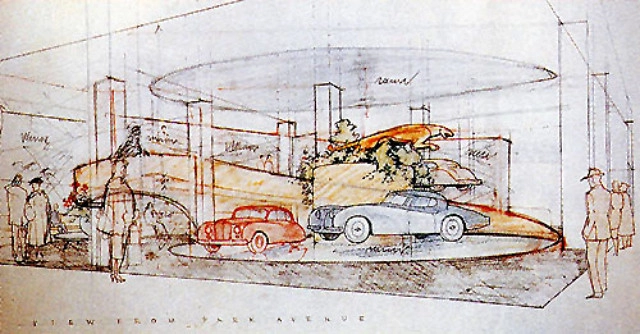
Frank Lloyd Wright’s drawing for the Hoffman Show Room (courtesy the Frank Lloyd Wright Foundation) via Hyperallergic.com
In late March, one of the few Frank Lloyd Wright designs in New York City was demolished quietly at 430 Park Avenue. This seldom-noticed interior retail space was home to the Hoffman Auto Showroom for over five decades and just as it was considered for preservation by the Landmark Preservation Commission, the owners of the building applied for its demolition. For many people, this may seem like an act of corporate greed or "corporate vandalism" and it may be so, but the landmark designation for interior spaces applies strictly to public space only according to NYC's landmark laws.
So was this space ever anything more than private property? And aside from having been designed by one of America's most famous architects, did the design have "special historical, architectural or cultural significance"?
Rauh House / John Becker via Cincinnati Preservation Association
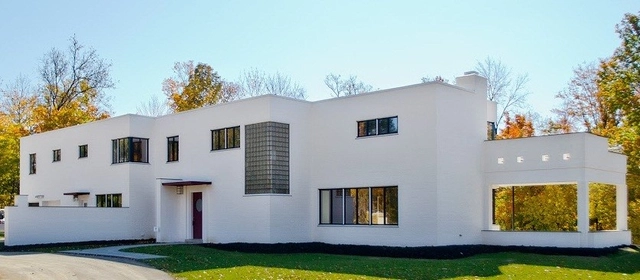
On April 24th and 25th, Cincinnati Preservation Association (CPA) will celebrate the gift and the restoration of the Frederick and Harriet Rauh House, designed by pioneering Cincinnati Modernist John Becker in Woodlawn, by hosting “Preserving Modern Architecture,” a two-day symposium at the house. In September 2011, CPA launched the restoration of the 1938 Rauh House with a festive celebration honoring Emily Rauh Pulitzer, donor of the house and funder of the work. A year later, the restoration of this pioneering International Style residence is complete.
Divisive concrete behemoth Preston Bus Station may yet be saved from its planned demolition. On the heels of a well co-ordinated campaign to save the brutalist monument, local businessman Simon Rigby has stepped in and offered to relieve the council of the building planning refurbish and operate the bus station himself.
Read more about the controversy and Rigby's plan after the break...
In response to the Commission on Chicago Landmarks’ decision to reject landmark status to Prentice Woman’s Hospital for the second time in three months, the two preservationist groups challenging the City of Chicago have withdrawn their lawsuits. This eliminates the last barrier standing in Northwestern University’s way to demolish the historic, Bertrand Goldberg structure for a new biomedical research facility.
“We felt that we had done as much as we possibly could to demonstrate the significance of the building and ways to reuse,” stated Christina Morris, a senior field officer for the National Trust for Historic Preservation. “We just couldn’t see that we’d have any other outcome.”
For many, this news is disheartening as architects and preservationists from around the globe have fought in solidarity for much of the past year in an attempt to illustrate the importance of this one-of-a-kind structure.
Amidst the longstanding, heated battled to save Bertrand Goldberg’s iconic Prentice Woman’s Hospital, the results of the 2012 Chicago Prize Competition: Future Prentice have been announced! Presented by the Chicago Architecture Foundation, in collaboration with Chicago Architectural Club and the Chicago Chapter of the American Institute of Architects, the international competition intended to act as a platform for public debate about the future of the controversial Chicago landmark.
More information and the winning proposals after the break…
Cook County Judge Neil Cohen has granted Bertand Goldberg’s Prentice Woman’s Hospital a temporary reprieve after preservationist filed a lawsuit against the city and the Chicago Commission on Public Landmarks yesterday afternoon. Plaintiffs, Landmarks Illinois and the National Trust for Historic Preservation claim that the commission “acted arbitrarily and exceeded its authority,” after granting and subsequently revoking Prentice landmark status in just a short afternoon on November 1. These proceedings, which typically takes months, followed Mayor Rahm Emanuel’s decision to publicly support Northwestern University’s plan to demolish the vacant icon.
Despite strong opposition from preservationists and architects world-wide, Chicago Mayor Rahm Emanuel has announced his decision to support the demolition of Bertrand Goldberg’s Prentice Women’s Hospital. In a op-ed piece released by the Chicago Tribune, Emanuel supported his stance by arguing that Northwestern’s new biomedical research facility would “bring 2,000 jobs and hundreds of millions of dollars in investment” to Chicago. Emanuel believes Goldberg’s “vision is alive in Chicago beyond one building” and allowing Northwestern to build the new medical center is crucial in keeping Chicago at the forefront of scientific innovation.