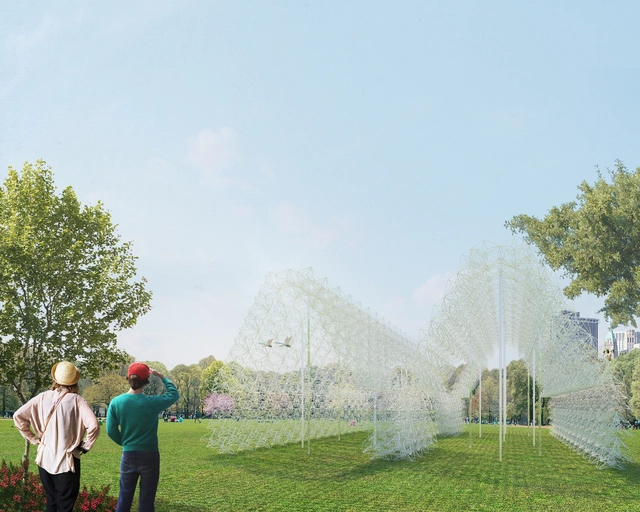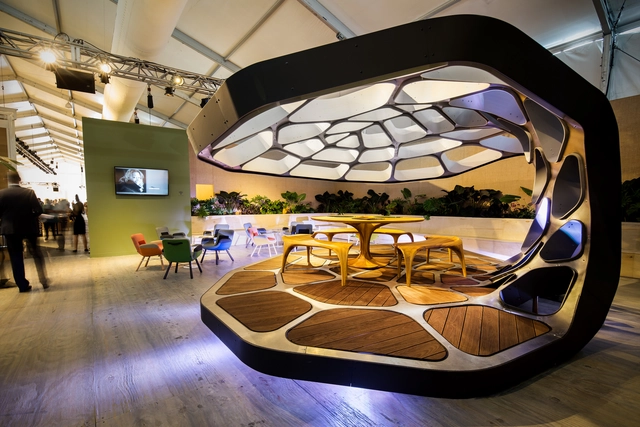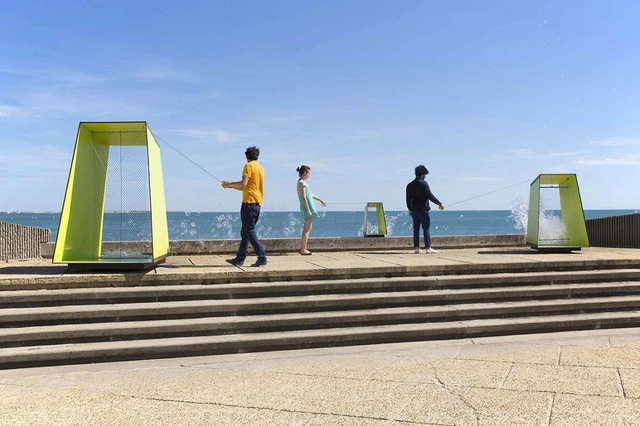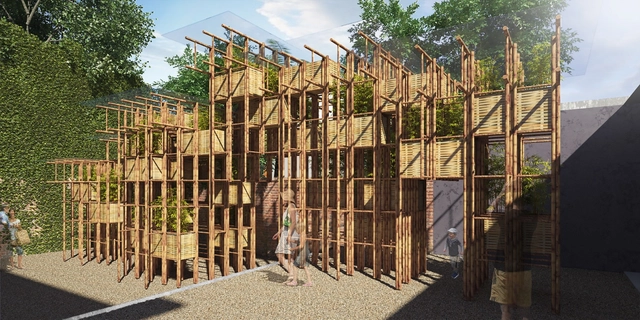
Israel has unveiled its theme for the 2016 Venice Biennale: “LifeObject: Merging Architecture and Biology”. Their pavilion will be comprised of a large-scale sculptural installation and seven speculative architectural scenarios relating to Israel. The exhibition will focus on the relationship between biology and architecture, acting as a “research oriented platform.”
MVRDV’s design for the Dutch exhibition “Hola Holanda” at the Book Fair of Bogotá (FILBO) features a modular system of crates that will be repurposed as neighbourhood libraries after the Book Fair ends. Avoiding the waste of resources created by one-time pavilions, the Dutch firm has introduced a playful element of sustainability to the fair, maintaining its spirit even after the event ends.
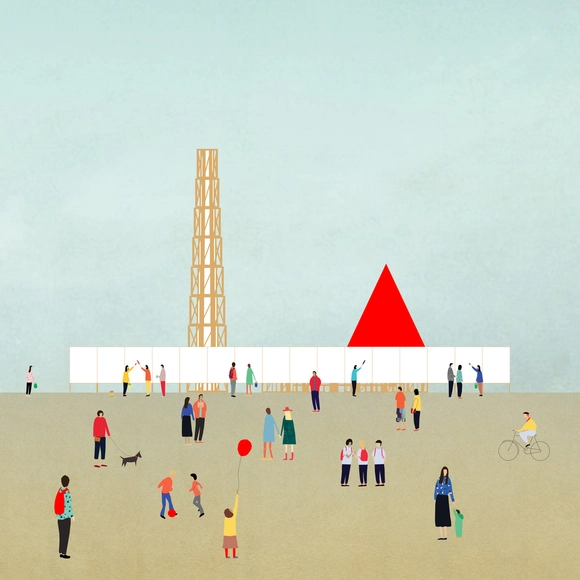
International architecture competition organizers Bee Breeders have announced the three winners and honourable mentions of their competition to design a Charlie Hebdo Portable Pavilion. Intended to be a travelling exhibition of the work of the French Magazine “Charlie Hebdo,” participants were asked to “support and promote” principles of free speech in their design. Responding to the terror attacks against Charlie Hebdo and the ensuing global discourse on free speech, the competition sought to deconstruct the “conventional assumptions of free speech,” and look specifically at “what makes speech free and how much of it comes at a cost.”
Entries were judged for the way they challenged these assumptions in terms of space, material and form. Preference was given to projects that had clear concepts, circulation, sequence and narrative, in addition to public engagement and a “reconciliation between the abstract and theoretical with the physical and real.” Consideration was also given to the way projects contributed to a discourse – rather than expressing an opposition - concerning the growing grey areas between "ideological, political, and cultural binaries."
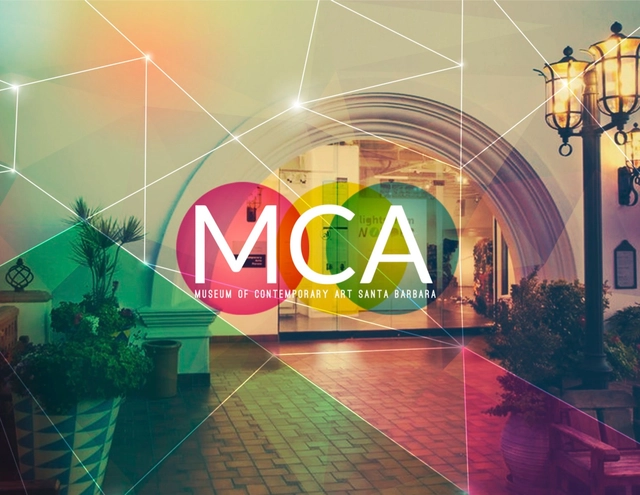
Museum of Contemporary Art Santa Barbara, Photo Credit: Stacey Bryant
MCASB invites proposals for a large-scale, outdoor, traveling pavilion to be built and installed at each site of its new public art program, TakePart/MakeArt. As a central feature of TakePart/MakeArt, the mobile pavilion will be a bold and vibrant beacon for MCASB as it travels through three different communities across Santa Barbara County: Isla Vista, the Westside, and the Waterfront.
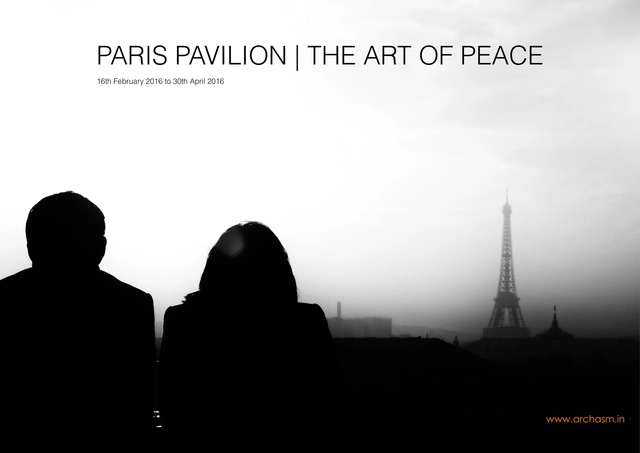
The city of Paris is rightfully termed as 'the cultural capital of the world' because of its rich and diverse ethos and character. Paris has been the artistic epicentre of the world since renaissance, inspiring many artists, philosophers, writers and architects to innovate and break the shackles of resistance. The city was home to great revolutionaries like Picasso, Miro, Modigliani, Voltaire and Corbusier. But one of the most tolerant cities of the world was shook by recent terror attacks that sent shockwaves around the world.
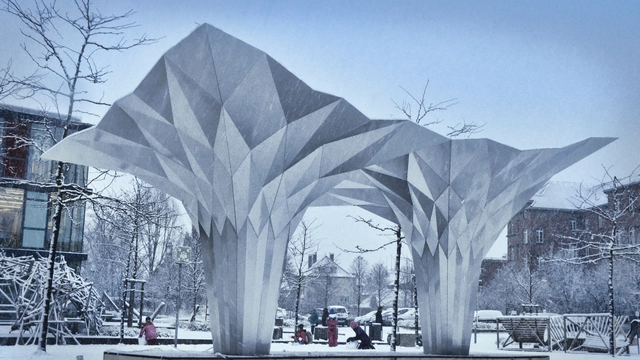
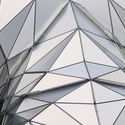
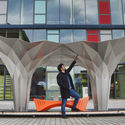
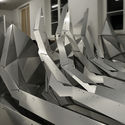
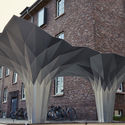
The advent of parametricism has brought architects many new design capabilities; form finding, sun shading and visual texturing are just a few of the ways the technology has impacted structures. But perhaps its most noble function is its ability to optimize structure, especially through the folding of thin, rigid materials. This is the function that architect Tal Friedman has chosen to explore in his Origami Pavilion.
A design for a pavilion constructed out of recycled clothes hangers has been selected as the winner of the sixth annual City of DreamsPavilion Competition. The temporary structure will be built on Governors Island and available to the public for summer 2016, pending final approval and fundraising.
Hosted by FIGMENT, the Emerging New York Architects Committee (ENYA) of the American Institute of Architects New York Chapter (AIANY), and the Structural Engineers Association of New York (SEAoNY), the competition speculates on possible futures with solutions to the current strain on economic and natural resources. Designers are required to consider their materials from sourcing to disposal, or ideally, reuse, promoting sustainable thinking.
Over 100 design proposals were submitted, and the jury selected four finalists who were each given a month to further develop their designs in response to jury comments. See the winning design and the three finalists after the break.
With recent advancements in building technology, Revolution Pre-Crafted hopes to democratize the design of pre-fab structures, offering a line of products that incorporate the distinct spatial and social brands of the designers. See a selection of the Revolution Precraft line after the break.
Based on the concept of listening to the sounds of the ocean inside a shell, STUDIOKCA, commissioned by NASA, has created the NASA Orbit Pavilion to immerse visitors in the sounds of satellites orbiting in outer space.
The traveling, nautilus-shaped pavilion provides a space in which to experience the trajectories of 19 satellites orbiting Earth. Made with 3,500 square feet of water-jet cut aluminum panels, the pavilion is "scribed with over 100 'orbital paths' fitted together and bolted to a curved framework of aluminum tubes."
The south of France is known for its endless beaches, nineteenth century architecture, lush greenery, and monuments to its storied history. For nearly a decade, Le Festival des Architectures Vives (Festival of Lively Architecture) has been infusing contemporary architecture into the staid Southern French landscape through the creation of an array of artful temporary pavilions. Beginning in 2006 and 2013 respectively, the towns of Montpellier and La Grande Motte have played host to a series of structures designed to animate historical segments of the two cities. Founded with a mission to celebrate the seminal work of burgeoning architects, the festival aims to produce meaningful and interactive works designed to activate the historic centres of the two ageing cities.
Explore the bizarre and inspired installations of Le Festival des Architectures Vives after the break.
Courtesy of The Sherman Contemporary Art Foundation (SCAF)
The Sherman Contemporary Art Foundation (SCAF) has announced the fourth iteration of its annual pavilion series Fugitive Structures. Designed by Vo Trong Nghia Architects, the pavilion centers around “the innovative use of bamboo, and [the architect’s] passion and self-imposed duty to green the world’s urban landscapes with plants and vegetation.”
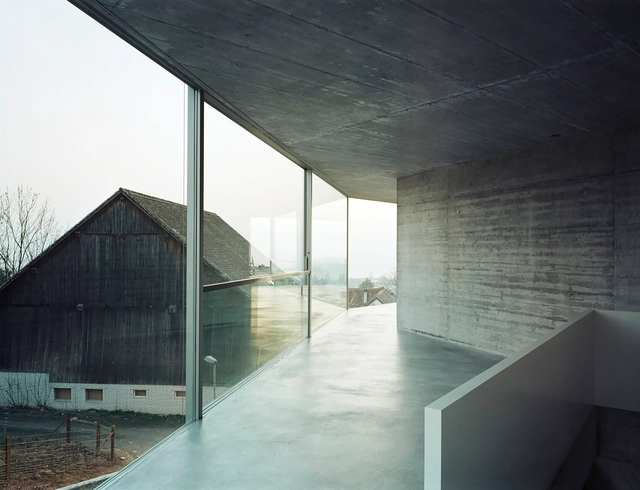
The Swiss Arts Council Pro Helvetia has nominated Christian Kerez, a Venezuela-born, Swiss architect, to represent Switzerland at the 15th Architecture Biennial in Venice in 2016. The exhibition will be curated by Swiss art historian Sandra Oehy, and will be on display at the Biennial from May 28 to November 27, 2016. Switzerland will also be represented by <<Salon Suisse>>, a platform for discussion and debate on contemporary art and architecture.
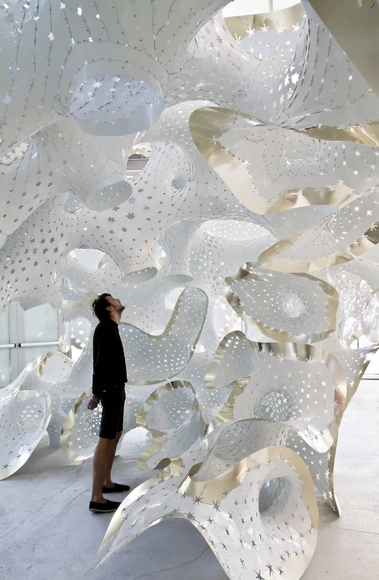
In light of the recent kickoff of Art BaselMiami, Marc Fornes / THEVERYMANY has shared its Labrys Frisae Pavilion, which was installed at Art Basel Miami from 2011 to 2014. Constructed from aluminum less than one millimeter thick, the installation sought to blur the distinction between edge and space through “an immersive, multisensorial experience.”
“The structure’s interior leads a visitor to lose their time as they peruse the curves and try to understand the space,” which changes as viewers move throughout, especially at night, when shadows emerge through the shell’s intricate perforation.
Simon Battisti, Leah Whitman-Salkin, and design collective Åbäke have been selected to represent Albania at the 15th International Biennale in Venice in 2016, with their project entitled, “I Have Left You the Mountain.” The project was selected from an open call for proposals from the Albanian Ministry of Culture that was held earlier this fall.
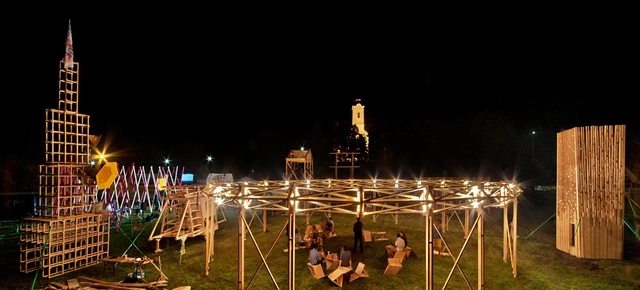
Set in the depths of rural Hungary, Hello Wood has emerged from the landscape for its 2015 edition, entitled 'Project Village'. Since 2010, the Hungarian-led collective of architects, designers, students and artists have gathered from around the world to create temporary wooden installations. Now in its sixth year, Hello Wood was realized with the help of 150 volunteers from 30 countries, and co-curated by Johanna Muszbek, with the shared vision to build a series of community-driven pavilions. Together the teams created fifteen unique wooden pavilions, each centred on a different component of the architecture of a village.
Kengo Kuma & Associates has unveiled its latest project for the Galerie Philippe Gravier in Paris. Entitled Yure, a Japanese expression for a nomadic habitat moving in the wind, the project is made from identical wooden pieces, seeking to blur the lines between art and architecture with its organic structural geometry.
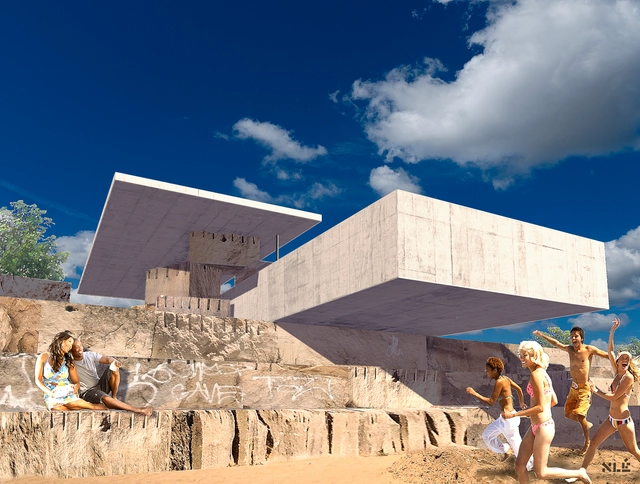
With its Lakefront Kiosk competition, the Chicago Architecture Biennial is hoping to leave a long-lasting impact and legacy for its city. The ROCK, a submission from NLÉ Architects in collaboration with School of the Art Institute of Chicago, is giving the public the opportunity to shape that legacy. Throughout the course of the event, which opened on October 3rd, eventgoers are invited to Millennium Park to add value to the 1930s limestone rocks that will create the pavilion through carving, painting, performances and other unimagined processes.
Uncountable hours, and piles of failed sketches and models to go with them – much of the architecture process is left unseen, held behind locked doors, but Harvard Graduate School of Design (GSD)’s Pavilion for Design Miami exposes this process for the first time. After a school-wide competition involving over 100 students in 32 teams, a judging panel of GSD faculty and representatives of Design Miami selected “UNBUILT” to represent the school at this year’s fair.