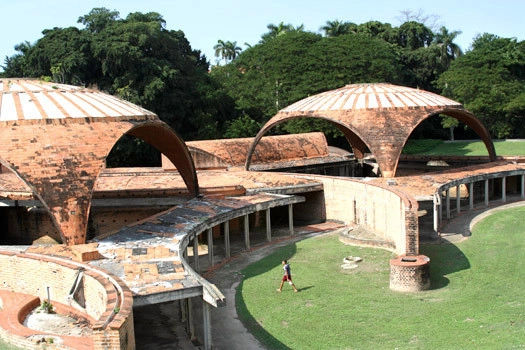
Ricardo Porro, the leading architect behind Cuba’s National Art Schools - one of the largest architectural achievements of the Cuban Revolution - has died of heart failure in Paris at the age of 89. After spending nearly a half a century in exile, Porro lived long enough to see his two arts schools reemerged on the world stage as “crown jewels of modern Cuban architecture.”
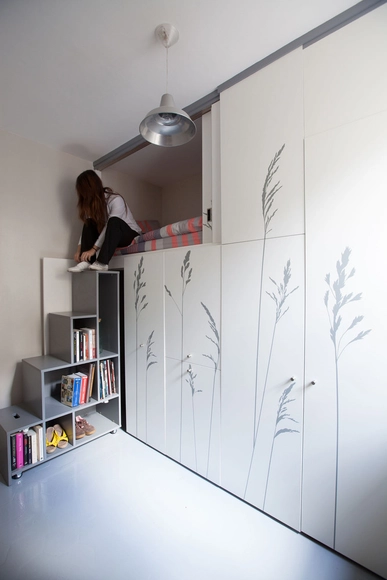
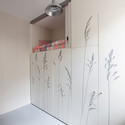
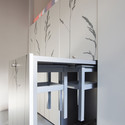
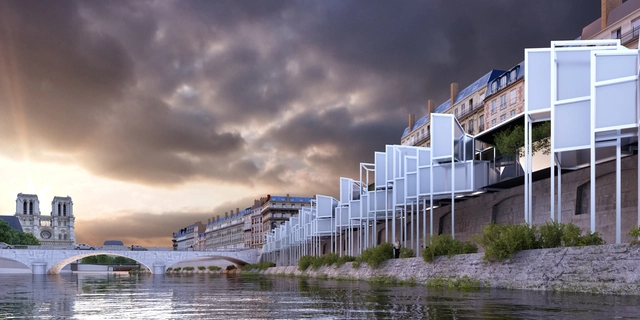
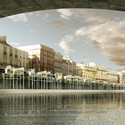
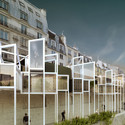
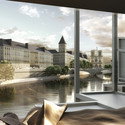
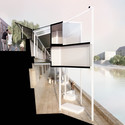
With nearly 120 museums, Paris has the largest concentration of museums in the world. This, as MenoMenoPiu Architects believes, puts the city at risk of becoming a living conservatory. Therefore the Parisian practice has proposed the “EauBerge Paris Capsule Hotel” as a way to mitigate the need for short-term housing for tourists and preserve the quality of everyday life for residents.
"Just like the other European capitals such as Rome, Venice, or Barcelona, Paris risks to become a city museum,” says MenoMenoPiu. “The increase of tourists in the French Capital causes panic and also leads to a gradual decentralization from the Parisians.”
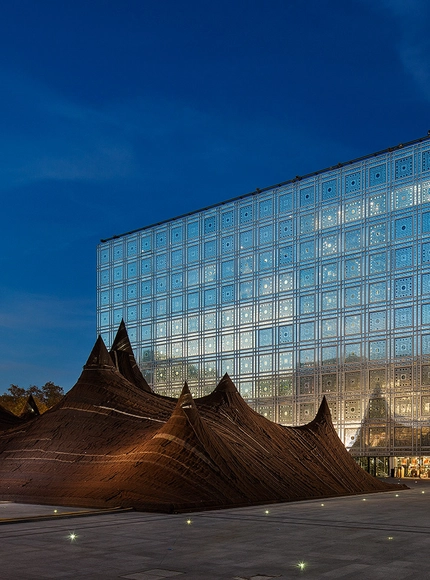
In conjunction with the Contemporary Morocco exhibit (Le Maroc Contemporain) at the Jean Nouvel-designed Institut du Monde Arabe in Paris, a giant tent has been constructed on the plaza in front of the building. Designed by Tarik Oualalou and Linna Choi of OUALALOU+CHOI, the tent harmonizes contemporary design and technical innovation with traditional fabrication methods. Constructed from more than 650-square-meters of camel and goat wool woven by female cooperatives in the Saharan desert, the tent serves as an urban landmark and a symbol for the Contemporary Morocco exhibit. The rhythm and scale of the tent’s silhouette renders a topographic dimension to the structure which pays homage to the nomadic traditions of southern Morocco.
Eugène Viollet-le-Duc, the French architect most famous for the 'restoration' of Notre-Dame de Paris, is a person we unequivocally associate with 19th century Gothic Revival. Although there is no doubt that his interpretive restorations of medieval French monuments were some of his greatest achievements, a new exhibition at Paris' Cité de l'architecture et du patrimoine seeks to uncover a "well-connected character who pursued an uninterrupted career drawing, building, teaching, restoring, and many other things."
In a review for Domus, Léa-Catherine Szacka examines this first major retrospective dedicated to the designer, theorist and artist since 1980 in celebration of the bicentennial of his birth. According to Szacka curator Jean-Michel Leniaud has, in this exhibition, shifted focus to Viollet-le-Duc's artistic output, thereby presenting "the less known and the more unexpected aspect" of his career.
If buildings could talk, what would they say about us? Cathedrals of Culture, a six part collection of films recently premiered at this year's Berlin International Film Festival, "offers six startling responses to this question". The project, filmed entirely in 3D, allows "six iconic and very different buildings to speak for themselves, examining human life from the unblinking perspective of a manmade structure".
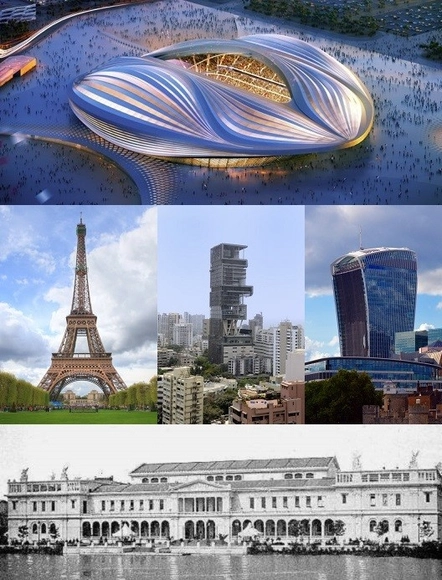
The criticism surrounding Al Wakrah has prompted us to look far and wide for the world’s most debated buildings. Could Al Wakrah be the most controversial building of all time? Check out ArchDaily’s roundup of nine contenders after the break.
Find out which buildings top our controversial list after the break
Widening the debate on whether or not Paris should preserve its 19-century skyline or “embrace innovation,” Parisian city council members have rejected the controversial, 180-meter “Triangle Tower” designed by Herzog & de Meuron. Despite the 83-78 vote, the fight carries on; Mayor Anne Hidalgo has declared the veto to be invalid and hopes a new round of balloting will rule in favor of the tower. Though, in a city that fears of loosing its “existing urban fabric to skyscrapers,” it seems unlikely that the tower will be built.
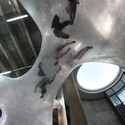
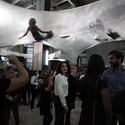
They began with a single roll of tape, frenetically navigating the space between columns with the help of a ladder and a lot of creativity. Ten days and twelve sets of hands later, Tape Paris was completed at Palais de Tokyo for 'Inside,' an exhibition of site-specific projects designed to be interactive and introspective. Tape Paris delves into the physical and psychological experience of interior space through an experiential model of exploration. Visitors travel through a matrix of elastic tunnels suspended precariously above the traditional exhibition space, as guests observe their movements from below. The biomorphic skin is a playground for the senses, offering opportunities to climb, relax, and discover.
Enter the elastic world of Tape Paris after the break
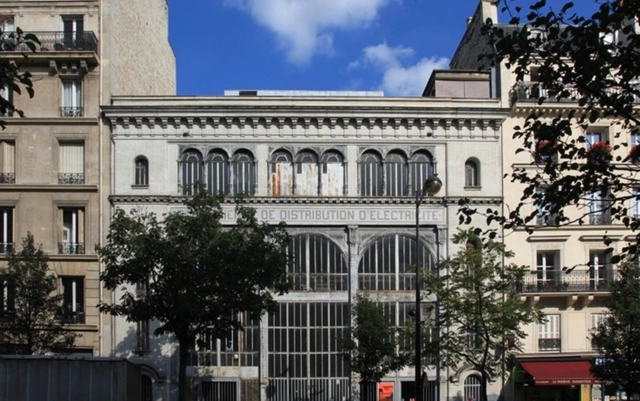
Site: Sous-station Voltaire (11e). Image Courtesy of Reinventer Paris
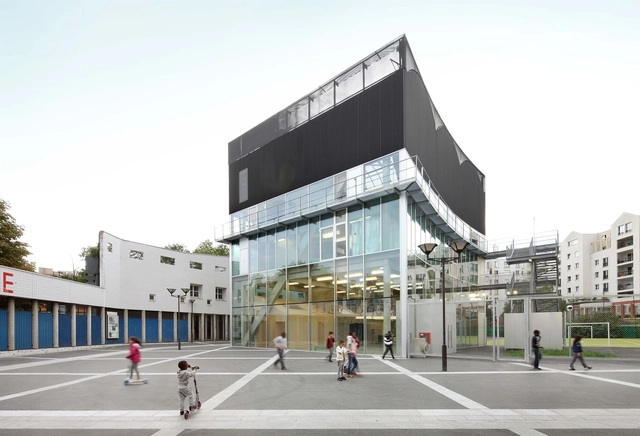
The City of Paris has called upon the architects of the world to propose "innovative urban projects" to reimagine the city's urban future. As the first competition of its kind in the world, Mayor Anne Hidalgo and her Deputy, Jean-Louis Missika, will "select and implement the new forms of buildings that will shape the future of Paris," putting innovation at the top of the criteria. Offering 23 sites, located in the centre of Paris and on the peripheries, the City is convinced that "the challenges faced by the world can be addressed through local answers." According to the Mayor, "from today, world creators are given carte blanche to reinvent the ways of living, working and trading in Paris." "Surprise us!"
Yesterday, during the opening of a new photography gallery, Centre Pompidou president Alain Seban announced the contemporary art museum will soon open a new design and architecture gallery inside the famed Renzo Piano- and Richard Rogers-designed building. “Eventually, there should be almost no offices in the building, and we'll keep only the technical facilities that are strictly indispensable," said Seban. “When allocating the spaces, the works and the visitors have to take precedence."
These mesmerizing time-lapse videos by photographer Mayeul Akpovi allow you to see several French cities like never before. Combined with captivating soundtracks, the videos show the architecture of Paris, Marseille and Lyon throughout the day with changing light and varying levels of activity. Above, Part I of Paris in Motion displays shots of clouds moving across the sky, reflections on the Le Grande Louvre, La Grande Arche. Check out the remaining six videos after the break.
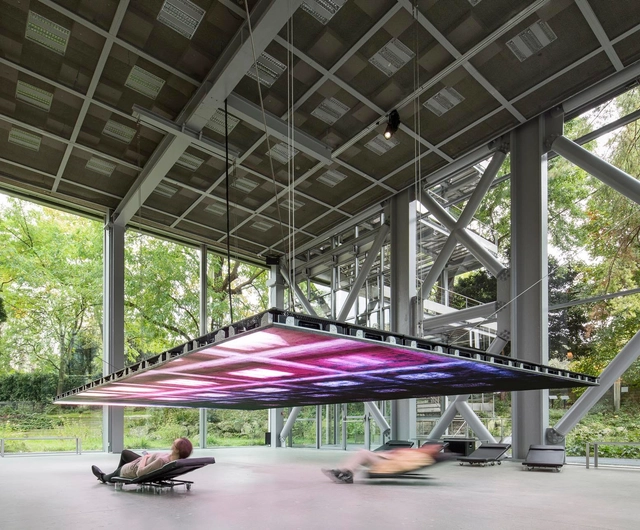
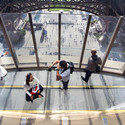
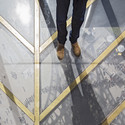
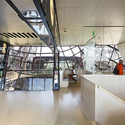
In celebration of the Fondation Cartier pour l’art contemporain’s 30th anniversary, Diller Scofidio + Renfro has installed an immersive exhibition that encourages visitors to experience the Jean Nouvel-designed, glass and steel museum building in an entirely new way.
“The Fondation Cartier building designed by Jean Nouvel will be used as raw material for their work, a first in the history of the institution. Musings on a Glass Box is a complex work occupying the entire ground floor of the Fondation Cartier, where a disturbance in the ceiling will trigger a surprising reaction. The result is an immersive environment, including an integral acoustic component by American composer David Lang and sound designer Jody Elff, that works with the building’s architecture to raise questions about transparency, perception, and one’s relation to space.”




_Philippe_Ruault.jpg?1417047358&format=webp&width=640&height=580)
_Philippe_Ruault.jpg?1417047291 "© Philippe Ruault")
_Philippe_Ruault.jpg?1417047344 "© Philippe Ruault")
_Philippe_Ruault.jpg?1417047324 "© Philippe Ruault")
_Philippe_Ruault.jpg?1417047275 "© Philippe Ruault")
_Philippe_Ruault.jpg?1417047358)
.jpg?1415937638&format=webp&width=640&height=580)
.jpg?1415937580 "© Francesco Mattuzzi")
.jpg?1415937827 "© Francesco Mattuzzi")
-(1).jpg?1415938058 "© Francesco Mattuzzi")
.jpg?1415937957 "© Francesco Mattuzzi")
.jpg?1415937638)