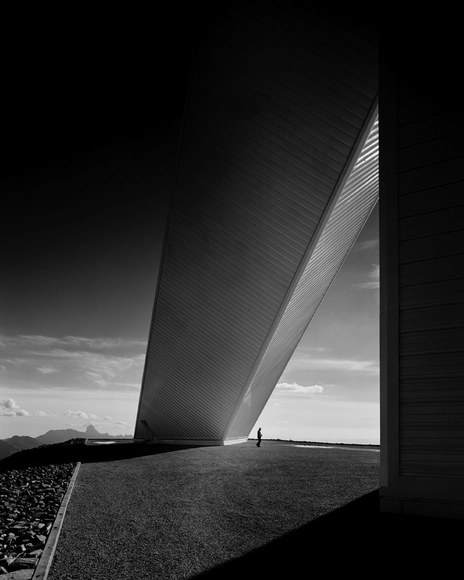
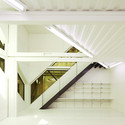
Now on view at the Yossi Milo Gallery through March 2, rarely-seen images by modernist architectural photographer Ezra Stroller (American, 1915-2004) captures a Post-War American landscape with stunning images of industry, technology, transportation and working class Americans.
Beyond Architecture covers the full range of Stoller’s work, including photographs commissioned by Fortune, Architectural Forum, and House Beautiful magazines in the 1940s and for commercial projects for IBM, Upjohn Pharmaceuticals and CBS in the 1940s and 1950s. Included are photographs of Skidmore, Owings & Merrill’s John Hancock Building, Chicago, and the United Nations Headquarters, designed by an international team of architects led by Wallace K. Harrison and including Oscar Niemeyer and Le Corbusier.
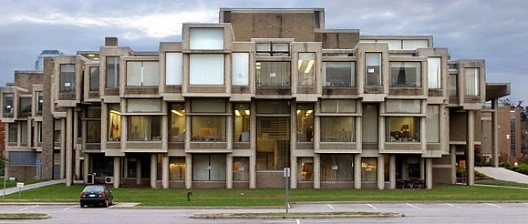
Although preservationists continue to mourn the seemingly inevitable demise of Chicago’s Prentice Women’s Hospital, a solid victory for Brutalism has finally been confirmed. Lawmakers in Goshen, New York, have passed a proposal to renovate Paul Rudolph’s iconic Orange County Government Center, authorizing $10 million in design funding. The 15-6 vote was secured by the overwhelming evidence that an upgrade would be more cost effect than County Executive Ed Diana’s fallback plan to replace two-thirds of the building and preserving only the court section. In addition, lawmakers felt the pressure of a March 12 deadline that would risk losing up to $2.7 million in federal funds to repair water damage caused by Hurricane Irene and Tropical Storm Lee in 2011.
Just in time for Valentine's Day, Situ Studio has unveiled the fifth edition of Times Square’s annual Heartwalk installation - a heart-shaped “room within the city” made of salvaged Sandy debris. Inspired by the “collective experience of Hurricane Sandy and the love that binds people together during trying times,” Heartwalk begins as two weathered ribbons of wooden planks that gradually lift to form an illuminated heart enclosure in the middle of Duffy Square.
People are already falling in love, as you can see Instagram's #heartwalktsq is filling up with images of elated New Yorkers standing within the “heart of New York City”.
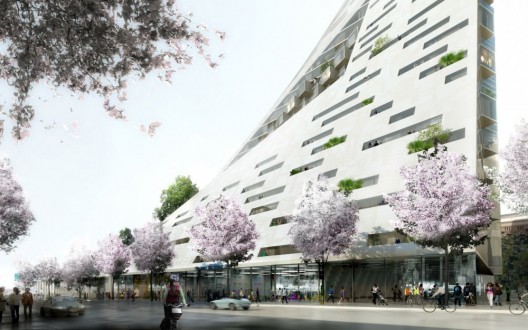
After an “arduous” public review and a heated debate over affordable housing, New York’s City Council has unanimously awarded final approval to BIG’s tetrahedral-shaped West 57th apartment building in Manhattan. As reported by Crain’s New York Business, a compromise has been made to include 173 affordable housing units within the 32-story, 750-unit residential building and the neighboring industrial building that will be converted into 100 additional rental apartments. As you may recall, the community board and Councilwoman Gail Brewer initially threatened to “torpedo the project” if the apartments were only made affordable for a 35 year period. However, Durst apparently won them over by contributing one million dollars into an affordable housing fund.
"The good news, which is the matra of my office and community board No. 4, is there will be, yes, by law, 35 years of income-restricted affordable housing," stated City Councilwoman Brewer, who represents the area.
When applying “major surgery” to a beloved, 20th century “masterpiece”, you’re going to face some harsh criticism. Such is the case for Norman Foster, as the legendary British architect has been receiving intense backlash from New York’s toughest critics for his proposed renovation to the New York Public Library. First, the late Ada Louise Huxtable exclaimed, “You don’t “update” a masterpiece.” Now, the New York Time’s architecture critic Michael Kimmelman claims the design is “not worthy” of Foster and believes the rising budget to be suspect.
More on Kimmelman's critique and Foster’s response after the break...
Organized by Christopher Marcinkoski and Javier Arpa, in cooperation with the Architectural League of New York, ‘The City That Never Was’ symposium will be taking place Friday, February 22, from 9:00am-5:30pm EST at the Scholastic Building in New York. The one day event will use the current economic and housing crisis in Spain as a lens to reconsider how planners, designers, politicians, and financiers conceive of and realize large-scale contemporary urbanization and settlement. It will be organized through four primary themes — infrastructure, waste, landscape, and instant urbanism – in order to explore new possibilities for how future patterns of urbanization can be conceived, financed, planned, deployed, and inhabited. For more details, including the complete itinerary and speaker information, please visit here.
With many museums worldwide seeking to extend, to accommodate larger collections, Athens-based Oiio Architecture Office have asked: “What if we decided we needed a little more of Guggenheim?”
Their solution is to stretch Frank Lloyd Wright’s original building skywards, by continuing its iconic ramp, creating an additional 13 floors.
Martin Barry, founder and director of reSITE in Prague and associate at W Architecture and Landscape Architecture in New York, will give an evening lecture at 6:30pm EST on February 7th. Taking place at the NYU Silver Center, his lecture will focus on how organization is advocating for more transparent, contemporary and sustainable urban planning in Czech cities. Martin will discuss the outcomes of reSITE 2012 and describe their plans for reSITE Festival and Conference to take place in June 2013. The event is presented by NYU Department of Art History & Urban Design and Architecture Studies with Czech House NYU. For more information, please visit here.
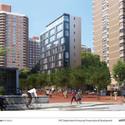
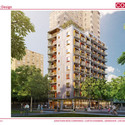
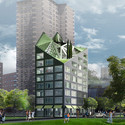
In an effort to address housing concerns throughout the city, New York City held the adAPT NYC Competition in search for a micro-unit apartment building that would be developed into a new housing model for the "small household population". The winner and five finalists were announced earlier this week, revealing a sharp focus on consolidating various living areas to save space and resolving to give multi-functionality where ever possible. There is also an emphasis on community in each of the proposals, making up for the small units with more public amenities within the building. Join us after the break to take a closer look at the projects.
New York City Mayor Michael Bloomberg has announced the winner of adAPT NYC - a city-sponsored competition that challenged developer-led teams to design an innovative micro-apartment that responds to 21st century housing problems. With an all time high of 8.4 million people, and an expected million more by 2030, New York City’s shortfall of affordable one and two person apartments is continuing to grow at a staggering rate. In an effort to solve this imbalance, the winner of adAPT NYC will build an experimental project on a piece of city-owned land in Kips Bay, Manhattan, that has been alleviated from the 1987 density restriction that requires all new apartments to be greater than 400 square feet.
“The growth rate for one- and two-person households greatly exceeds that of households with three or more people, and addressing that housing challenge requires us to think creatively and beyond our current regulations,” said Bloomberg.
The Museum of Modern Art and MoMA PS1 has selected CODA’s (Caroline O’Donnell, Ithaca, NY) large-scale, self-supporting Party Wall, made from leftover shreds of skateboard material, as winner of the 2013 Young Architects Program (YAP). Drawn from five finalists, the porous skin of CODA’s temporary urban landscape will shade visitors of the Warm Up Summer Music series with its reclaimed woven screen, while providing water in refreshing cooling stations and seating with its detachable wooden skin on the lower half of the linear structure.
Created and conceived by Patrick Duffy, the creative director of the OUT NYC, and designed by award-winning Italian designer and architect Antonio Pio Saracino, the Arches of Hope installation will be launched at its opening reception on Thursday, January 17, from 6:30pm-8:30pm at the OUT NYC and be on display until January 24. In collaboration with Lifebeat: Music Fights HIV/AIDS and the MTV Staying Alive Foundation, the stunning and inspiring interactive art installation will be unveiled on the eve of President Obama’s second inauguration as part of a multi-faceted campaign aimed at raising awareness of the rise of HIV and AIDS in young people. More images and information after the break.
Taking place February 1-2 at Abby and Howard Milstein Auditorium, Milstein Hall at Cornell University, the Design for Biodiversity Symposium will focus on the extended threshold between building and environment. Since its emergence in the 1970s, the field of Urban Ecology has investigated relations between living organisms and their urban environments, and has primarily addressed the city at the scale of urban planning. Within this framework, architecture, at the building scale, has thus far not been extensively tackled. How might architecture actively support multi-species habitats? Can these habitats help us replace existing, fossil fuel dependent, mechanistic systems with low impact, ecologically integrated systems that leverage natural sources? How does reimagining the city in this way change how we think about urban form and phenomenology? And finally, what are the appropriate models to study? These questions will be answered at the event and more. For more information, please visit here.
New York’s Garment District, consisting of 18 blocks in the west side of midtown, was the city’s most well known industries in the boom of the 1920s through the early 50s. The influx of immigrants and the geography of New York City made it a natural hub for manufacturing and trading activity. The work began in small workshops and at home in crowded tenements and eventually grew out of these crammed space into factories and warehouses. The industry inadvertently transformed Seventh Avenue into rows of skyscraper factories that faithfully abided to New York City’s zoning regulations. The 125 loft buildings all shared the pyramidal forms due to step-back laws governing design.
Now, The Skyscraper Museum in New York City is celebrating this neighborhood and its influential development of business, industry and architecture and the mark that it left on the city with an exhibition called URBAN FABRIC. It is curated by Andrew S Dolkart, the Director of the Historic Preservation Program, and will be running through February 17th.
Learn more and watch the curator’s lecture after the break.
When plans for the High Line were first revealed it made quite an impression on the design community. The converted elevated rail line, long abandoned by New York City, was threatened by demolition until a group of activists fought for its revival and helped transform it into one of the most renowned public spaces in Manhattan. Now Queens, a borough with its own abandoned infrastructure is on its way to redeveloping the land for its own version of the High Line, to be known as the Queensway Cultural Gateway.
In late December, the Trust for Public Land announced that New York Governor Andrew Cuomo has awarded a $467,000 grant to the organization to begin a feasibility study on the 3.5 mile Long Island rail line. Early proposals reveal a new pedestrian and bike path, public green space and a cultural gateway that will celebrate Queens’ diversity in art, sculpture and food, serving the 250,000 residents that live in the neighborhoods along the route, which include Rego Park, Forest Hills, Richmond Hill, Ozone Park and Forest Park.
In response an outrage that broke out amongst Democrats and Republicans, after House Speaker John Boehner failed to vote for Sandy relief before the end of the Congressional session two days ago, the House of Representatives have approved a $9.7 billion relief measure to aid flood victims of Hurricane Sandy. This is good news, as the Federal Emergency Management Agency’s (FEMA) recently warned that it would soon run out of funding if no measures were taken. Senate approval is likely to come later in the day and a second congressional vote is scheduled to take place on January 15 for a larger $51 billion request.
Understanding the importance of issuing this federal support, AIA President Mickey Jacob has offer Congress three key objects for helping these communities recover.
Read AIA President Jacob’s letter to congress and his three objectives after the break…