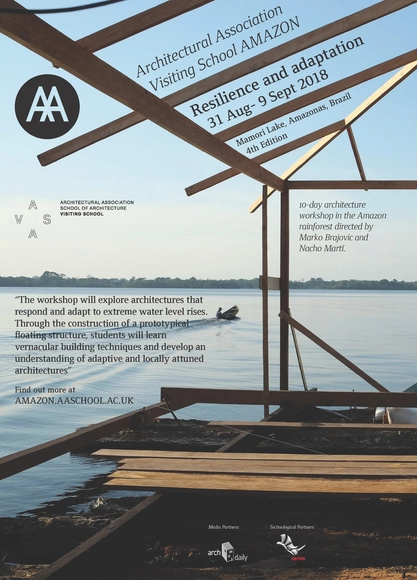
The Architectural Association Visiting School Amazon is organising for the fourth consecutive year a workshop in the Brazilian Amazon rainforest open to design and architecture students and professionals in which an experimental floating structure will be designed and constructed in collaboration with Atelier Marko Brajovic and Ecofloat.
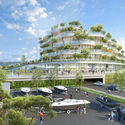
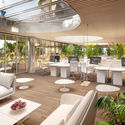
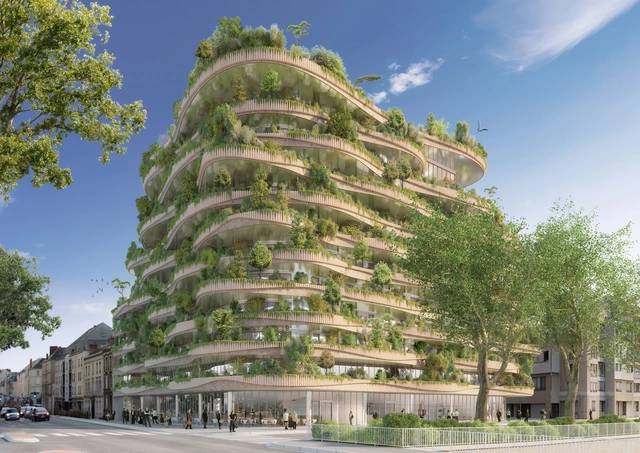
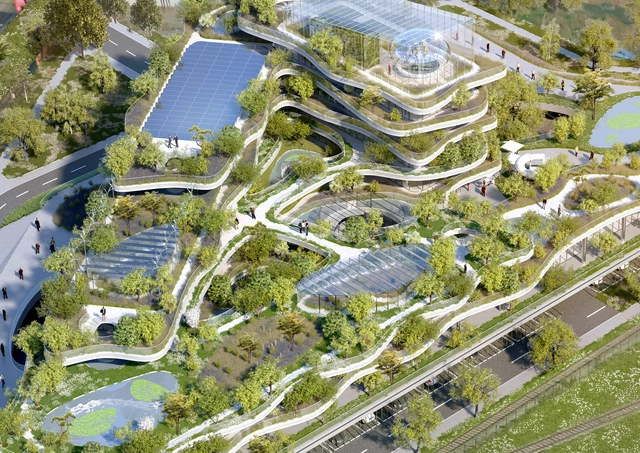
For the "Imagine Angers"international design competition, Vincent Callebaut Architectures worked in collaboration with Bouygues Immobilier group to submit a proposal for the French city at the intersection of social and technological innovation, with a focus on ecology and hospitality. Named Arboricole, meaning “tree” and “cultivation,” this live-work-play environment gives back as much to the environment as it does its users. Although WY-TO prevailed in the competition, the Callebaut scheme succeeded in winning the public vote.
It’s the holy grail for any biomimicry design futurist: buildings and structures that use generative geometry to assemble and repair themselves, grow, and evolve all on their own. Buildings that grow like trees, assembling their matter through something like genomic instructions encoded in the material itself.
To get there, architecture alone won’t cut it. And as such, one designer, Haresh Lalvani, is among the most successful at researching this fundamental revision of architecture and fabrication. (Or is it “creation and evolution”?) He employs a wildly interdisciplinary range of tools to further this inquiry: biology; mathematics; computer science; and, most notably, art.
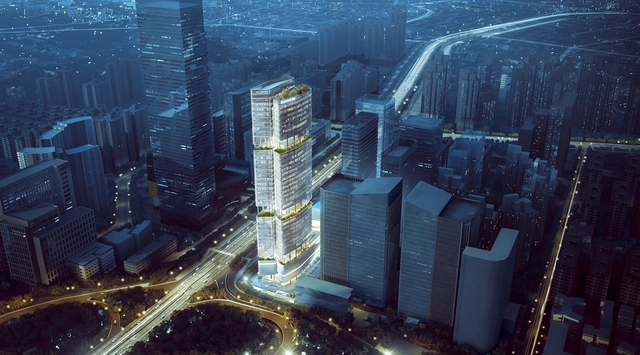
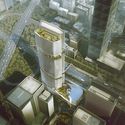
Aedas has released its design for Gmond International Building, a representative regeneration project located in the old town area of Shenzhen, China. The 200-meter super high-rise building is inspired by the traditional form of Chinese totem bamboo, which symbolizes prosperity and moral integrity.
With nearly 60,000 square meters of gross floor area, the building will house the headquarters for Tellus-Gmond, Grade 5A lettable office spaces, and a jewelry-trading center.
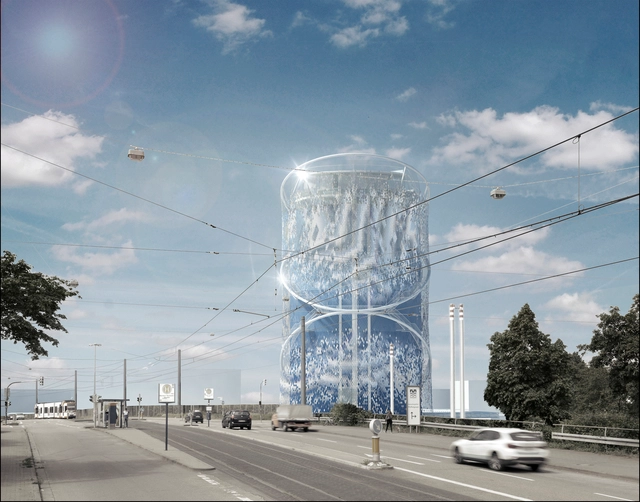
LAVA (Laboratory for Visionary Architecture) has won the competition to redesign an energy park and energy storage building in Heidelberg, Germany, for the Stadtwerke Heidelberg. Currently a cylindrically shaped storage center, the space will be transformed into a dynamic sculpture, city icon, and knowledge hub for sustainable energy, fully accessible to the public with city views.
In order to display the concepts of energy transition, decentralization, networking, flexibility and adaptability, the project will feature a multi-layered façade structure inspired by geometries in nature like leaves, spider webs, and reptile skins. “The result is a dynamic, ever-changing surface of light and shadow, animated by wind, turning the building into a beacon of a dynamic new energy regime.”
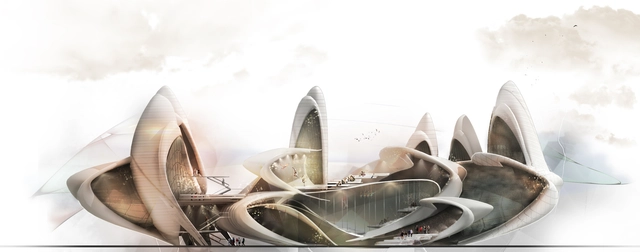
The winning proposal, entitled Elytra, is an “eye-catching, cutting-edge, [and] unconventional” design that will tower over Moscow’s Tverskoy District, an area which features a burgeoning artistic scene.
Inspired by the forewings of insects—called elytra—the project opens upwards as a protective shell, and will feature both public and private space.
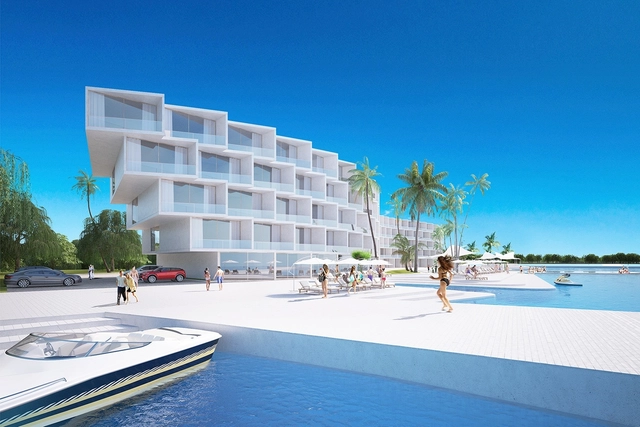
Architects of Invention has unveiled their design for the Coral Holiday Apartments, an upscale lifestyle community in Seychelles, an archipelago in the Indian Ocean off the coast of East Africa. Located on the reclaimed portion of the main island of Seychelles, the project will feature professionally serviced apartments, a spa, several restaurants, a clubhouse, a pool, private marina and direct access to the beach.
Have you ever seen a building that breathes through thousands of pores? That may now be a possibility thanks to Tobias Becker’s Breathing Skins Project. Based on the concept of biomimicry, the technology is inspired by organic skins that adjust their permeability to control the necessary flow of light, matter and temperature between the inside and the outside. In addition to these performative benefits, the constantly changing appearance of these façades provides a rich interplay between the exterior natural environment and interior living spaces.
In a recent article published by the Financial Times, architect and public speaker Michael Pawlyn delves into how biomimicry can be applied to architecture in order to solve design problems and create a more sustainable future. Even in very early examples, biomimicry has been critical in the development of architecture, for example when Filippo Brunelleschi studied eggshells to create a thinner and lighter dome for his cathedral in Florence. In a modern example, biomimicry has been utilized—through the examination of termite mounds—to create cool environments without air conditioning in warm climates such as in Zimbabwe.
The Victoria and Albert Museum has unveiled its latest installation: the Elytra Filament Pavilion, a project displaying the culmination of four years of research on the integration of architecture, engineering, and biomimicry principles, in an exploration of how biological fiber systems can be transferred to architecture.
The 200-square-meter structure is inspired by lightweight construction principles found in nature, namely "the fibrous structures of the forewing shells of flying beetles known as elytra," states a press release.
Israel has unveiled its theme for the 2016 Venice Biennale: “LifeObject: Merging Architecture and Biology”. Their pavilion will be comprised of a large-scale sculptural installation and seven speculative architectural scenarios relating to Israel. The exhibition will focus on the relationship between biology and architecture, acting as a “research oriented platform.”
From bricks grown from bacteria to cement derived from the reef building process of coral, biomimicry has taken the world by storm. A collection of products inspired by this phenomenon are showcased in Bloomberg’s article “14 Smart Inventions Inspired by Nature: Biomimicry,” ranging from transportation breakthroughs to ingenious feats of engineering. Read on after the break for two highlighted architectural inventions inspired by the natural world.
Antarctic icebergs morph into a sprawling multi-functional hub for research, transport and accommodation in one of the latest projects to come out of Zaha Hadid's Studio at the University of Applied Arts in Vienna. Designed by architecture student Sergiu-Radu Pop, the project hypothesizes a point of arrival for the world's final frontier of development. The project employs biomimicry as a primary design tool, replicating the jagged asymmetrical edges of ice formations along the coast of the southern ocean.
Enter the Transformable Antarctic Research Facility with more photos and info after the break
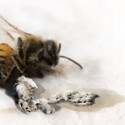
Biomimicry is quickly emerging as one of the next architectural frontiers. New manufacturing processes such as 3D printing, coupled with the drive to make buildings more environmentally sustainable, have led to a wave of projects that are derived from natural phenomena or even constructed with biological materials. A recent example of this trend is “Hy-Fi,” this summer’s MoMA PS1 design that is constructed of organic and compostable eco-bricks. Other projects such as MIT Media Lab’s Silk Pavilion have taken biological innovation a step further by actually using a biometric construction processes - around 6,500 silkworms wove the Silk Pavilion's membrane. “Animal Printheads,” as Geoff Manaugh calls them in his article "Architecture-By-Bee and Other Animal Printheads," have already proven to be a viable part of the manufacturing process in art, and perhaps in the future, the built environment as well. But what happens when humans engineer animals to 3D print other materials?
Material Minds, presented by ArchDaily Materials, is our new series of short interviews with architects, designers, scientists, and others who use architectural materials in innovative ways. Enjoy!
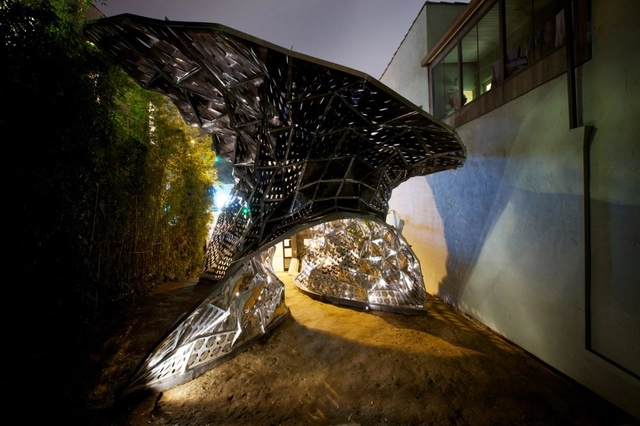
Before attending Columbia University for her Masters in Architecture, Los Angeles-based architect Doris Kim Sung took a fairly non-traditional approach to becoming an architect: she was a biologist. Naturally then, Sung’s architectural work tends to take inspiration from the biological world, particularly in the way she experiments and innovates with materials. Much of her work involves thermal bimetals, a material that expands and contracts with temperature swings; it can even act as a sun shade and ventilation system, without the need for electricity.
So where does a biologist-turned-architect draw inspiration from? We interviewed Ms. Sung to find out for ourselves -- the responses, like her work at dO|Su Architecture, are simply fascinating.
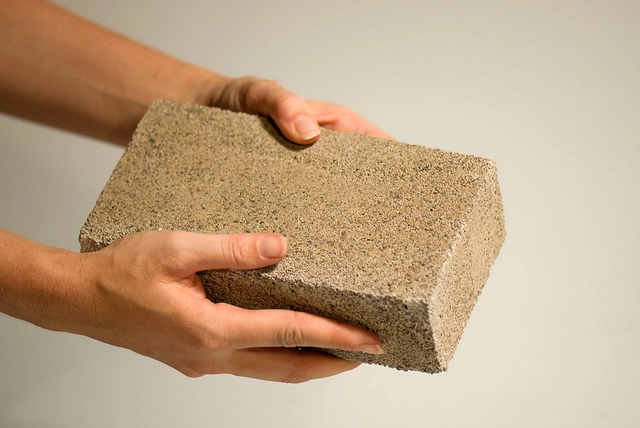
A unique biotechnology start-up company have developed a method of growing bricks from nothing more than bacteria and naturally abundant materials. Having recently won first place in the Cradle to Cradle Product Innovation Challenge, bioMason has developed a method of growing materials by employing microorganisms. Arguing that the four traditional building materials - concrete, glass, steel and wood - both contain a significant level of embodied energy and heavily rely on limited natural resources, their answer is in high strength natural biological cements (such as coral) that can be used "without negative impacts to the surrounding environment."
"Our research integrates computational form-finding strategies with biologically inspired fabrication", claims the 'about' page of MIT Media Lab's Mediated Matter Group. Though this may sound like run-of-the-mill architectural boasting, you are unlikely to find any more exemplary combination of scientific research, digital design and biomimetic construction than their recently completed Silk Pavilion.