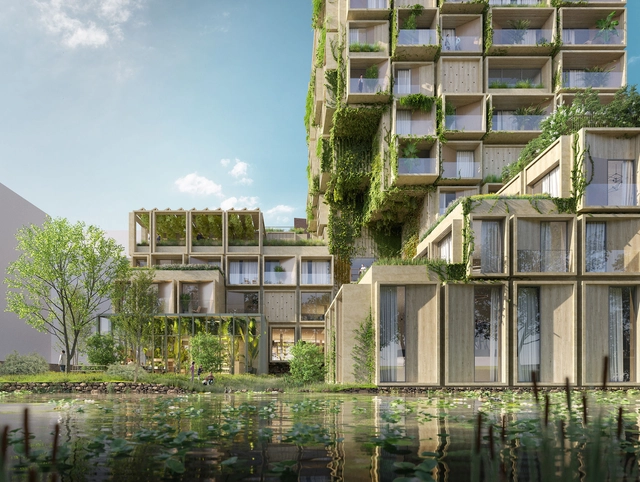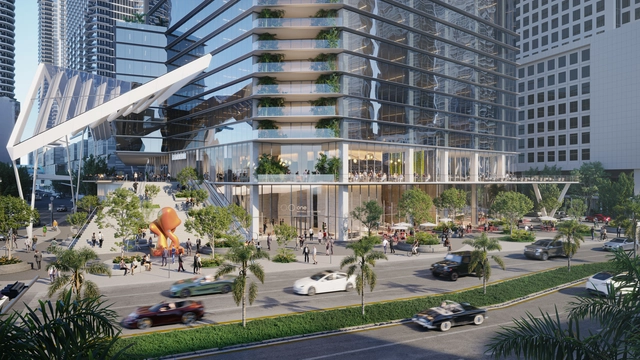
UNStudio revealed a mixed-use high-rise building design in Dusseldorf integrated within the new Belsenpark masterplan. The tower, designed in collaboration with OKRA Landscape Architects, results from an international architecture competition held by private developer Pandion and features a diverse ground floor programme tied together by a pocket park. The project integrates prefabrication and modular design, thus reducing the building's environmental impact.
A carbon neutral building is achieved when the amount of CO2 emissions is balanced by climate-positive initiatives so that the net carbon footprint over time is zero. Considering their unmatched ability to absorb CO2, planting trees is often viewed as the best carbon offsetting solution. But as cities become denser and the amount of available horizontal space for green areas drastically reduces, architects have been forced to explore other approaches. Therefore, to address these climatic challenges and connect people to nature, exterior green walls have become a rising trend in increasingly vertical cities. Even if there is research to claim that these can positively impact the environment, many question if they can actually contribute to a carbon neutral architecture. Although the answer may be quite complex, there seems to be a consensus: green walls can be effective, but only through good design.
Ray working on a model for the Billy and Audrey Wilder House in 1950 (unbuilt).. Image Courtesy of Eames Office
On the heels of the Eames Office’s 80th anniversary marked by an exhibition and a Ray-inspired sneaker, director Eames Demetrios spoke to Metropolis about the matriarch who continues to inspire design.
Despite being the smallest rooms of houses, bathrooms have always been one of the most challenging and critical to design, which often left them fairly simplified. The past few years, however, saw these spaces undergo significant change; what was once only limited to functionality, ease of maintenance, and privacy, is now being given a strong character with pops of color, classic fixtures, and patterned surfaces. Similarly for public bathrooms, where "functionality" and "ease of maintenance" are now complimented with aesthetics, technology, and high quality finishing. In this interior focus, we explore the three main bathroom typologies used in residential projects, and look at how architects have employed them through 12 examples.
Architecture firm HKS and landscape designer Hood Design Studio have been selected by global entertainment and media company CMNTY Culture to design a new creative campus in the heart of Hollywood. Dubbed CMNTY Culture Campus, the project will feature production spaces, offices, performance venues, bringing together creative industries in a 500,000-square-foot development.
The upcoming exhibition in The Architect's Studio series hosted by the Louisiana Museum of Modern Art presents the work of Forensic Architecture, a multidisciplinary research group operating at the intersection of architecture and investigative journalism. Led by architect Eyal Weizman, the collective of architects, artists, software developers, journalists, lawyers, and animators investigates and documents human rights violations across a wide range of global conflicts.The practice constructs models and virtual spaces to share a new perspective on specific events.
Biblioteca Jose Vasconcelos / Taller de Arquitectura X / Alberto Kalach. Image Cortesía de Taller de Arquitectura X / Alberto Kalach
Over the years, interior design has evolved according to the needs that arise, but above all according to the experiences we seek to provoke in the user. In the last two years, we witnessed a radical change and a particular interest in this subject because the pandemic forced us to pay specific attention to the configuration of the places we inhabit. This brought about much more holistic designs that cater to the wellbeing of the user, combining colours, sensory experiences, technology and natural elements that promote health.
For centuries and centuries we’ve built – and the diversity in our global built environment is a testament to that. The many different cultures around the globe have had different ways of building throughout history, adapting locally found materials to construct their structures. Today, in our globalized present, building materials are transported across the globe far from their origins, a situation that means two buildings on completely opposites sides of the world can be more or less identical.
Tragedy, protest, insurrection, and political turmoil have led to a renewed awareness of racial injustice and democratic instability. These issues create new challenges for users and designers of public spaces in America. Cultural spasms have resulted in contested public spaces — sites of killings, protests in streets and parks, and forgotten burial grounds. These spaces need a new form of environmental justice.
Under the latest round of NYC's Department of Design and Construction (DDC) Project Excellence Program, Commissioner Thomas Foley has announced that the agency has selected 20 firms to provide architectural design services for New York City’s future public buildings project. 10 of the selected firms are certified Minority- and Women-Owned Business Enterprises (M/WBEs), meeting the city’s ambitious goals of supporting M/WBEs and increasing its ability to generate culturally competent designs.
Martin Benavidez founded Ben-Avid in 2018, an architectural practice he runs from Córdoba, Argentina, where he develops national and international architectural projects of various scales and complexities.
His projects are commercial spaces, galleries and exhibition pavilions, urban and metropolitan transport infrastructure, among others. They are collaborative and tell stories. It is architecture that has a narrative. His Pavilion for Expo 2020 Dubai together with MMBB Arquitetos and JPG.ARQ is one of his most recent projects. Its protagonists are the waters of Brazil: its rivers and mangroves, a natural heritage that underlies the whole discourse on the sustainability of the planet.
Selected by ArchDaily as one of the Best New Practices of 2021, we conducted the following interview with Martin to tell us more in detail about all his inspirations, motivations, work processes and upcoming projects.
Paris has been making headlines for years with its aggressive steps to anti-car, pro-pedestrian urban improvements. Faced with increasing issues around air pollution and an attempt to reclaim streets for alternate modes of transit, as outlined in their proposed plan for a 15-minute city, the French capital is seen as a leader in future-forward urbanist strategies. Recently, their department of transportation set a deadline for their lofty goals of eliminating traffic from its roads. In just two years from now, in time for the French capital to host the Olympics, Paris plans to ban non-essential traffic from its city center, effectively eliminating around 50% of vehicular mobility. What does this plan look like? And how might other cities use this strategy to eliminate their own urban issues?
The election of Kéré is not only symbolic in a time of identity demands, where the institutions that make up the mainstream are required to more faithfully represent the social, cultural, and sexual realities that make up our societies, but it also confirms the recent approach of the Pritzker Prize jury.
The 60th edition of Salone del Mobile.Milano 2022, which will take place from the 7th till the 12th of June 2022 at the Fiera Milano Rho, is reflecting on the ongoing ecological transition of the design world, with a mission to "demonstrate that it is both possible and crucial to start embedding sustainability and environmental awareness into furniture production". More than 2,000 exhibitors, including over 600 young designers under the age of 35, will express their own identities and creative freedom, using the exhibition space as both an architectural and communication element with sustainability and ecology as main criteria.


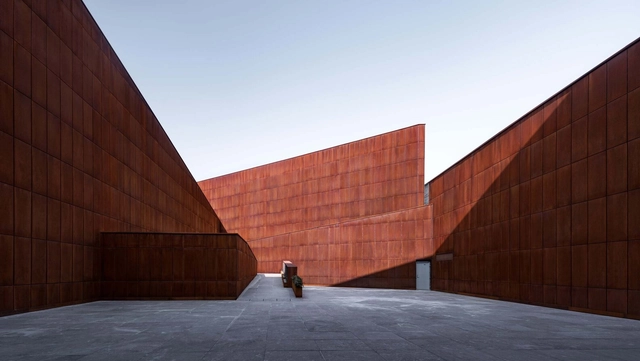
Aedes Architecture Forum recently inaugurated the "Jinyun Quarries – The Quarry as Stage" exhibition, which showcases the transformation of abandoned stone quarries in the Zhejiang Province, China, into a platform for cultural and social activities. Beijing architect Xu Tiantian and the team of DnA_Design and Architecture were tasked with developing a new public infrastructure inside nine of the mines in Jinyun County, thus opening up new economic perspectives for the local people. Running until May 5th, the exhibition highlights the extraordinary spatiality of the stone quarries while communicating the complexity of the structures through a series of models, plans and photographs of the interventions.
Based in São Paulo, Atelier Marko Brajovic was founded in 2006 by architect Marko Brajovic. With a multidisciplinary practice, the idea of the hybrid manifests itself as the conceptual north of the office that operates on several fronts: architecture, scenography, expography, creative direction, interior and product design. With a vast language that explores different areas, formats and aesthetics, its projects are, above all, recognized for breaking with the modern canon and seeking solutions in nature.
Balconies provide residents with great views while literally and figuratively looking down on the neighbors, but they also offer numerous other advantages.