Landscape architect, James Corner, has a way of not only designing captivating landscapes, but making places where people want to be. While thousands have experienced his transformation of New York’s industrial rail line, Corner’s impact is also evident in major metropolises on an international level as his competition entries and built work inspire a sense of urban renewal and restore confidence in their settings. In fact, Fast Company has recently named James Corner Field Operations as one of 50 most innovative companies of the world for “creating intimate green spaces out of industrial urban blight.”
Since 2007, controversy has been stirring due to the rising costs and delayed schedule of Herzog & de Meuron’s Elbphilharmonie concert hall in Hamburg, Germany. Recent reports state the court has approved the city of Hamburg’s €40 million lawsuit against the primary contractor HochTief, who has stopped working in four areas of the €600 million project this past November. HochTief blames the architect due to differences in its plans.
When the statistics showed architecture as the field of study where recent graduates had the highest unemployment rate, some suggested that future students ought to pursue different educational backgrounds. Courtney Lukitschhas shared her response to such a claim by defending the merits of an architecture education. ArchDaily reaches a wide range of readers – from established professions to students just entering the field – and we’d like to hear your thoughts on the value of pursuing an architecture education.
“Recently published reports about education degrees ‘not to pursue’ in architecture, design and art, made the rounds in the national press and A&D industry, raising eyebrows and demanding closer scrutiny. Needless to say, this news spread like wildfire on social platforms such as Facebook and twitter, oddly to scant commentary among top-tier critics, academics and educators, architects and designers, a decidedly vocal and opinionated group of incredibly well educated professionals.”
Read the rest of Lukitsch’s article after the break.
Many of you may have probably noticed Scott Timberg’s article “The Architecture Meltdown” (Salon, February 4, 2012) circling the internet. The gloomy article discusses the unknowing future and possible demise of the architectural profession – the “glamour profession of the creative class”. Timberg describes struggling professionals that are either unemployed or working full-time at intern wages within a profession that is largely focused on the 1 percent.
There is no doubt that many architects and recent graduates are struggling. Architecture succeeded with the economy and crashed with it as well. With statistics revealing the highest unemployment rates among those with bachelor’s degrees in architecture and articles flooding the internet with titles “Want a Job? Go to College, and Don’t Major in Architecture” (New York Times, January 5th, 2012), there is not doubt that people are scared and unsure of where the profession is heading. Meanwhile, the (AIA) is cheering for a “2.1 percent rise in spending this year for non-residential construction projects”, a bit of optimism many are grasping onto for hope. However, we are headed somewhere. As Timberg states, “People will always need houses, cities and nations will always need schools and libraries and civic buildings, and trendy restaurants will need redesigns. Architecture will never die completely.”
Please continue reading to see Thomas Fisher’s response to Scott Timberg.
Just last week, Mayor Bloomberg and City Council Speaker Christine Quinn enacted 29 new recommendations of the Green Codes Task Force that will provide the proper foundation for New York to meet the aggressive PlanNYC Goals for 2030. The impact of these new codes is estimated to reduce greenhouse gas emissions by 5 percent; lower the energy costs for lighting by 10 percent; save 30 billion gallons of water through better plumbing regulations; treat 15 million gallons of toxic construction water; recycle 100,000 tons of asphalt; and save $400 million in overall energy costs. The implementation of such codes is the result of the formation of the NYC Green Codes Task Force, an organization led by Urban Green Council, that proposed over 100 recommendations in 2010 to address a wide range of sustainable issues; and, in the two years since that report, the Mayor’s Office and City Council have made 29 of those recommendations law, and are currently working to codify 8 others.
More about the new building codes after the break.
Ever wonder why the skyline of Los Angeles is peppered with flat top skyscrapers? Or for that matter, why does such a global cosmopolitan city have so relatively few skyscrapers dotting its cityscape, the majority residing in downtown LA?
The answer lies in a section of the Los Angeles Municipal Code introduced in 1974 – Sec. 57.118.12 – “Emergency Helicopter Landing Facility.” The code stipulates that “Each building shall have a rooftop emergency helicopter landing facility in a location approved by the Chief.” The text also dictates that the helipads measure 50′x50′ in addition to a 25′ safety buffer. The resulting skyline thus far has been dominated by flat roof skyscrapers that would only make it through the planning process if in strict accordance with this code. However, a newly introduced proposal called the Hollywood Community Plan would allow skyscrapers to be constructed along the subway served “Hollywood Corridor.” In lieu of embarking on a plan that would surely result in more box type towers, an amendment has been introduced into the plan that would exempt skyscrapers within the corridor from having to conform to Sec. 57.118.12 helipad requirements. More After the break.
European Union Climate Commissioner Connie Hedegaard urges world leaders attending the United Nations Conference on Sustainable Development in Rio de Janeiro this June to double the share of renewable energy they use by 2030 and give all citizens access to sustainable power.
BDOnline’s recent report Foster & Partners sees profits soars reveals that the firm has “posted a major rise in profits for the year ended April 30, 2011, with pre-tax profits of £10.9 million, up from £1.6 million.” Most of the firms work is said to come from Asia and China, as turnover at the practice is up to £159 million from £134 million.
Houston’s Museum of Fine Arts, the leading cultural institution of the region, has recently selected Steven Holl Architects to design a new museum building to support its collections, exhibitions, and various educational programs. After a comprehensive international competition, MFAH asked Steven Holl, Snøhetta, and Morphosis to develop site-specific concepts for the planned expansion. The jury unanimously chose Holl as his strong portfolio of built museums, such as the Nelson-Atkins Museum of Art and the recently finished Cité de l’Océan et du Surf, display a sense of elegance and clarity much desired by the MFAH.
The Preservation Green Lab at the National Trust for Historic Preservation has recently published their study The Greenest Building: Quantifying the Environmental Value of Building Reuse. Resolving many conflicted arguments, this study confirms that reusing and retrofitting existing buildings with an average level of energy performance almost always offers environmental savings over demolition and more energy-efficient new construction. The research provides the most comprehensive analysis to date of the potential environmental impact reductions associated with building reuse. The Preservation Green Lab utilizes Life Cycle Analysis (LCA) methodology to compare reuse and renovations with new construction over the course of a 75-year life span. Continue reading for more.
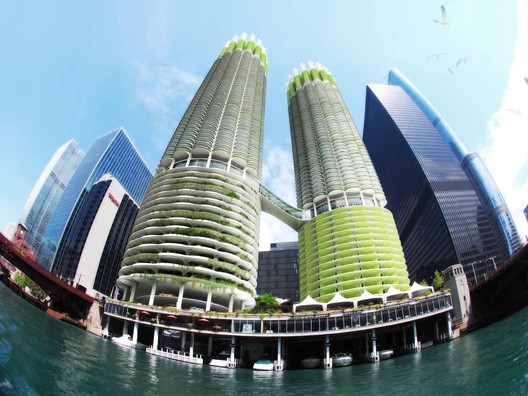
Starting tomorrow, the five design teams selected to redesign the outdoor spaces of Chicago’s Navy Pier will begin to reveal their schemes to the public. Lead by AECOM, Aedas Architects, James Corner Field Operations, !melk and the Xavier Vendrell Studio, each team will be given thirty minutes to present their ideas, followed by a ten minute question and answer session. The presentations will take place on January 31st and February 1st at the Museum of Contemporary Art. Continue reading for the presentation schedules and more information on the competition.
Every January the Council on Tall Buildings and Urban Habitat conducts a review of skyscraper construction and compiles all the data from the previous year. The trend since 2007 has seen record breaking years for buildings taller than 200 meters completed, with 88 skyscrapers completed in 2011. Even as the global economy is slowly recuperating from the 2008 financial crisis, it would appear as though this trend will remain relatively stable. China, leading the pack at 23 completed towers is predicted to remain at the forefront of skyscraper market, followed by Middle Eastern countries in the next decade. UAE, South Korea, and Panama City – an up and coming cosmopolitan city – rounded out the top four. Of the towers completed in 2011, 17 have made their way into the top 100 tallest buildings – Shenzhen’s Kingkey 100, at 442 meters crowning this year’s list. More after the break.
The AIA recently unveiled their 2012 legislative agenda, and has made it clear that creating jobs in the design and construction industry are a priority. We have been covering the numerous initiatives that the AIA has been implementing over the past year ranging from the Stalled Building Index, the regularly updated Architectural Billing Index and their update of the 2030 Commitment Reporting Tool. Of particular importance, especially for those of us who are running small firms or contemplating breaking into this fragile market as a sole proprietor, is an emphasis on fostering our growth. With the bulk of firms falling into this category – 95% of all firms in the US employ 50 or fewer people – this initiative should put some pressure on the political machine that has the authority to reign in the tax rates on small entrepreneurs and stimulate growth through the reevaluation of private sector lending. In tandem with this concerted effort by the AIA, it is practically imperative as a small business owner, that we take control and become much more fluid in an increasingly amorphous and uncertain environment. Whether it is by seeking out non-traditional design opportunities, or introducing new initiatives that are unique to your firm, we as a design community are certainly up to the task. (See Jennifer Kennedy’s recent article on the topic here.)
Watch Thomas Leeser of LEESER Architectureshare some insight into what architecture means and how his firm expresses that philosophy. One of our favorite lines is when Leeser stated, “We are not architects with a particular style; we are architects with a particular message.” The clip shares some background pertaining to Leeser’s Museum of Moving Image in Astoria, New York that exemplifies the firm’s idea of a changing continuous media surface and ties the conceptual understanding between film and architecture. What are your thoughts on Leeser’s closing comment when talking about the Bric media center and Urban Glass project – “Our work can influence and change the world around us, there is a really impact…it’s not just like another building” – perhaps, not just in terms of Leeser’s work, but for the field of architecture at large.
The Excavating Wilderness: A Orienting Trajectory Across Central Park proposal by Syracuse University graduate Jeff Kamuda investigates the tensioning between natural wilderness and the built environment. With the rise of modern civilization, a fluctuating tenet between humans and nature can be observed in its reincarnation of the urban park. Situated in New York City’s Central Park, the project introduces a set of natural phenomena through a unique and atypical approach, which in turn serves to stimulate a dialogue between the individual, the park, the city, and the cosmos. Stretching a mile across Central Park from Grand Army Plaza at 59th street to the American Museum of Natural History at 77th Street, the triparted project achieves a dramatic juxtaposition of subterranean experience combined with elevated architecture. Read more after the break.