
-
Architects: Steven Holl Architects: Steven Holl, Chris McVoy (design architect), Chris McVoy (partner in charge), Martin Cox, Richard Tobias (project architect), Masao Akiyoshi, Gabriela Barman-Kraemer, Matthias Blass, Molly Blieden, Elissavet Chryssochoides, Robert, Edmonds, Simone Giostra, Annette Goderbauer, Mimi Hoang, Makram El-Kadi, Edward Lalonde, Li Hu, Justin Korhammer, Linda Lee, Fabian Llonch, Stephen O'Dell, Irene Vogt, Urs Vogt, Christian Wassmann (project team)
- Area: 15329 m²
- Year: 2007
-
Manufacturers: Bendheim, Goppion, Lamberts, Tremco, Artexture+, Cricursa
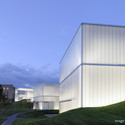
Text description provided by the architects. The expansion of The Nelson Atkins Museum of Art fuses architecture with landscape to create an experiential architecture that unfolds for visitors as it is perceived through each individual's movement through space and time. The new addition, named the Bloch Building, engages the existing sculpture garden, transforming the entire Museum site into the precinct of the visitor's experience. The new addition extends along the eastern edge of the campus, and is distinguished by five glass lenses, traversing from the existing building through the Sculpture Park to form new spaces and angles of vision. The innovative merging of landscape, architecture and art was executed through close collaboration with museum curators and artists, to achieve a dynamic and supportive relationship between art and architecture. As visitors move through the new addition, they will experience a flow between light, art, architecture and landscape, with views from one level to another, from inside to outside.

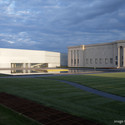
The threaded movement between the light-gathering lenses of the new addition weaves the new building with the landscape in a fluid dynamism based on a sensitive relationship to its context. Rather than an addition of a mass, the new elements exist in complementary contrast with the original 1933 classical "Temple to Art":

- Original Building New (in Complementary Contrast)
- Opaque Transparent
- Heavy Light
- Hermetic Meshing
- Inward views Views to landscape
- Bounded Unbounded
- Directed Circulation Open Circulation
- Single Mass Transparent lenses

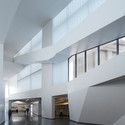
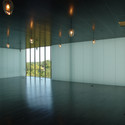
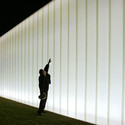
The first of the five "lenses" forms a bright and transparent lobby, with café, art library and bookstore, inviting the public into the Museum and encouraging movement via ramps toward the galleries as they progress downward into the garden. From the lobby a new cross-axis connects through to the original building's grand spaces. At night the glowing glass volume of the lobby provides an inviting transparency, drawing visitors to events and activities. The lenses' multiple layers of translucent glass gather, diffuse and refract light, at times materializing light like blocks of ice. During the day the lenses inject varying qualities of light into the galleries, while at night the sculpture garden glows with their internal light. The "meandering path" threaded between the lenses in the Sculpture Park has its sinuous complement in the open flow through the continuous level of galleries below. The galleries, organized in sequence to support the progression of the collections, gradually step down into the Park, and are punctuated by views into the landscape.

The design for the new addition utilizes sustainable building concepts; the sculpture garden continues up and over the gallery roofs, creating sculpture courts between the lenses, while also providing green roofs to achieve high insulation and control storm water. At the heart of the addition's lenses is a structural concept merged with a light and air distributor concept: "Breathing T's" transport light down into the galleries along their curved undersides while carrying the glass in suspension and providing a location for HVAC ducts. The double-glass cavities of the lenses gather sun-heated air in winter or exhaust it in summer. Optimum light levels for all types of art or media installations and seasonal flexibility requirements are ensured through the use of computer-controlled screens and of special translucent insulating material embedded in the glass cavities. A continuous service level basement below the galleries offers art delivery, storage and handling spaces, as well as flexible access to the "Breathing-Ts".

The ingenious integration of art and architecture included a collaborative effort with artist Walter De Maria, one of the great minimalist artists of our time. De Maria's sculpture, One Sun /34 Moons, is the centerpiece of the expansive granite-paved entrance plaza with a reflecting pool that forms a new entry space shaped by the existing building and the new Lobby "Lens". The "moons" of the art work are circular skylight discs in the bottom of the pool that project water-refracted light into the garage below. Conceived as a vehicular Arrival Hall, the garage is generously proportioned, directly connected to the new museum lobby on both levels, and spanned with continuous undulating vaults by an innovative pre-cast concrete ‘wave-T'.

A strong relationship between the architectural concept and the Museum's important oriental art holdings is illustrated by works in the permanent collection such as Verdant Mountains (12th century) by Chiang Shen or The North Sea (16th century) by Chou Ch'en, which demonstrate the timeless merging of art, architecture and landscape. The new addition celebrates this fusion with the new Isamu Noguchi Sculpture Court, setting a binding connection to the existing Sculpture Gardens.