Is it the perfect blend of sculpture and engineering, or it is a twisted form of nonsense? Opinions are quite varied on the subject of Anish Kapoor and Cecil Balmond’s observation tower, ArcelorMittal Orbit, which will serve as a permanent reminder of London’s hosting of the 2012 Olympic Games. The red steel structure will rise close to 400 feet – taller than New York’s Statue of Liberty and London’s Big Ben – to be Britain’s largest piece of public art. Criticized for undertaking such a massively expensive project during the country’s recession, London Mayor Boris Johnson has claimed that the Orbit will not only enhance visitors’ experiences at the Olympic Games but will also be “the right thing for the Stratford site” beyond the summer time, calling on its potential to become ”the perfect iconic cultural legacy”.
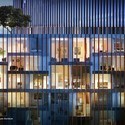
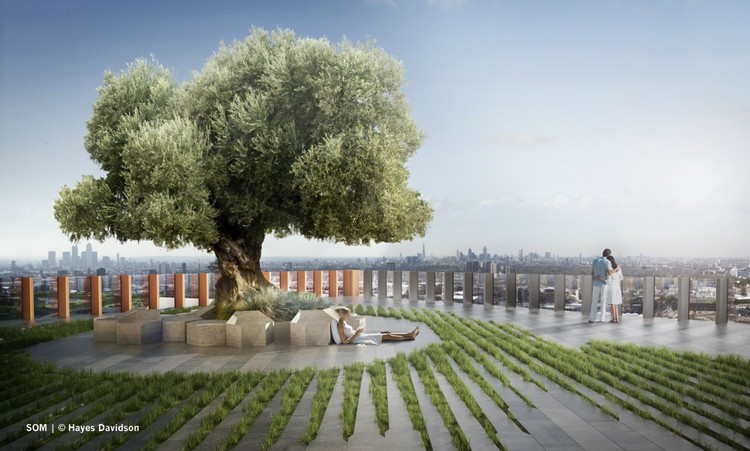
A triple height entrance lobby will welcome visitors to a world-class hotel, two restaurants, three sky gardens and a 248 unit residential tower, all with stunning views over Olympic Park. These are some of the key features offered in the newly unveiled plan for the 42-storey Manhattan Loft Gardens in London, designed by Skidmore, Owings & Merrill (SOM). It is planned to be built near the Stratford International Station – the gateway to the 2012 London Olympics. Completion is scheduled for 2014.
The days of carrying around rolls of construction documents on site are in flux. The rapid change of both software and hardware has already dramatically changed the way architects, engineers, and general contractors communicate with each other. For those of you who do site visits on a regular basis, you are no doubt familiar with the relatively drawn out process the contractor has to take in order to get clarification on a detail or problem distillation – taking pictures of detail, scanning redlines, emailing to architect, etc. However, what if, and it is happening, you can bring out an iPad or similar device with all the drawings loaded ready to view in palm of your hand. Questions can simply be marked up right on the spot and instantly fired off for review or approval.
Yesterday, the final steel beam rose 977 feet into the air and was placed atop 4 World Trade Center – the 72-story tower designed by Pritzker Prize-winning Japanese architect Fumihiko Maki. As gospel singer BeBe Winans sang “God Bless America”, the 8 ton beam, signed by all members of the team and adorned with an American flag, reached its final destination atop the city’s sixth tallest tower.
At over 80 years of age, Maki is making his New York debut in an elegant manner. The tower was designed to serve as a “respectful backdrop” to the National September 11 Memorial and not to compete with 1 World Trade. ”This is a special place with a sacred meaning and we felt we had to be respectful,” explained Osamu Sassa, Maki’s project architect, to The New York Times. Such a ideology offers a strong contrast with the other architectural statements that will eventually rise as part of the World Trade Center complex, such as Norman Foster’s 2 World Trade and Richard Roger’s 3 World Trade. While the minimalism of Maki may have kept the design under the radar during its design and construction stages, the grace of its simplicity will craft a dignified presence while visiting the site. ”The design of the tower at 150 Greenwich has two fundamental elements – a ‘minimalist’ tower that achieves an appropriate presence, quiet but with dignity, and a ‘podium’ that becomes a catalyst for activating the surrounding urban streetscape as part of the revitalization of lower Manhattan,” explained Maki.
Antoni Gaudí (1852 -1926), the Catalán architect best known for his whimsical style and his inimitable masterpiece, the still unfinished Sagrada Familia, would have turned a ripe 160 years old today.
The Green Building Council of Australia has released Green Star – a new comprehensive rating system that can assess the degree to which communities, as a whole, succeed in creating livable and sustainable environments. This is a new and dynamic way to look at the culture of sustainability. “Green building” is not only reflected in individual buildings; it is the accumulation of the buildings, the infrastructure, the urban planning and design, the amenities of the community and the lifestyles that communities live. Projects such as DIY Urbanism in the Netherlands by MVRDV and “e_co_llectiva” by Athanasios Polyzoidis & Katerina Petsiou have this kind of regard for the development of holistic community.
The New York Economic Development Corporation and Mayor Bloomberg of NYC announced the completion of the final plan for Willets Point - a peninsula on the Flushing River in Northern Queens, New York. The development of Willets Point is part of the urban renewal project associated with Citi Field – the Mets’ new stadium. Nicknamed the Iron Triangle, the project will include housing for mixed incomes, retail and entertainment amenities, a hotel, a convention center, office space, parks and open space, and a new public school, all of which falls under the umbrella of LEED-certified buildings and infrastructure. As with every redevelopment plan, there are positives and negatives to restructuring the community.
Now in its fifth year, the World Architecture Festival moves from Spain to Singapore (October 3rd-5th). And for this year, we are happy to announce ArchDaily as a media partner, and as part of the jury!
The architecturally intense event includes the awards and a festival gallery, with more than 700 entries from around the world in 30 categories, accompanied by live presentations from the finalists, a seminar and keynotes with renowned international architects. In these, and other activities (full summary), you will be able to exchange ideas with over 2,000 architects representing more than 65 countries, broaden your horizons and your contacts book.
Any projects completed between 1 January 2011 – 30 June 2012 can be entered or if you don’t have a completed project you can enter any future projects you have on the drawing board.
The Department of State’s Bureau of Overseas Buildings Operations (OBO) has announced the selection of Tod Williams Billie Tsien Architects and Davis Brody Bond to design the New Embassy Compound (NEC) in Mexico City, Mexico. After an intense round of presentations and interviews, the duo was selected from a talented shortlist of nine architectural/engineering teams. As reported on the Latin American Herald Tribune, the jury believed that “their portfolio of work is compatible to the local culture and shows sensitivity that highlights their connection to the character of the site.”
Help kick start the suckerPUNCH + land of tomorrow exhibition that will feature twenty student projects from around the United States that explore the possibilities of fabrication and material experimentation at the start of the 21st century. Slated for Fall 2012, this exhibition will have it all – “transmogrifications, strange sensations, primal textures, unfamiliar geometries, self-propagating architectural species, augmented atmospherics, vicissitudinous juxtapositions, reinvented building typologies, sensual pleated skins, a crisis or two, physiologically responsive interfaces, threshold blurring gizmos, and plenty of robots”.
If funding is successful, this exhibition will provide the rare opportunity to display the exploration and research from multiple U.S. architecture schools in one location. The three top projects will have prototypes fabricated by Drura Parrish at PR&vD.
If you read our infographic, then you know that Public-Interest Design is one of the few growing sectors of the architecture industry. From the prevalence of Design-Build curriculums in Architecture Schools to the rise of the 1% program and non-profits like Architecture for Humanity, Public-Interest Design (PID) is hitting its stride.
The latest SEEDoc follows the story of the Grow Dat Youth Farm - a brilliant example of what we call “Urban Agri-puncture” (a strategy that uses design & Urban Agriculture to target a city’s most deprived, unhealthy neighborhoods) that is changing the lives of New Orleans youth.
The 2012 RIBA Award winners have been announced! Since 1966, RIBA has set the standard for architectural excellence across the UK with the RIBAAwards. As bdonline points out, this year RIBA has halved the number of projects who have received awards in an attempt to harden the competition. Shortlisted from 739 entries, the 59 winners chosen from the UK and EU will now be considered for the 2012 RIBA Stirling Prize – the UK’s most prestigious architecture prize whose 2011 winner was the Evelyn Grace Academy by Zaha Hadid Architects.
RIBA president Angela Brady said: “The judges were delighted to see so many well considered, crafted and innovative projects, and the use of beautiful materials; these projects are truly exciting and inspiring.”
Every June 21st since 2003, Go Skateboarding Day has rallied skateboarders around the globe – in skateparks and public plazas, downtown nooks and parking lots – to grind, ollie, and kickflip it with the best of them.
If I didn’t lose you at “ollie,” you’re probably wondering: what the heck does this have to do with architecture?
Well, I could talk about the architectural challenge that a skate park, as an interactive public space with specific topological requisites and social implications, offers architects. I could show you some cool testaments to the fact, such as the Architecture for Humanity-sponsored projects in Afghanistan and Manhattan, opening today.
But, rather selfishly, I’m more interested in what skateboarding has to offer us beyond skateparks. A skater, unlike your typical pedestrian, experiences space just as intensely and consciously as an architect himself, albeit in a different way. He/she is alive to the possibility of space, not in its totality, as an architect would be, but as a collection of tactile surfaces to be jumped on, grinded, and conquered.
The skater offers a revolutionary perspective for the architect: one that allows you to see buildings beyond what they were intended to be, to see (and design) buildings as “building blocks for the open minded.”
If you love architecture, this is one auction you won’t want to miss! Architecture for Humanity has launched their highly anticipated I Love Architecture Charity Auction, featuring over 70 sketches from 50 of the world’s top architects and designers. The time to start bidding is now, as the auction will close on June 29th. All proceeds will support Architecture for Humanity.
UPDATE: In an e-mail to ArchDaily, a Sr. PR Manager at OMA told us that while Victor van der Chijs expressed his hopes that Turkey will host the Olympics in an interview with an Anatolia news agency earlier this month, OMA is not planning on opening an office in Turkey any time soon.
The Metropolitan Transportation Authority has selected L.A.’s Gruen Associates and London’s Grimshaw Architects to design the new master plan for Union Station in Los Angeles. The pair was awarded with the commission over some of the biggest names in the profession, such as Norman Foster and Renzo Piano (view the other five fantastical proposals here). They will transform the historic 1939 station and its surrounding 40 acres into a world-class, 21st century transportation hub that will host the future high-speed rail system that plans to connect L.A. and San Francisco.
The master planning process could take as little as 24 months. No surprise, considering both Gruen and Grimshaw have a great amount of experience with transit related projects. Gruen recently worked with Metro on the first phase of the Expo Line, while Grimshaw has extensive resume in Europe and is involved with the forthcoming Fulton Street Transit Center in Lower Manhattan, which is planned for completion in 2014.
China is well known for its mind-bogglingly fast-paced construction, but its latest claim is truly one for the record books.
Sky City, an 838-meter (2,750-ft) building to be built by Chinese construction company Broad Sustainable Building (BSB), of Broad Group, will not just be the tallest skyscraper on the planet, won’t just be “earthquake-proof,” won’t just implement a sustainable design approach – it will go up in only 90 days.
Skeptical? BSB isn’t. They’ve used their building technique (which involves pre-fabricating and assembling up to 95% of the materials in modular form before construction even begins) to assemble a 15-story building in 6 days and a 30-story hotel in 360 hours,CNN reports. As for safety concerns, BSB has built a 30-story prototype that withstood a simulated magnitude 9 earthquake — whether the 220-story Sky City will be as secure remains to be seen, but BSB certainly seems confident.
Architect: CEBRA Location: Tuborg Havnevej 7, Hellerup, DK Client: Experimentarium Area: Approximately 30.000 m2 modernization and extension Program: Center for Natural Science and Technology Competition Year: 2011 Completion Year: 2015
After placing first in the design competition to transform an old mineral water bottling plant into a Science Center, CEBRA will move forward with the adapted proposal upon receipt of a substantial donation from the The A.P. Møller and Chastine Mc-Kinney Møller Foundation. The original building will be restored to serve as an interactive national center for science, technology and culture and house the Experimentarium’s diverse exhibition and education activities for the neighboring communities. CEBRA’s solution of layering a new expression on the historic entity brings science to the forefront while acknowledging contextual cues that create links back to its surroundings.