


-
Architects: Zen-In Architects
- Area: 733 m²
- Year: 2019


.jpg?1558056368&format=webp&width=640&height=580)
The American architect, designer, and futurist Buckminster Fuller once defined the Dymaxion principle as “constructing ever more with ever less weight, time, and ergs per each given level of functional performance.”

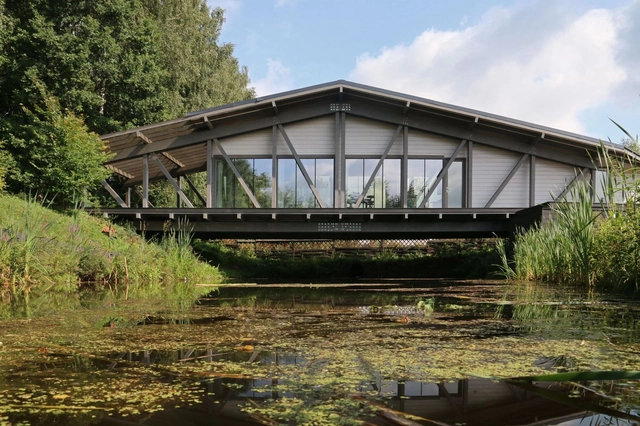
Metaphorically, building bridges equates to creating new opportunities, connections, and paths. The first bridges likely formed naturally with logs falling across rivers and natural depressions, though humans have also been building rudimentary structures to overcome obstacles since prehistory. Today, technological advances have made it possible to erect bridges that are both impressive and sculptural, playing a key role in transportation and connectivity. Usually needing to overcome large spans, with few points of support, bridges can be quite difficult to structure. But when is the bridge more than a connection between two points, instead resembling a building with a complex program? How can these 'bridge houses' be structured?


Despite all the hurdles and the pain, 2020 did not fail us in terms of content. Reacting to the global situation, ArchDaily's team of editors has tackled all the pressing issues that occurred this year and influenced the worldwide state of turmoil. While the whole planet was on pause, these writers were in search of critical substance, seeking to produce exclusive editorial pieces that highlight present-day topics and concerns. Generating articles in 4 languages, English, Spanish, Portuguese, and Chinese, this group of diverse individuals provided both local and global perspectives, reaching everyone that “talks architecture”.
Aspiring "to empower everyone who makes architecture happen to create a better quality of life", ArchDaily’s selection of best articles is the result of many aspects. Some of the choices explored distinctive subjects while others were very well-received among our readers. Emphasizing its academic standards, our platform focused its efforts on covering a vast range of ideas, from the consequences of the pandemic on the built environment, cities and their transformations, technical expertise and material specifications, to artificial intelligence and the future.
Before the pandemic, the world was already facing a series of global transformations in the field of construction, where emerging countries were at the forefront of a powerful economic shift. As the world's population is expected to reach the 10-billion milestone before 2100, the construction sector should be able to understand and adapt to the megatrends that are reshaping the globe.

Many architects work in a variety of areas, designing everything from the layout of a city block to the most minute details of a building. A common trend among these projects is that the furnishings, the very things that make a structure usable and livable, are often afterthoughts for the project's creators and only become important when the structure is already built.

In recent years, with the accelerated urban development of public spaces in China, public washrooms have been assigned numerous new roles. Designers have come up with a variety of proposals which suggest turning public washrooms into a place where social gathering can be redefined, and temporary stay can be more engaging. Although the scale of public washrooms is significantly smaller than that of any other type of architecture, Chinese architects have been working innovatively on fitting the public washrooms into the changing social contexts. Below are a few examples that demonstrate some current architectural experiments with public washroom design in China.
.jpg?1558056313&format=webp&width=230&height=230&crop=true)
.jpg?1558056433&format=webp&width=230&height=230&crop=true)
.jpg?1558055203&format=webp&width=230&height=230&crop=true)
.jpg?1558055302&format=webp&width=230&height=230&crop=true)
.jpg?1558056368)


.jpg?1612787187&format=webp&width=230&height=230&crop=true)
.jpg?1612786692&format=webp&width=230&height=230&crop=true)
.jpg?1612787161&format=webp&width=230&height=230&crop=true)
.jpg?1612786881&format=webp&width=230&height=230&crop=true)


.jpg?1611313167&format=webp&width=230&height=230&crop=true)


