In this latest photoset, photographer Laurian Ghinitiou gives us a first look at BIG’s Transitlager, a new mixed-use arts complex located within and around an existing warehouse building in Basel, Switzerland. Now nearing completion, the renovation and expansion is characterized by its reaction to the existing geometries of the nearby industrial infrastructure, taking the form of two distinct buildings, one placed on top of the other. The complex will contain a series of multifunctional floors for art, commerce, working and living in becoming the center of the new arts district of Dreispitz.
In this latest photoset, photographer Laurian Ghinitiou turns his lens toward JDS Architects’ Maison Stéphane Hessel, a recently-completed, competition-winning mixed-use building in Lille, France. Containing space for a 70-cradle nursery, a 200-bed youth hostel and an office for socioeconomic innovation, the expressively playful building has been designed to respond to the three stages of human growth, from birth, through adolescence and into adulthood. The building volume lifts at its entrances to create public space and invite the entire community to use the building as a retreat from the bustling city, while inside, carved spaces with built-in, soft-edged furniture provide the ideal setting for learning and development.
Zaha Hadid Architects' new Port House in the Belgian city of Antwerp, which has been almost a decade in planning and construction, officially opens this week. A monumental new structure sits above a repurposed and renovated (formerly derelict) fire station, providing a new headquarters for Europe's second largest shipping port. Housing 500 staff, who will now be under the same roof for the first time, the building represents a sustainable and future-proof workplace for its employees. Photographer Laurian Ghinitoiu has visited to capture his unique perspective on this new addition to the city's crane-covered skyline.
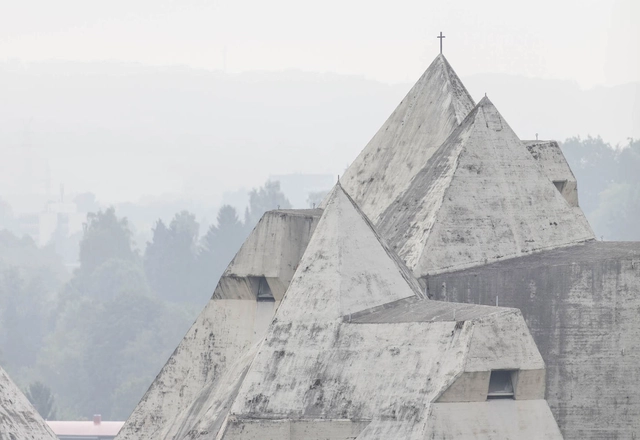
This exclusive photo essay by Laurian Ghinitoiu was originally commissioned for the fifth issue ofLOBBY. Available later this month, the latest issue of the London-based magazine—published in cooperation with the Bartlett School of Architecture—examines the theme of Faith as "a fervent drive, a dangerous doctrine, a beautifully fragile yet enduring construct, an unapologetic excuse, a desperate call for attention and a timely consideration on architectural responsibility."
In 1986 the Pritzker Architecture Prize announced their first German laureate. In a speech at the ceremony in London’s Goldsmiths’ Hall, the Duke of Gloucester suggested that the prize “may not guarantee immorality,” inferring, perhaps, that not even the most prestigious award in architecture could compete with an œuvre so compact, focussed and enduring as that of Gottfried Böhm – a “son, grandson, husband, and father of architects.”
Text via Blain|Southern. For her first exhibition with Blain|Southern, Chiharu Shiota will create a new site-specific monumental installation in the Berlin gallery, eight years after she last exhibited in her home city.
Shiota is primarily known for her immersive installations, such as The Key in the Hand, with which she represented Japan at the Venice Biennale in 2015. Weaving intricate networks of yarn, the artist creates new visual planes as if she were painting in mid-air.
The installation Uncertain Journey fills the gallery’s vast central atrium with dense webs of red yarn – seemingly growing from above, reaching down towards the skeletal hulls of boats which rest on the gallery floor below. The colour of blood, the nexus of yarn is laden with symbolism, for the artist it alludes to the interior of the body and the complex network of neural connections in the brain. Enclosed by the canopy overhead, the boat carcasses raise existential questions of fate and belonging, evoking ideas that can be as complex as the tangled yarn itself.
This past weekend, the Bauhaus in Dessau was animated by the Bauhaus Festival. Titled “Circus, Circus – from Black to White,” the event was intended to present all the fun of the fair with a monochrome twist--in opposition to the wild colors usually associated with circuses--and in the words of the Bauhaus was a “kinetic explorations of bodies, objects, media, space and sound.” The event was also an opportunity to tap into the legacy of Bauhaus legend László Moholy-Nagy, whose experiments in film and media blend well with the performative nature of the circus. The event featured a number of performances by artists, while “Cybernetic Circus” by Anhalt University of Applied Sciences and the Initiative Neuer Zirkus turned the grounds of the Bauhaus into an “architectural landscape” of performance modules inspired by Maholy-Nagy. Also featured were installations by students at Burg Giebichenstein University of Art and Design Halle titled “Neo Luna Park.” Photographer Laurian Ghinitoiu traveled to the event to capture the festivities, showing their interaction with Walter Gropius’ famous building.
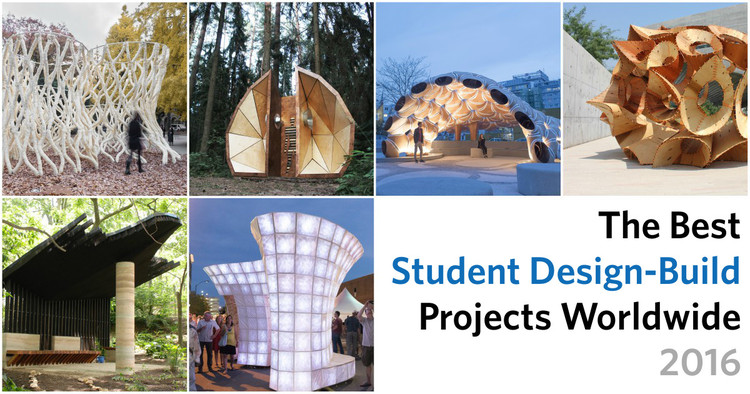
Last year, we asked the graduating students among the ArchDaily community to show us the design-build projects which they may have completed as part of their studies. The response we received was astonishing, and we were so impressed with the results that we simply had to do it again this year. So, two months ago we once again teamed up with ArchDaily Brasil andallfourArchDailyen Español sites to put out another call for submissions, and once again the response was overwhelming. Across over 100 submissions, the quality of the projects we received was so high that this year's results are bigger and better, containing 36 projects from 20 different countries. So, read on for the best student-built work from around the world in 2016.
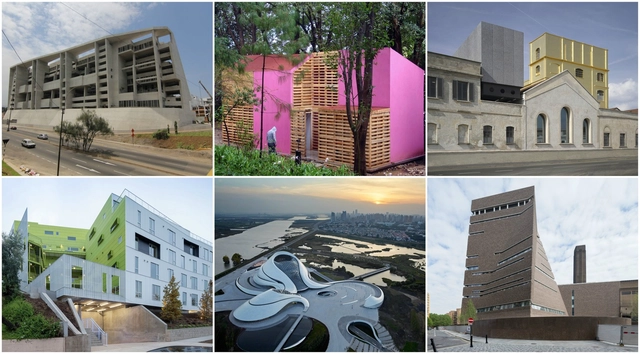
The award, now in its ninth year, “celebrates design that promotes or delivers change, enables access, extends design practice or captures the spirit of the year.” Nominees are selected in six categories, including Architecture, Digital, Fashion, Graphics, Product and Transport. An exhibition on the projects will be on display from 24 November 2016 – 19 February 2017.
Earlier this summer, the Vitra Schaudepot on the Vitra Campus was officially opened. The latest in a string of structures designed by emerging and well-known architects, this gallery space is the second building by Swiss-practice Herzog & de Meuron. Conceived as "a visible storage facility" presenting a cross-section of the Vitra Design Museum's extensive collection of furniture and lighting, over 400 objects will provide "a comprehensive introduction to the history of furniture design." Featuring a café, shop and a new entrance for visitors to the museum, the building is also able to host temporary exhibitions. Photographer Laurian Ghinitoiu has turned his lens to this latest addition in Weil am Rhein.
For Mauricio Pezo and Sofía Von Ellrichshausen, the architect's job is about much more than dealing with functional issues, as well as social issues, sustainability, and safety. “Of course architecture from its very essence is solving problems, and the problems constantly change,” says von Ellrichshausen in this interview with The Architectural Reviewoutside their Vara Pavilion at the 2016 Venice Biennale. “But probably the life span of architecture is many times larger than the problem that it addresses initially. Therefore we think of architecture more in terms of this larger span and hopefully it might embody a set of values and not necessarily propose a solution.”
In May 2016, the After Belonging Agency discussed the theme of the forthcoming Oslo Architecture Triennale—entitled After Belonging: a Triennale In-Residence, On Residence, and the Ways We Stay In-Transit—as part of In Therapy, the exhibition of the Nordic Pavilion at the 2016 Venice Biennale. The hour-long discussion, which also includes presentations by Shumi Bose and Füsun Türetken, begins with an in-depth description of how the Triennale intends to focus on the future challenges of migration by investigating how cities and architecture can react to large groups of people moving and resettling.
https://www.archdaily.com/791923/three-nordic-refractions-the-after-belonging-agency-discuss-the-theme-of-the-2016-oslo-triennialeAD Editorial Team
In two lectures delivered by Bart Lootsma, Professor and Head of Institute for Architectural Theory and History at the University of Innsbruck, the 2016 Venice Biennale—Reporting From the Front—is dissected, unpicked and evaluated through the national participations (pavilions) and Alejandro Aravena's central exhibitions. Lootsma, who has broadcast the lectures as publicly available resources on architecturaltheory.eu, is the co-curator of the 2016 Pavilion of Montenegro.
https://www.archdaily.com/791670/bart-lootsma-dissects-unpicks-and-evaluates-the-2016-venice-biennaleAD Editorial Team
In this interview, presented in collaboration with PLANE—SITE, Cynthia Davidson and Monica Ponce de Leon—curators of the US Pavilion at the 2016 Venice Biennale—explain why the United States' contribution to the 2016 Venice Biennale has brought together "visionary" American architectural practices to speculatively address the future of the city of Detroit. They argue that these projects have "far-reaching applications for cities around the world."
https://www.archdaily.com/791116/video-speculative-detroit-architectural-imagination-2016-venice-biennaleAD Editorial Team
As part of ArchDaily's coverage of the 2016 Venice Biennale, we are presenting a series of articles written by the curators of the exhibitions and installations on show.
All architecture is exhibitionist. Exhibitions are not simply sites for the display of architecture, they are sites for the incubations of new forms of architecture and new ways of thinking about architecture. [1] – Beatriz Colomina
An architecture biennale can be more than a place to simply represent and celebrate the status quo in architectural production. The Biennale’s state of exception and its spatial distance from where people normally work open up a space for examining and critically questioning the conditions of everyday work and production. Although, technologically speaking, more is possible today than ever before, in recent years architects’ creative latitude has been greatly reined in by an enormous—and growing—burden of rules and regulations. Against this background, the architectural exhibition is becoming an ever more relevant medium for a critical practice of architecture. Understood in these terms, an exhibition is no longer just a place for representing architecture ex post facto, as it is still often treated today. Instead, the fact of the exhibition space’s autonomy, and its distance from the “real” world of public and private architecture, has a potential that is increasingly being recognized and put to use. Exhibitions are becoming a place for researching and producing an experimental and critical architectural practice: a place not for the presentation of finished products, but for the production of content. The simultaneous limitations and license to experiment lent by the exhibition space focuses the object of research, allowing for the emergence of new insights, interpretations, and meanings. This calls into question the supposed boundary between architecture and the exhibition. Inquirybecomes a form of display.
As part of ArchDaily's coverage of the 2016 Venice Biennale, we are presenting a series of articles written by the curators of the exhibitions and installations on show.
The Amazon rainforest is our common frontline: constant battles are being fought to preserve the greatest source of biodiversity, oxygen production and climate regulation of the planet.
The Amazon is also the battlefront between the ancestral vision of its inhabitants and the modern vision that western society has over this territory. If we were to learn from the indigenous knowledge, now endangered by hegemonic “western civilization”, we would open an unforeseen insight about medicine, nutrition, and the sustainable production of the rainforest. The dissolution of this last frontline would have global implications and it would even change the way we see our world.
In this interview, presented in collaboration with PLANE—SITE, Jack Self—co-curator of the British Pavilion at the 2016 Venice Biennale—reveals how the frontline of architecture in Britain today is not just a housing crisis, but "a crisis of the home." In provocatively presenting "the banal," Self reveals why the British participation at the 2016 Venice Biennale proposes five new models for domestic life, each curated through time of domestic occupancy, alongside how it seeks to address the ways in which we might live in the future.
https://www.archdaily.com/790670/video-designing-through-time-home-economics-2016-venice-biennaleAD Editorial Team
As part of ArchDaily's coverage of the 2016 Venice Biennale, we are presenting a series of articles written by the curators of the exhibitions and installations on show.
The title relates to the processes of architecture, which can be slow to come to fruition and therefore one also refers to architecture and patience, and to the meaningful sustained existence of buildings in their fragile environments.
The installation is a glass labyrinth, which one crosses to reach an internal landscape. The glass is clear – therefore it is an alternate take on the architectural manifestation of the 'labyrinth': an age-old space of intrigue and discovery. It refers to the idea that although one is sure of one’s intentions - has a clear vision - the path to achieving that may not be straightforward but rather quite 'labyrinthine', in the economies and climatic zones that the architect operates in. That is, one can see clearly but cannot progress easily.


.jpg?1479192914&format=webp&width=640&height=580)
.jpg?1479192822 "Basel Transitlager / BIG. Image © Laurian Ghinitoiu")
.jpg?1479192791 "Basel Transitlager / BIG. Image © Laurian Ghinitoiu")
.jpg?1479193093 "Basel Transitlager / BIG. Image © Laurian Ghinitoiu")
.jpg?1479192869 "Basel Transitlager / BIG. Image © Laurian Ghinitoiu")
.jpg?1479192914)
.jpg?1477400767&format=webp&width=640&height=580)
.jpg?1477400756&format=webp&width=230&height=230&crop=true)
.jpg?1477400056&format=webp&width=230&height=230&crop=true)
.jpg?1477400087&format=webp&width=230&height=230&crop=true)
.jpg?1477398338&format=webp&width=230&height=230&crop=true)
.jpg?1477400767)
.jpg?1474634758&format=webp&width=640&height=580)
.jpg?1474634442&format=webp&width=230&height=230&crop=true)
.jpg?1474634454&format=webp&width=230&height=230&crop=true)
.jpg?1474634533&format=webp&width=230&height=230&crop=true)
.jpg?1474634733&format=webp&width=230&height=230&crop=true)
.jpg?1474634758)
.jpg?1474570511&format=webp&width=230&height=230&crop=true)
.jpg?1474569951&format=webp&width=230&height=230&crop=true)
.jpg?1474569428&format=webp&width=230&height=230&crop=true)
.jpg?1474569212&format=webp&width=230&height=230&crop=true)

.jpg?1474121915&format=webp&width=640&height=580)
.jpg?1474121884&format=webp&width=230&height=230&crop=true)
.jpg?1474121948&format=webp&width=230&height=230&crop=true)
.jpg?1474121816&format=webp&width=230&height=230&crop=true)
.jpg?1474121873&format=webp&width=230&height=230&crop=true)
.jpg?1474121915)
.jpg?1473087666&format=webp&width=640&height=580)
.jpg?1473088561&format=webp&width=230&height=230&crop=true)
.jpg?1473087820&format=webp&width=230&height=230&crop=true)
.jpg?1473088648&format=webp&width=230&height=230&crop=true)
.jpg?1473088081&format=webp&width=230&height=230&crop=true)
.jpg?1473087666)


.jpg?1473019568&format=webp&width=230&height=230&crop=true)
.jpg?1472123988&format=webp&width=640&height=580)
.jpg?1472123757&format=webp&width=230&height=230&crop=true)
.jpg?1472123736&format=webp&width=230&height=230&crop=true)
.jpg?1472123873&format=webp&width=230&height=230&crop=true)
.jpg?1472123884&format=webp&width=230&height=230&crop=true)
.jpg?1472123988)

.jpg?1470992306&format=webp&width=230&height=230&crop=true)
.jpg?1471021982&format=webp&width=230&height=230&crop=true)

.jpg?1471021974&format=webp&width=230&height=230&crop=true)
.jpg?1470992306)


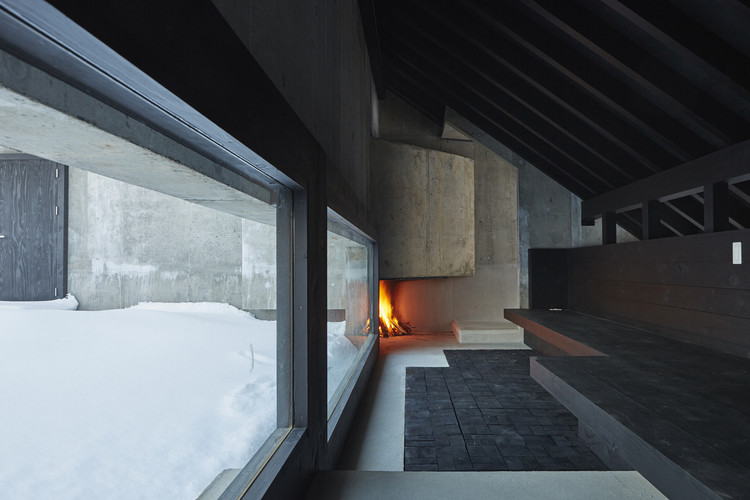
.jpg?1469542883&format=webp&width=640&height=580)

.jpg?1467139351&format=webp&width=640&height=580)
.jpg?1465169187&format=webp&width=640&height=580)
.jpg?1465169402&format=webp&width=230&height=230&crop=true)
.jpg?1465169213&format=webp&width=230&height=230&crop=true)
.jpg?1465169268&format=webp&width=230&height=230&crop=true)
.jpg?1465169297&format=webp&width=230&height=230&crop=true)
.jpg?1465169187)
.jpg?1467068397&format=webp&width=640&height=580)
.jpg?1467068288&format=webp&width=230&height=230&crop=true)
.jpg?1467068340&format=webp&width=230&height=230&crop=true)
.jpg?1467068408&format=webp&width=230&height=230&crop=true)
.jpg?1467068330&format=webp&width=230&height=230&crop=true)
.jpg?1467068397)