David Adjaye OBE, principal of Adjaye Associates, will be Knighted by Her Majesty Queen Elizabeth II for his services to architecture at an investiture in 2017. The Central Chancery of the Orders of Knighthood at St. James's Palace, who administer the Knight Batchelor awards that will be bestowed upon the architect, described Adjaye as "one of the leading architects of his generation and a global cultural ambassador for the UK."
https://www.archdaily.com/802706/david-adjaye-to-be-knighted-by-queen-elizabeth-iiAD Editorial Team
Pedestrians, the most vulnerable users of road space, will now be more visible to drivers in the Netherlands with the inauguration of a new luminous pedestrian crossing this past November in Brummen, west of Amsterdam.
Designed by the Dutch firm Lighted Zebra Crossing, and installed free of charge for the municipality, this crossing makes pedestrians more visible at night or during bad weather. Each of the lines has two plates of lights that at night remain illuminated at all times and not only when there are people on them.
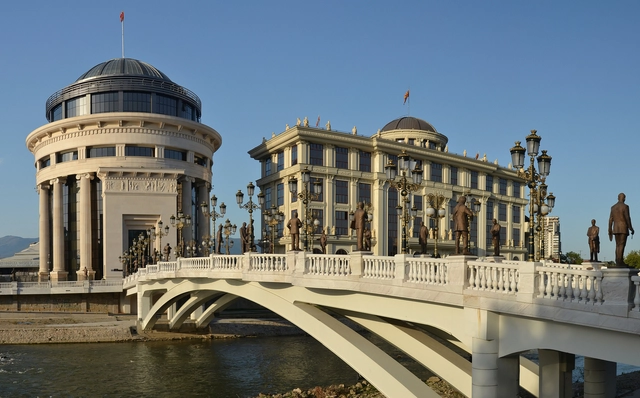
After the earthquake in Skopje in 1963, a slew of foreign architects worked to change the capital into an architecturally dynamic urban landscape. Now, that vision may be obsolete. In Architects of Modernist Skopje Decry Retrograde Remodel, Bojan Blazhevski investigates the overwhelming number of buildings enduring "Skopje 2014" — a remodeling of existing buildings in the capital city. More than 20 modernist buildings have already been made over. Described as "kitsch" by a hostel manager in the city, the project, which aims to draw in more tourists and regain historical elements, has culminated in a neo-classical display. The imitation buildings, however, have produced controversy, with opinions divided on the aesthetic quality of the project.
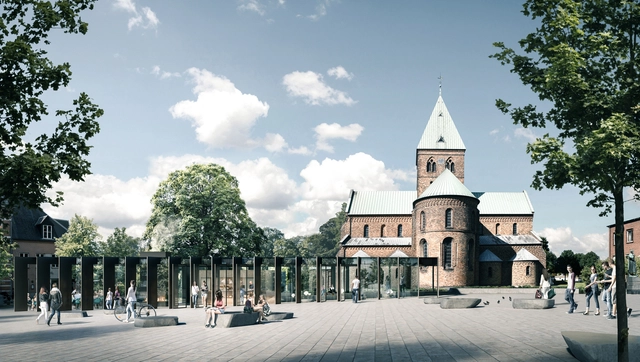
There is so much history in and around Ringsted Square, said Hvidesten. I am therefore delighted that the winning project gives us a pavilion that will not just integrate with the overall architecture of the square; it will also forge a link with history, retain a clear view of St. Bendt’s Church, and provide a new focal point of the square and its many functions, which will appeal to both young and old.
This reconstruction is primarily of language. The architects draw from archives—mental, digital or printed on paper—distant from the typical parametric and highly schematic rationales that characterized the last thirty years of design in architecture. Within the theoretical system that drives architectural composition, these archives inevitably become homages, references, and quotes.
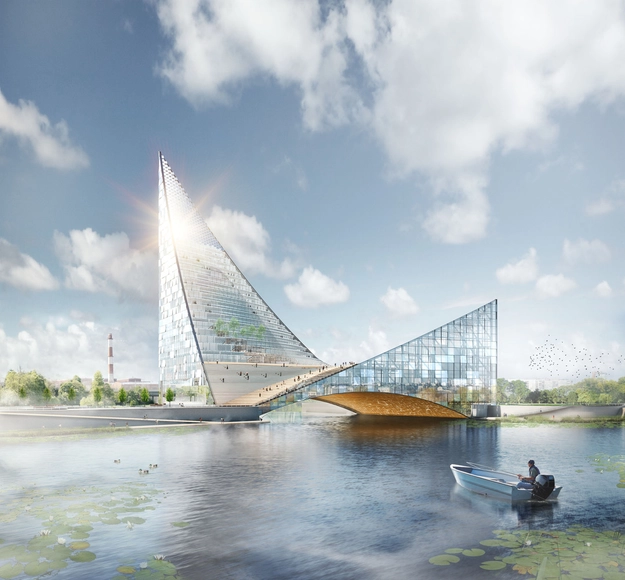
PIARENA has won the Archchel-2020 competition to create a Congress Hall for BRICS and SCO events in central Chelyabinsk, Russia along the Miass River. Separated into two parts by the river, the site will additionally host business meetings, public events, and exhibitions.
In order to emphasize the curve of the river, the new congress hall building will be a solid volume spanning across the river, rectangular in footprint, but curved in a sail shape above.
Rising up to 61 and 150 meters, the building is hoped to become a new urban landmark, as well as a pedestrian crossing over the river.
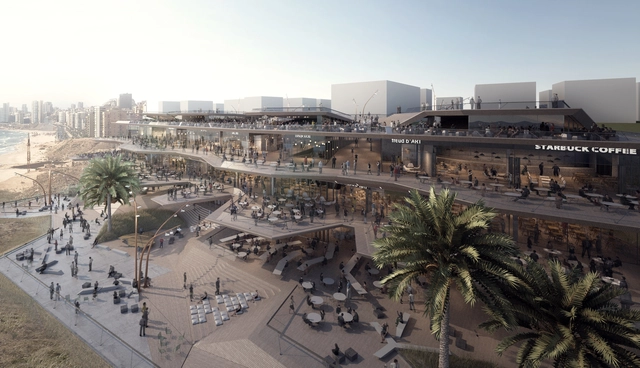
BAD.Built by Associative Data has released its designs for BARCELONA, a new mixed-use development on the Mediterranean coast of Beirut, Lebanon at the Ramlet El Bayda waterfront.
Spanning 18,000 square meters, the project will serve as “a new gastronomic experience, embracing the Mediterranean from a remarkable vantage point,” through a clustered development featuring restaurants, coffee shops, lounges, and event spaces.
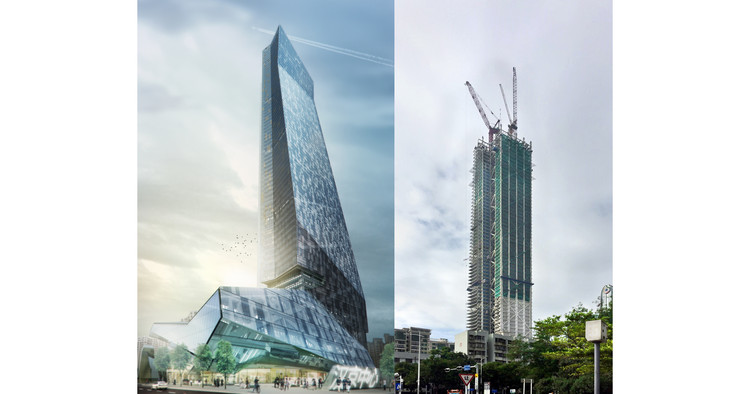
Morphosis Architects’ Hanking Center Tower in Shenzhen, China has recently topped out, with the 62nd floor now in place. Defined by its detached core configuration, the building positions its primary core 9 meters outside its main body, connected by a series of sky bridges and braces, in order to increase flexibility and light penetration into the floor plate.
Two secondary cores in the body of the building provide structural reinforcement and house private elevators for VIP users, as well as freight elevators and mechanical services.
In an effort to serve global professionals and bring density to the suburb of Nanshan, the tower will feature flexible office space on its open floor plate, anchored by high-end retail and dining.
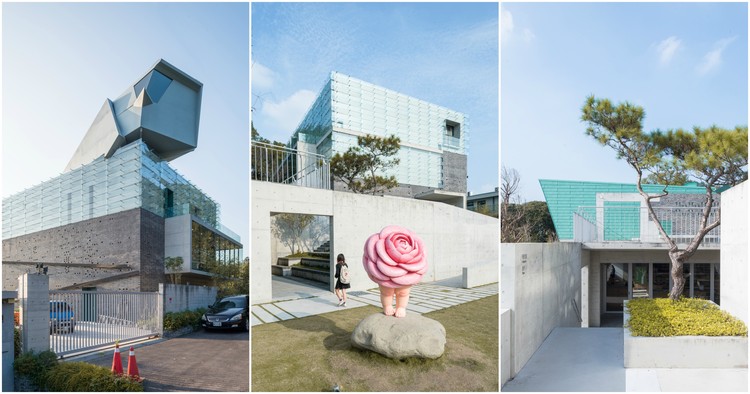
Located in the Tsaotun Township of Nantou County in Taiwan, the Yu-Hsiu Museum of Arts was completed in October of 2015, after 4 years of design development. The request received by AMBi Studio’s design team, led by architect and founder Wei-Li Liao, was for a building that was "subtle," "delicate" and "clean." The building’s focus is therefore on creating a harmonious relationship between the manmade and naturally formed architectural elements, paying respect to the surrounding Jiu-Jiu Peaks. This relationship is demonstrated in the combination of the building’s artificially constructed corridors and the existing vegetation in the area, and the museum’s doubled-façade construction which creates an "intermediary" space between outside and inside.
This successful design led the building to win first prize at the 2016 Taiwan Architecture Awards, causing the selection committee to praise Liao for his "continual effort... to explore the experience of perception... and poetic spatiality." Taiwan-based photographer Lucas K Doolan visited the site to capture the building’s interaction with nature in detail, exploring the museum’s carefully considered materiality.



.jpg?1482901803&format=webp&width=640&height=580)
.jpg?1482901851 "© Tim Van de Velde")
.jpg?1482901775 "© Tim Van de Velde")
.jpg?1482900941 "© Tim Van de Velde")
.jpg?1482900968 "© Tim Van de Velde")
.jpg?1482901803)


.jpg?1482902393&format=webp&width=640&height=580)
.jpg?1482902364 "© Geert Van Hertum")
.jpg?1482903766 "© Geert Van Hertum")
.jpg?1482903651 "© Geert Van Hertum")
.jpg?1482902279 "© Geert Van Hertum")
.jpg?1482902393)