


Humanity is facing a collective new challenge unprecedented in our lifetime. One of isolation, driven by self-quarantine, for a period unknown. It is a social experiment with no predictable outcome. But one constant in the equation is architecture.
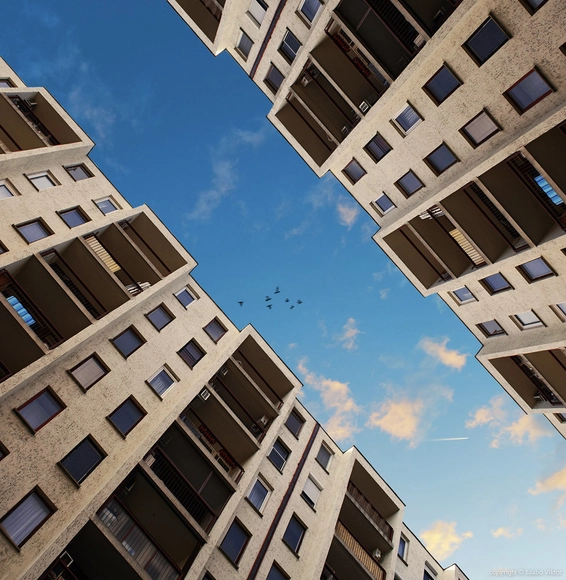
With over half the world’s population inhabiting cities or densely populated areas, billions of people are currently residing in small spaces, disconnected from one another by brick, concrete and steel. The social housing experiment of the 1950s and 60s created a new architectural typology, which was compounded by an underlying social construct, driven by capitalism, that told us to mind our own business. Somehow, during the age of high rises that followed, turned this idea of isolation into a status symbol, as private penthouses, accessed by private elevators, today float high above the city streets.
The Midnight Charette is an explicit podcast about design, architecture, and the everyday. Hosted by architectural designers David Lee and Marina Bourderonnet, it features a variety of creative professionals in unscripted conversations that allow for thoughtful takes and personal discussions. A wide array of subjects are covered with honesty and humor: some episodes provide useful tips for designers, while others are project reviews, interviews, or explorations of everyday life and design. The Midnight Charette is also available on iTunes, Spotify, and YouTube.
This week David and Marina answer questions from listeners about finding a job when you're much older than your classmates, graduating from school without work experience, leaving architecture at the end of a Master's program, taking the CSE, and transferring schools because of IPAL. If you have any questions call or text the hotline at 213-222-6950.
https://www.archdaily.com/936932/on-finding-motivation-to-keep-practice-architecture-and-age-significance-when-getting-hiredThe Second Studio Podcast
“A House is a place (…) as physical as a set of feelings. (…) a home is a relation between materiality and mastery and imaginative processes, where the physical location and materiality and the feelings and ideas are united and influence each other, instead of being separated and distinct. (…) a house is a process of creation and comprehension of ways of living and belonging. A house is lived, as well as imagined. The meaning of house and the way it materially manifests itself, it´s something that is created and recreated in an unceasingly way through every day domestic tasks, which are themselves connected to the spacial imaginary of the house”1

The sentence above is the starting-point of the current reflection, in an exercise that will mark meaningfully my approach to the way of projecting houses.
Since the recent COVID-19 quarantine restrictions were enforced, social media has been filled with images of employees working from home, students transitioning to home-school learning, and friends and family socializing via Skype calls and Zoom meetings. With the outpouring of tips for how to work from home, and how to keep a regular routine during these certain times, many people are questioning how to create a long term plan for online studio design instruction.
This article aims to provide some practical tips to schools and students around the globe based on our experience with online design studio teaching in our Master program at Tsinghua University’s School of Architecture since February.
https://www.archdaily.com/936580/tips-for-design-studio-teaching-in-the-age-of-covid-19Martijn de Geus
Shift architecture urbanism developed micro-markets that can operate on a hyper-local scale during coronavirus shutdowns. The research elaborated on a scheme allowing traders to provide fresh food in a safe way to the self-quarantined inhabitants of the city.