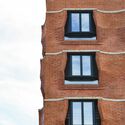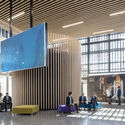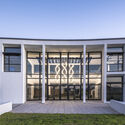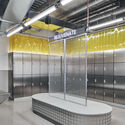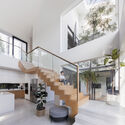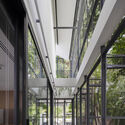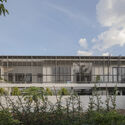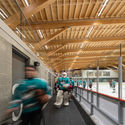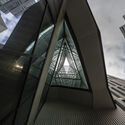
For 10 days, Berlin's abandoned International Congress Centre (ICC) was transformed into a stage for performance, acrobatic and visual arts, films, concerts and talks during Berliner Festspiele's "The Sun Machine Is Coming Down" event. The 1970s futuristic building that remained closed for the last seven years provided the framework for a multi-layered experience, illustrating its potential for reactivation and adaptive reuse.
María Cristina Cravino, the head of numerous research projects and publications on informal settlements and the politics of public habitation, draws from her background in anthropology to become one of the most prominent voices in the discussion about rights to the city and modern urban conflicts.
To get her perspective, we sat down with Cravino to discuss her observations and understanding of the issue--especially in the context of quarantine and lockdowns--as well as her reflections on the role of academia in exploring the problem and finding solutions.
On August 12, 1833, the Town of Chicago had roughly 200 inhabitants. Four years later, in 1837, it was upgraded to The City of Chicago – an interesting fact given that there are still 19 incorporated towns in Illinois. The Great Chicago Fire of 1871 killed 300 people, destroyed about 3.3 square miles (9 km2), and left more than 100,000 residents homeless. However, by that time Chicago had become the world’s fastest-growing city and its population had risen over 300,000 inhabitants. The fire meant these ambitious citizens had to start again.
With admirable strength, the city was reborn from the ashes and some of Chicago’s best architecture was constructed immediately after. Structures like the Rookery Building (1888, Frank Lloyd Wright), the Auditorium Building (1889, Louis Sullivan) and the Monadnock Building (1893, Burnham & Root, Holabird & Roche) are a few examples of the high standards the city was aiming for.
Designing residential projects has become nothing short of a challenge. Whether it being for the housing crisis and its repercussions, the heightened environmental awareness, or the fact that people are spending more time inside their dwellings, architects are now focused on building projects that look beyond the typical house and that provide answers to questions like: how can architects offer residents privacy and comfort while maintaining a connection with the outdoors? And how can these spaces cater to the spatial and functional needs of all family members, especially when the lines between work, play, and rest are blurred?
From a Matrix-inspired housing compound in Saudi Arabia to the world's first steel 3D printed structure of modular houses in Sardinia, this round up of unbuilt apartments showcases how architects have reimagined the traditional residential typology, and looked into how these structures can cater to their users, the site, and the environment. This round up also includes projects from the Netherlands, Siberia, Sweden, and Italy.
It is easy to show cool images of adaptive reuse. The contrast of living history and control over it makes for dynamic visuals. But there is a deeper meaning to adaptive reuse. Architecture embodies humanity and humanity changes, so our buildings change.
OMA / Reinier de Graaf and Buro Happold have unveiled their design for the Al Daayan Health District in Doha, Qatar. The project explores the "potential of modularity, prefabrication, and automation in relation to the rapid changes in medical science" on a 1.3 million-sqm plot with low cost, cross-shaped modular units that are prefabricated on site. In addition to the prefabrication of the units, a local high-tech farm will supply food and medical plants for medicine production, and a solar farm will allow the district to function autonomously.
Whether figuratively or in an urban context, bridges are a strong symbol and often become iconic projects in cities. Building bridges can mean creating connections, new opportunities. But they are also fundamental pieces of infrastructure that solve specific issues in an urban context. As these involve highly technical equipment, with complex constructions and overwhelming bold structural requirements, they require projects that do not need full integration between architecture and engineering and, in many contexts, is a type of projects that architects are not so involved with. Marc Mimram Architecture & Engineering is a Paris-based office comprised of an architecture agency and a structural design office. In its project portfolio, there are several bridges, as well as various other project typologies. We spoke with Marc Mimram about his latest project in Austria, the bridge at Linz, photographed by Erieta Attali.
Cork is obtained from the bark of the cork oak, a slow-growing tree in the Mediterranean region that lives an average of 200 years. The valuable property of the cork oak is that it regenerates itself. After each peeling, the bark grows back. Therefore, no tree is cut down or permanently damaged for the cork harvest. In addition, a peeled cork tree binds more CO2 than an unpeeled tree.
Combining the benefits of laminate with the special properties of cork, EGGER Comfort flooring is made up of two layers of cork that provide warmth and special comfort when walking, coming from sustainable forestry.