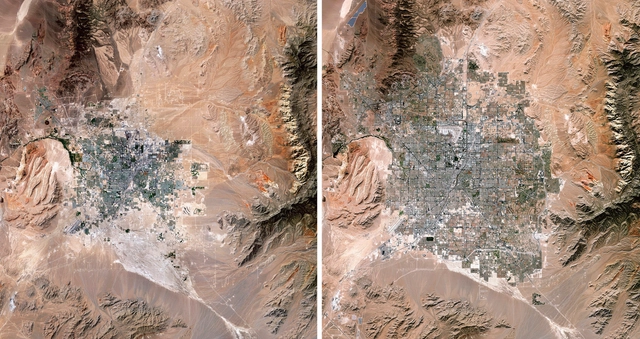
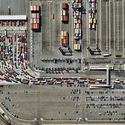
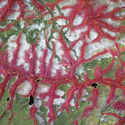
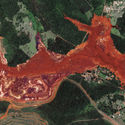
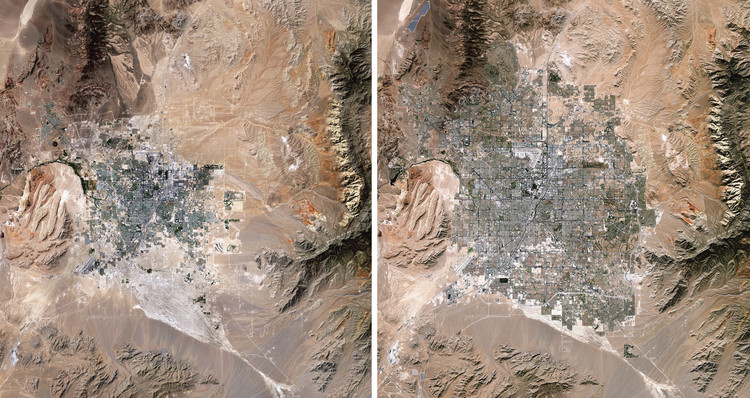
Las Vegas Expansion, 1989/2019. Source Imagery courtesy of The European Space Agency (ESA) Paris, France
Human impacts on Earth are a common issue nowadays, and many people say that there is no turning back. Climate crisis, greenhouse gases, exploitation of natural resources, production of solid waste and atmospheric pollution are some of the most pressing issues that the global community must address if we want to ensure a sound future for the next generations.
These topics can be viewed in full-color and high-definition in the new book Overview Timelapse: How We Change the Earth, by Benjamin Grant and Timothy Dougherty, which compiles 250 satellite and drone photographs of places on Earth that are in constant transformation.
To talk about architecture and social media is to immediately think of Instagram. Launched in 2010, the app was characterized from the very beginning by combining photo sharing with typical social network features. Its success was extraordinary; within hours of its launch, it was already the most downloaded free photography app. Within two months, the number of registered users surpassed the one-million mark.
Dutch design practice Mecanoo has released a new documentary exploring the modernization of Washington DC’s Martin Luther King, Jr central library. Called "A Legacy of Mies and King", the documentary explores both architect Ludwig Mies van der Rohe's vision in the sixties, as well as the recent effort to create a modern library that reflects a focus on people while celebrating the exchange of knowledge, ideas and culture.
Fungi are everywhere—in the air, in water, on our bodies, on trees, on bathroom ceilings, and underground. They can manifest as mushrooms (including edible, medicinal, psychedelic, or highly toxic ones) or in other simple forms like mold. They can trigger illnesses, but they also produce life-saving antibiotics like penicillin and help ferment excellent cheeses and breads. Could they, then, also become the packaging and construction materials of the future?
Few historical events have been as pivotal to the history of architecture and urbanism as the Industrial Revolution. To accommodate the productive framework that transformed capitalism starting in the 18th century, an entire spatial system was created. Beyond factories, this network included raw material processing plants, power generation and distribution hubs, warehouses, and transport terminals. In urban terms, this process did not merely allocate large swaths of land to industrial activities; it triggered a multisystemic transformation that reshaped how people lived, occupied, and moved within the urban environment.
https://www.archdaily.com/1122136/de-industrial-architecture-8-projects-that-redefine-the-space-of-the-machineIsabel Martin
The sixth edition of the international architecture and city festival Open House Madrid was held from September 25 to 27, featuring a special edition organized to comply with necessary health measures and ensure the safety of all participants. The event offered visits to 27 renowned architecture studios across the city—some in virtual formats, others in person, and some in both.
https://www.archdaily.com/1124217/27-architecture-office-visits-at-open-house-madrid-2020ArchDaily Team
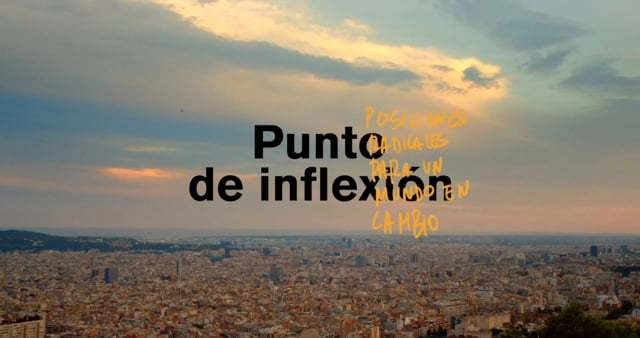
"We are at a historic moment. Everything is changing—the way we relate, work, and build. The boundaries between the physical and the digital, the local and the global, are blurring as we move toward an uncertain horizon shaped by the climate emergency and social inequalities. In this context, the role of architecture, design, and urban planning is fundamental."
These are the opening words of a new documentary produced by the Arquia Foundation—the first in a series profiling different Spanish cities—directed by Javier Peña. The film explores Barcelona's most radical architecture through the lens of a generation of architects who emerged in 2008 in the midst of the financial crisis. It features contributions from Anna and Eugeni Bach, Maio, David Steegmann, Adrià Escolano, Vora Arquitectura, Bonell + Dòriga, Raúl Sánchez, Arquitectura G, FLEXO Arquitectura, Carles Enrich, La Col: cooperativa de arquitectos, and Harquitectes.
As our cities continue to grow and expand rapidly, there has been an increasing demand for architects and craftsmen to build houses more cost-efficiently under tight deadlines. Modular architecture has been introduced as a concept which involves assembling multiple pre-fabricated modules on site to create a working unit. By joining similar elements together in various ways, modular architecture allows for more flexibilities in design and standardized repair.
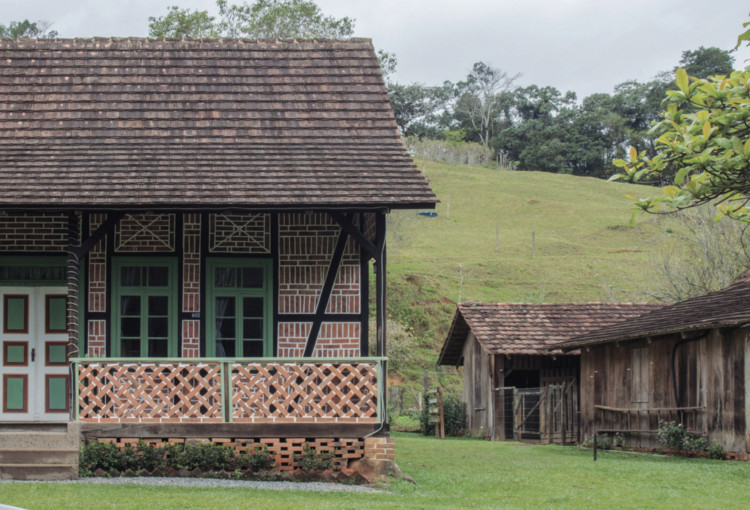
Erwin Rux House, Rio da Luz. Source: Espaço Arqueologia, 2019, taken from the book "Morar na Colônia: a arquitetura da imigração em Testo Alto e Rio da Luz"
A watercolor-illustrated tourist map, a mobile application available for Android and iOS, and two books gathering stories from the neighborhoods of Rio da Luz, in Jaraguá do Sul, and Testo Alto, in Pomerode—both in Santa Catarina—comprise the Projeto Lumiar. The initiative will launch these products online at 7:00 PM this Thursday, the 8th. The result of two years of research with local communities, the launch event is supported by the National Historic and Artistic Heritage Institute (Iphan).
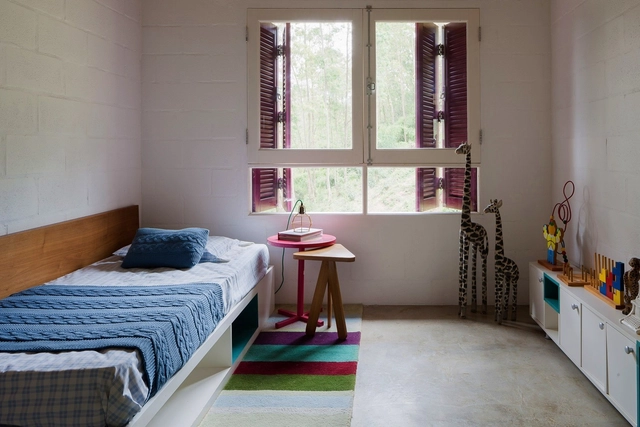
Many factors influence people's well-being, but few have power as great as the quality of sleep. Adults spend, on average, a third of their day (and their life) sleeping. In the case of young children, this proportion is even higher. According to a study published by the WHO in 2019, babies (4 to 11 months) should sleep between 12 and 16 hours/day; and children up to 4 years old should sleep between 10 and 13 hours/day.
Quality sleep acts directly on the child's brain development, especially during his first and second childhood (from birth to 12 years old). During the rest period, the body releases the hormones necessary for growth and learning, and this is directly related to physical, motor, emotional, and cognitive development. It is also known that the environment where one sleeps interferes with the quality of that sleep, and some important aspects must be considered when designing sleeping spaces for children and babies.
In the field of architecture, the technological, social, and cultural changes driven by 21st-century globalization processes have enabled the development of transnational teams and diverse firms designing projects with innovative perspectives and visions unmoored from a single geographical location. Hyper-communication, exchange, and advanced digital resources are design tools that have allowed architects to operate with a more global vision of the practice, transcending national borders and enabling them to approach architectural challenges in a more open and pluralistic way.
The Chilean historian, monk, and architect Gabriel Guarda, co-author of the Benedictine Monastery Chapel alongside Martín Correa in Santiago, Chile, passed away today at the age of 92.
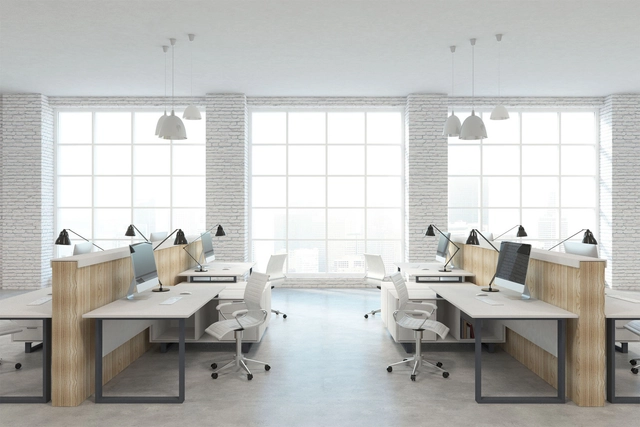
COVID-19 will likely change the way we live and work for an extended period. In this landscape, organizations have been seeking short-, medium-, and long-term solutions to guarantee their staff a safe return to work. Protecting the health of employees exposed to contact in the workplace requires implementing biosecurity strategies, social distancing, occupancy limits, cleaning, and disinfection. This article explores preventive measures recommended by HID Global, based on the application of identification technologies.
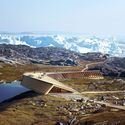
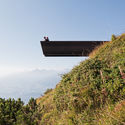
Building in nature constitutes a contradiction, as architecture enables immersive access to the landscape, while at the same time, natural landmarks are being slowly engulfed by tourists. The human presence in natural landscapes is an interplay of scales, a juxtaposition of archetypal shelters against the vast sceneries, as well as a negotiation between access to the landscape and environmental conservation. Exploring a variety of attitudes and formal strategies, the following takes a look at what could be learned from the experiences and design philosophies of several architects and practices that have perfected ways of addressing architecture in the landscape.
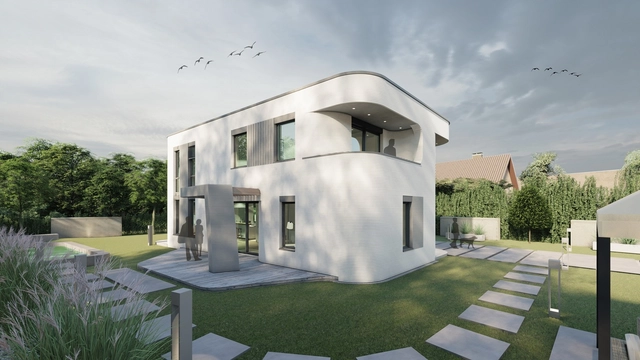
The first 3D printed residential building in Germany, built by PERI GmbH, and designed by MENSE-KORTE ingenieure+architekten is undergoing construction in Beckum, North Rhine-Westphalia. The two-story printed detached house with approx. 80 sqm of living space per floor is using a system put into practice in Germany for the first time. In fact, the construction technique has come through all of the regulatory approval processes over the last few weeks and months.
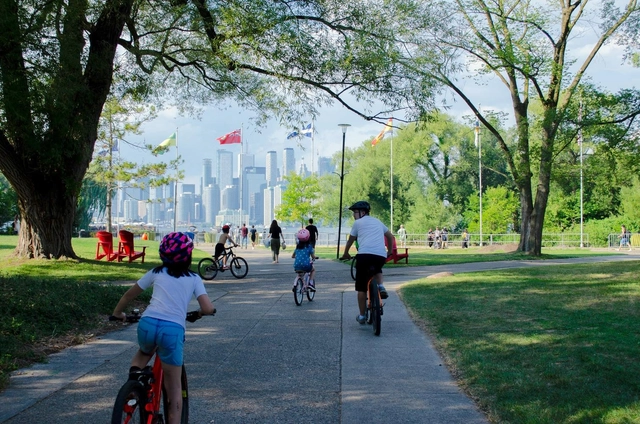
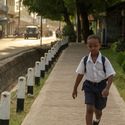
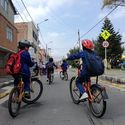
Children are often overlooked or entirely deprioritized in urban planning. Globally, it is estimated that up to 500 children die every day in traffic accidents. Thousands of others are injured in collisions or develop psychological trauma that can last for years. Whether on the streets or in public spaces, feelings of insecurity or discomfort discourage children from physical activity outdoors—at a time when 80% of children between the ages of 11 and 17 are not physically active, and another 38 million under the age of five are overweight or obese.
https://www.archdaily.com/1123822/how-to-design-safer-and-healthier-urban-spaces-for-childrenNikita Luke, Rohit Tak, Ariadne Samios e Claudia Adriazola-Steil
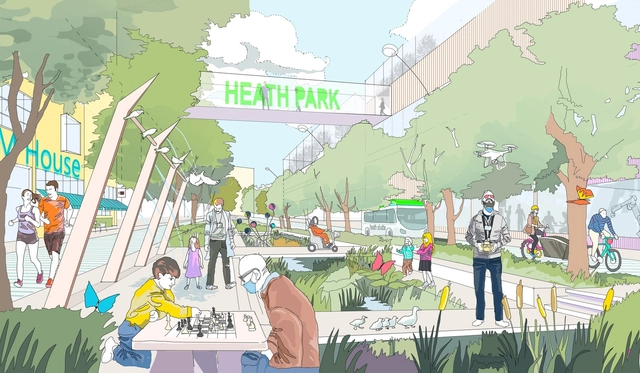
Multi-disciplinary design practice EcoResponsive Environments has won the RIBA competition for the ‘Vision of Future Living’ in Runcorn, England. Designed for SOG’s Heath Business and Technical Park, the proposal aims to help attract interest from global investors and reimagine what the site's future might hold. The competition for the redevelopment of The Heath asked architects to consider how we will live, work and play in the future.
Surface Ex-Tension by Jonathan Craig, Luis Arjona, Marco Nieto & Philip Elmore. Image Courtesy of Arch Out Loud
Since its installation in the late 1990s, a large clock in New York City’s Union Square has been counting up to 24 hours in each day with the number of hours, minutes, seconds, and milliseconds on display. However, the digital screen was recently repurposed as a Climate Clock and now projects the amount of time the world has left to take large-scale action on climate change- and the alarming truth, based on an IPCC Special Report on Global Warming counts down to only a little over seven years left until we reach the point of no return.
In 1755, Francesco Algarotti, disgusted with what opera had become, wrote An Essay On The Opera in which he called for its simplification. For Algarotti, opera had degenerated into a vehicle for soloists to grandstand with endless improvisations overshadowing the music and ignoring the drama. Even the drama had lost the plot with mythological characters in extraordinary and complex situations. Algarotti saw drama as being the essence of opera and wanted the emphasis restored to it, with everything else secondary. Christoph Willibald Gluck and his librettist, Ranieri de’ Calzabigi, were the first to make it work with their 1762 opera Orfeo ed Euridice. It had characters and drama people could relate to, music that could be remembered and lyrics and a plot that could be understood. It’s regarded as the first truly modern opera.
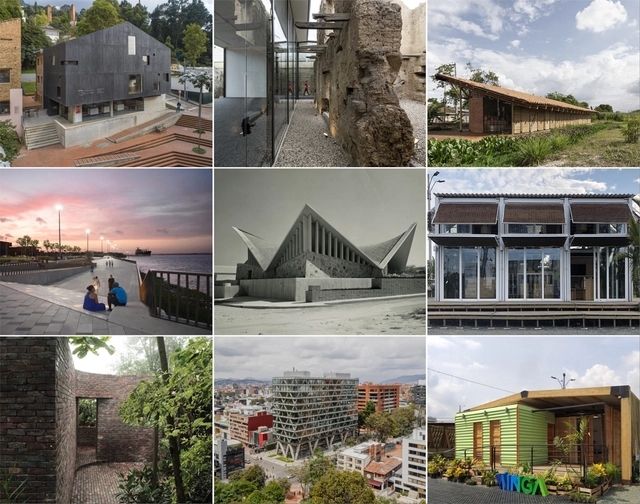
The Colombian Society of Architects (SCA) has announced the finalists for the 27th Colombian Biennial of Architecture and Urbanism (BICAU XVII) across all categories. The selected projects, which you can explore below, will receive either an Honorable Mention or be named winners of their respective categories; the winner of the National Architecture and Urbanism Prize will also be chosen from among them.
Five years after the Empena Viva project, Nitsche Arquitetos returns to artistically occupy the surroundings of the Minhocão. Through the Eclipse intervention, the team aims to illustrate the socioeconomic and temporal processes driven by São Paulo's urban dynamics using a simple gesture.
Image: Ivo Gonçalves – Prefeitura de Porto Alegre/Flickr, license CC BY-NC-SA 2.0
The Master Plan is the basic instrument for defining a municipality's development model. It establishes guidelines and strategies for executing plans, programs, and projects, seeking to emphasize public participation as well as economic, social, and environmental sustainability. Yet, its influence on the city goes far beyond what is commonly imagined: it ultimately dictates the volume and form of every new building.
A recent study conducted by the Royal Institute of British Architects (RIBA) examined how architecture students have been affected by the pandemic. Examining 398 architecture students, the COVID-19 survey found that these young adults are under significant stress and are concerned about their future career. In fact, the results highlight that 58% of students are struggling with mental health and almost half are concerned about job prospects.
Slate 1 CAU+Plural, composed entirely of women architects and urban planners, received 11,568 votes in the election for CAU/SP, held on October 15. The election, which recorded the highest turnout of architects and urban planners in the history of the Council of Architecture and Urbanism of São Paulo, marked the first time a single slate garnered nearly 40% of the valid votes.
In an unprecedented achievement, the slate secured the majority of seats in the Council, winning 49 plenary seats. Out of 77 total seats, 52 will be occupied exclusively by women. Thanks to this strategy, the next term will see a 77% female composition—with 54 titular members and 66 alternates, respectively. This effectively reverses the previous composition, where 76% of the state council was represented by men.