

-
Architects: Filipa Guimarães
- Area: 162 m²
- Year: 2015
-
Manufacturers: BRUMA, Primus Vitória, Sanindusa

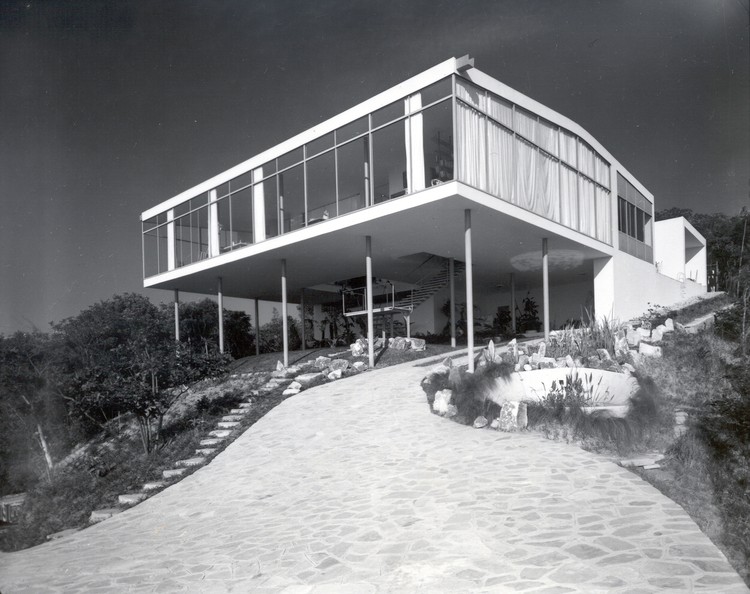
When we think of the residential designs of Italian architect Lina Bo Bardi, the immediate image that comes to mind is her private residence in São Paulo (1951)—more precisely, the image of its glazed social pavilion, captured from a low angle. This perspective further dramatizes the contrasting relationship between that light, suspended orthogonal volume and the steep natural slope of the terrain.
I would venture to say that no other work of Brazilian architecture is as well-known from a single photograph. This image, which has illustrated nearly every publication on the architect since the building's completion nearly 70 years ago, and which indeed justifies its famous moniker, the “Glass House,” exposes the unequivocal modern condition of this project—or, at least, the portion revealed by the angle of this celebrated photograph: a transparent, prismatic volume suspended on slender pillars set back from the edge of the floor slab and, consequently, free-standing within the elevated space.

On August 17, Brazil celebrated National Heritage Day, 21 days after a protest set fire to the statue of Bandeirante Borba Gato in the southern zone of São Paulo. This contradiction opens up an important discussion: how are we constructing memory in our cities? What are we valuing as our country's heritage?
The term historical and cultural heritage refers to the tangible and intangible creations of a given culture within society. What defines a cultural asset as heritage is its historical and social relevance, which can be linked to collective and individual memory, as it is through these memories that we understand the past. From an architectural perspective, the term heritage is constantly associated with historic buildings that typically embody Catholic religious values or the bourgeois lifestyle of the elite.