Jane Duncan, an Architect based in the English county of Buckinghamshire, has been elected as the 76th President of the Royal Institute of British Architects (RIBA). Taking over the reigns from current President Stephen Hodder in September 2015, Duncan will become only the third female President after beating fellow candidate Oliver Richards (by a majority of 52% of the vote) to the institute's highest position. According to the Architects' Journal, only 16.7% of RIBA members voted in the election.
eVolo Magazine is pleased to invite architects, students, engineers, designers, and artists from around the globe to take part in the eVolo 2015 Skyscraper Competition. Established in 2006, the annual Skyscraper Competition is one of the world’s most prestigious awards for high-rise architecture. It recognizes outstanding ideas that redefine skyscraper design through the implementation of novel technologies, materials, programs, aesthetics, and spatial organizations along with studies on globalization, flexibility, adaptability, and the digital revolution. It is a forum that examines the relationship between the skyscraper and the natural world, the skyscraper and the community, and the skyscraper and the city.
The participants should take into consideration the advances in technology, the exploration of sustainable systems, and the establishment of new urban and architectural methods to solve economic, social, and cultural problems of the contemporary city including the scarcity of natural resources and infrastructure and the exponential increase of inhabitants, pollution, economic division, and unplanned urban sprawl.
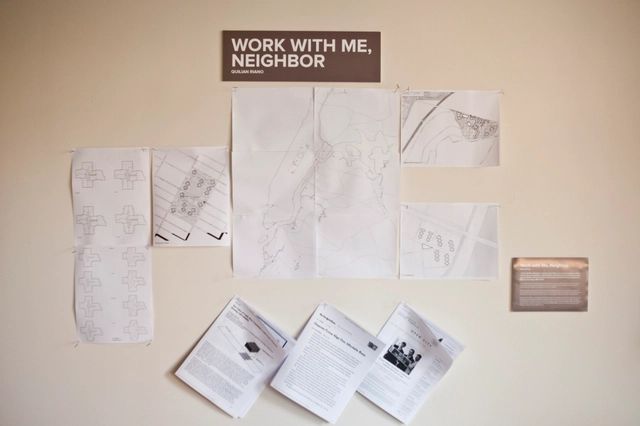
Institute for Public Architecture exhibition on public and affordable housing in NYC, "Total Reset." Installation by IPA Fellow Quilian Riano: “Work with Me, Neighbor.”
Mayor de Blasio has declared a “total reset” for public housing in New York. At the same time, the decline of affordable housing options has become New Yorkers' greatest concern.
"For the most part, the way urbanists view black neighborhoods (and other low-income neighborhoods and communities of color) are as problems that need to be fixed. At the heart of what I want to say is what can we as urbanists learn from these neighborhoods?" So asks Sara Zewde, a landscape architecture student at Harvard's Graduate School of Design and this year's Landscape Architecture Foundation’s Olmsted Scholar, in a fascinating profile on Metropolis Magazine. Read more about Zewde and her work here.
Winning entry "Circus for Construction" by Ann Lui, Ashley Mendelsohn, Larisa Ovalles, Craig Reschke, and Benjamin Widger. Image Courtesy of Storefront for Art and Architecture
Starting September 19th, the ten winners of WorldWide Storefront (WWSf) - an initiative by Storefront for Art and Architecture to create alternative spaces for the expression/exchange of art/architecture - will open across the globe for the next two months. While one winning proposal invites artists to travel the world on commercial freight ships, another will host exhibits and events out of a traveling semi-truck in the United States. For the full list of winners and more information, click here.
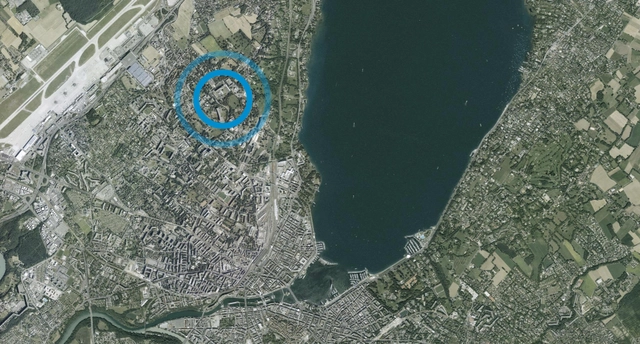
The World Health Organization (WHO, the Commissioning Organization) is the directing and coordinating authority for health within the United Nations system. On 23 June 2014, WHO launched an international, two-stage architectural design competition for the extension and redevelopment of WHO Headquarters in Geneva.
In an article for The Guardian Richard Rogers questions why, with space still left in urban areas, we should build in the countryside? Lord Rogers, no stranger to political activism, chaired the UK's Urban Task Force in the 1990s, culminating in his reportTowards an Urban Renaissance. Now, over fifteen years later, his plea for denser, better designed urban environments has been rekindled as he argues that: "We can't go on like this. The housing shortage threatens both the economy and our quality of life." Laying out a clear argument reinforced by his forty years of experience as an architect, you can read his article in full here.
From Architecture Forum Aedes. The exhibition "Building in the Metropolis MX" presents selected works from the Mexican studio Gaeta-Springall Architects. In their working process right through to realisation, architectural elements such as form, material and function serve a larger and more complex system: the City. Julio Gaeta, Luby Springall and their team take great care over designing the envelope in order to generate possible interactions through the porosity of the exterior skin. Here they set particular store by intelligent systems and technologies as the longevity and durability of the building lies in its efficiency and sustainability. Gaeta-Springall Architects dedicate themselves to space as an entirety, which they see as the “true stage of life”. For them, "Building in the Metropolis MX" means the linking of architectural, urban and social elements. It is here that they see their everyday work. After curating this year’s Mexican pavilion “Condemned to be modern” at the Venice Biennale, the presentation at Aedes is the second exhibition in Europe for Gaeta-Springall architects, already highly regarded in their home country.
For more information about the exhibition, head over to exhibition's site.
In a recent article for The Telegraph Jonathan Ruffer, a hedge fund manager turned campaigner for architectural heritage, discusses the significance of historic buildings in a time when they are "increasingly having to justify itself in the cold light of cost cuts." The notion of architectural "heritage" covers not only castles and stately homes but increasingly post-war and early contemporary structures. Speaking from a financier's point of view, Ruffler examines the "gulf" between public and private funding for restorative architectural schemes alongside the difficulty of mobilising large bodies to activate change. Arguing that "heritage has the power to change lives," the need for people to engage with their built heritage is more important than ever. Read the article in full here.
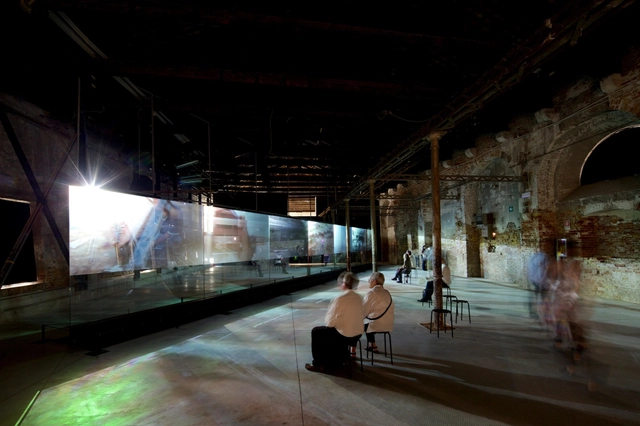
At its debut at the Venice Architecture Biennale 2014, Indonesia offers a peek into the country’s past 100 years of architectural history in its pavilion: “Craftsmanship: Material Consciousness.” Moving images projected onto glass panels tell Indonesia’s story through the development of six materials, traced over time: wood, stone, brick, steel, concrete and bamboo. See images of the pavilion and enjoy a statement from the curators after the break.
The series of earthquakes that began on 4 September 2010 altered the Canterbury landscape and had a huge impact on the people. Now it’s time to create a place to remember.
LEGO® Architecture Studio, a new concept of the LEGO Architecture line, makes his appearance in Italy in an innovative context of architecture and music. The LEGO Group chose Italy and the prestigious setting of the Sicilian "Villa Pennisi in Musica" event for the launch of the new set of building blocks.
Martino Stierli, The Philip Johnson Chief Curator of Architecture and Design, MoMA. Image Courtesy of MoMA
Martino Stierli, a Swiss architecture and art history professor interested in "how architecture is represented in the media and intersects with art," has been named Barry Bergdoll's successor as the chief curator of architecture and design at the Museum of Modern Art (MoMA).
Rafiq Azam is the principal of SHATOTTO architecture for green living, based in Dhaka, Bangladesh. He will introduce us to his work and city, which is also home to works by Louis Kahn. Azam’s “green” is not about global ratings or the current sustainability trend. It is his response to the sky, water, and vegetation that surround him and his city. There is an apparent simplicity in Azam’s work that disguises and belies a complex fabric revealing the wonders of the cosmos.
While other cities in the United States are shrinking, the world's largest retirement community - The Villages - is booming. Completely devoid of crime, traffic, pollution, as well as children, the fastest growing metropolitan area in the country raises serious questions about the concentrated demographic's future infrastructural needs. After all, by 2050, the over-60 set is expected to almost triple to 2 billion. To learn more, check out this fascinating article on Bloomberg.
Julia Morgan is the eighth posthumous winner of the Gold Medal, which has been issued since 1907. Image Courtesy of The Chronicle
Considering Julia Morgan was overlooked for over 100 years and has been dead for over 50, naysayers may consider her recent accolade as the first woman to receive the AIA Gold Medal something of an empty gesture. However, the prestigious group of supporters who compiled her nomination package - among them Michael Graves, Frank Gehry, and Denise Scott Brown - would beg to differ. To find out how and why the trio championed Morgan's case, check out this article on SFGate.
Urban farming is nothing new, but Aprilli Design Studio's proposal for a completely open-air skyscraper does put a novel spin on the sustainable ideal. Instead of tacking greenery onto roofs and balconies, they incorporate agriculture into cities by dedicating entire buildings to the cause. To learn more about the tree-like design, check out Fast Company's article here.