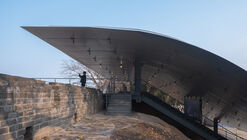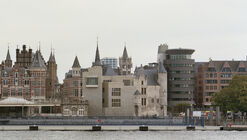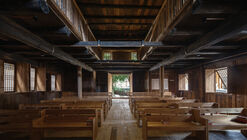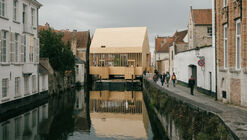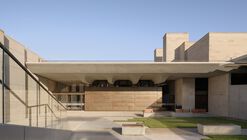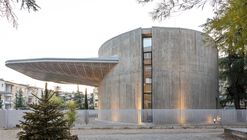
Architects: José María Sánchez García
Location: Mérida, Spain
Project Team: Enrique García-Margallo Solo de Zaldivar, Rafael Fernández Caparros, Maribel Torres Gómez, Laura Rojo Valdivielso, Francisco Sánchez García, José García-Margallo, Marta Cabezón López, Mafalda Ambrósio, Carmen Leticia Huerta, Marilo Sánchez García, Julia Ternström
Structural Engineer: CDE Ingenieros, Gogaite S.L
Services Engineer: ARO consultores
Project Year: 2011
Project Area: 2,158.19 sqm
Photographs: Roland Halbe
Heritage
Architects: Holzer Kobler Architekturen
Location: Wangen, Saxony-Anhalt, Germany
Project title: Arche Nebra (Nebra Ark)
Type: Visitor center and observation tower
Client: Burgenlandkreis, Kreisverwaltung
Year: 2007
Photographs: Jan Bitter
Architects: Acton Ostry Architects Inc
Location: Vancouver, British Columbia
Size: 14,000 square feet
Completion: 2009
Photographs: Courtesy of Acton Ostry Architects
Ben Kacyra, co-founder and CEO of Cyra Technologies and managing director of CyArk, discusses digital preservation of the World’s Heritage Sites through 3D laser scanning. The non-profit organization uses quick and precise 3D scanning systems to create high-resolution, digital models of historic sites through the creation of point clouds. These systems have the capability of gathering nearly 10,000 points per second, compared to a surveyor gathering only 500 points a day. With the constant threat of natural disasters and human destruction, the CyArk 500 Challenge aims to digitally preserve 500 World Heritage Sites within five years. Ben Kacyra states, “We are losing the sites and stories faster than we can physically preserve it.”
Could a digital archive of historical architecture offer some relief to the important buildings that are currently or may someday be at risk?

Courtesy of Architects 49
Architects: Architects 49
Location: Nakhon Pathom, Thailand
Client: The Office of His Majesty’s Principal Private Secretary
Project Year: 2009
Project Area: 17,653 sqm
Photographs: Courtesy of Architects 49

© a3gm
Architects: a3gm
Location: Clunia, Burgos, Spain
Project Architects: Jesús Alba Elías, Laura García Juárez, Jesús García Vivar, Smara Gonçalves Diez, Carlos Miranda Barroso
Collaborators: Ignacio Martínez Fernández
Contractors: Sopsa-Construcciones Peña Bravo
Project Year: 2007
Project Area: 668 sqm
Photographs: a3gm
Architects: Markus Scherer with Walter Dietl
Location: Franzensfeste, Italy
Client: Autonome Provinz Bozen
Collaborator: Heike Kirnbauer, Elena Mezzanotte
Structural Engineering: Baubüro-Klaus Plattner, Bozen
Project Year: 2009
Photographs: René Riller, Alessandra Chemollo
Architect: Perkins+Will, FBT Architects
Location: Albuquerque, New Mexico
Project Team: Eric Brossy de Dios, Angela Kunz, Ann Knudsen, Charlene Martin, Kevin Mereness, Ashley Stoner, Nathan Wilcox
Executive Architects: Fanning Bard Tatum Architects AIA, Ltd.
Project Year: 2008
Photographs: New York Focus Photography
Tea ceremonies have evolved a great deal since they first got their start in the ninth century, and as the ceremonies have grown and shifted in purpose, so have the tea houses that hold them.
Initially tea was seen as a medicine used to cultivate the mind, body and spirit; tea was seen as good for monks because it helped them to stay awake for long periods of meditation. For this reason, the military class sponsored the construction of large zen temples for monks to drink tea in. As tea began to grow in popularity beyond the temple, tea ceremonies became a source of entertainment for members of the upper class who could afford to gamble, read poetry and attend tea parties in extravagant pavilions. More information after the break. read more »

The Kronish House in Beverly Hills, California. From Mark Angeles via Unlimited Style
A place belongs forever to whoever claims it hardest, remembers it most obsessively, wrenches it from itself, shapes it, renders it, loves it so radically that he remakes it in his own image.
Joan Didion
Community pressure has swayed the owners of Richard Neutra‘s Kronish House to postpone plans for demolition, and has also prompted the city of Beverly Hills to draft legislation to preserve its architectural history. The house been spared until at least October 10 in order to give community activists time to devise a plan for its restoration. In a related, ground-breaking action the Beverly Hills City Council has asked the city’s Planning Commission to enact a first-ever historic-preservation ordinance.
Any trip to Athens, Greece would not be complete without a visit to the Acropolis, the purest remaining form of what the Greeks thought architecture should be. And yet, if you stopped by a few weeks ago, you might have been surprised to find large banners proclaiming support for a communist trade union adorning the Acropolis hill. These banners are the most visible and literal signs of the Greek debt crisis affecting the historic landmarks in the country, but they are not the ones doing the most damage. That honor goes to the drop in tourism that Greece has experienced since the beginning of the global recession and runs through the country’s fiscal problems to the present. More on how the debt crisis is affecting historical landmarks after the break.
When one mentions the architecture of Germany during World War Two, the first ideas that come to mind are not the possibilities for new growth in the 21st century. But that is exactly what the Nazi bunkers that were built provide for us today. In Berlin, these bunkers are a monolithic and often oppressive reminder of the past, but are also ripe for intelligent thought about what they can be used for in the future. More information and images after the break. read more »
David Tribby, of David Tribby Photography has spent the past few years documenting the abandoned and decaying architecture of Gary, Indiana and has shared his collection of work with us. Considering his work, Gary’s past and Gary’s present allows us to discuss a broader topic, the possible outcomes for abandoned architecture and their role in today’s urban centers. More of David Tribby’s photographs and a brief narrative after the break.
read more »

Courtesy DATA Architectes
Data Architectes has submitted their project, a proposal for the Cultural and Spiritual Russian Orthodox Center in Paris. Additional images and a short description from the architect after the break.
read more »
Architects: isuuru arquitectos – Aitzpea Lazkano Orbegozo y Carlos Abadías Banzo
Location: San Sebastian, Spain
Project area: 1,990 sqm
Project year: 2010
Photographs: Jesús Martín Ruiz
Of a total of 410 projects, five have been selected for the 2010 Aga Khan Award for Architecture at the Museum of Islamic Art in Doha. The five projects, selected by a Master Jury are:
- Wadi Hanifa Wetlands, Riyadh, Saudi Arabia
- Revitalisation of the Hypercentre of Tunis, Tunisia
- Madinat Al-Zahra Museum, Cordoba, Spain
- Ipekyol Textile Factory, Edirne, Turkey
- Bridge School, Xiashi, Fujian, China
For more information on the winners and images read on after the break.

FG+SG – Fernando Guerra, Sergio Guerra
Architect: João Luís Carrilho da Graça
Location: Lisbon, Portugal
Landscape Architect: João Gomes da Silva
Project Team: Francisco Freire, Vasco Melo, Pedro Abreu, Monica Ravazzolo, architects; Paulo Barreto and Vanda Neto, models
Foundations and Structures: Estudos Betar / José Pedro Venâncio and Paulo Mendonça
Water Installations: Estudos Betar / Marta Azevedo and Jorge Pinheiro
Electrical Installations: Ruben Sobral
Security Installations: GIPIC – Alexandre Martins
Graphic Design: Henrique Cayatte, Mónica Lameiro and Pedro Gonçalves
Project Area: 3,500 sqm
Budget: 1,000,000 €
Project Year: 2008-2010
Photographs: FG+SG – Fernando Guerra, Sergio Guerra

Courtesy of Raphael França and Adrien Mondine
Raphael França and Adrien Mondine have submitted their competition entry for a multicultural cemetery in Järva, Stockholm, Sweden. The challenge and aim of the competition was to develop a place for remembrance and reflection for all on a site already embedded with societal values. The chosen site has an interesting past: an artificial hill was created as a result of the dumping of construction debris from neighboring housing projects in the 70s and 80s, it was then dominated by frisbee players as the one of the most frequented sites in Sweden.
More information on the project and images after the break.
Architects: Radionica Arhitekture / Goran Rako
Location: Vid, Metković, Croatia
Project Team: Mario Beusan, Blanka Gutschy, Goran Rako, Nenad Ravnic
Structural Engineering: Branko Galic
Project Area: 1,200 sqm
Project Year: 2001-2004
Construction Year: 2007-2008
Photographs: Boris Cvjetanovic
Architect: Alberto Campo Baeza
Location: Cádiz, Spain
Project Year: 2000-2009
Photographs: Javier Callejas