We enjoy looking at historic interiors, but there’s more to them than meets the eye. Behind the walls, below the floors, and underneath the painted surfaces are the back-stories few people have heard about the city’s known and not-so-known landmarks. The authors of Interior Landmarks: Treasures of New York (The Monacelli Press; September 29, 2015) will take us behind the scenes of some of the City’s most interesting spaces. They will tell little-known and fascinating stories about places like City Hall and the Tweed Courthouse, Loew’s Paradise Theater, the Four Seasons Restaurant, the Dime Savings, and Manufacturers Trust bank buildings. They will share stories of the political wrangling, financial skullduggery, design competitions, preservation challenges, and restoration problems that designers and builders dealt with to provide insight into why these venues are so special and how even being a landmark doesn’t guarantee that a great space will remain safe from damage, or change. This program delves into the themes of our exhibition Saving Place: 50 Years of New York City Landmarks, on view through January 3.
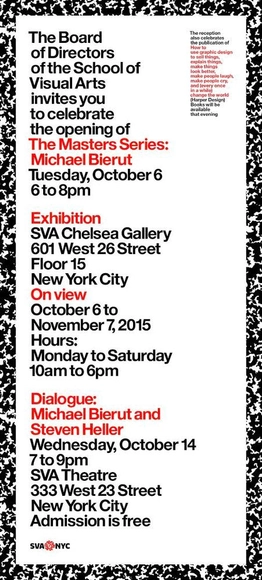
School of Visual Arts honors designer, critic and educator Michael Bierut with the 27th annual Masters Series Award and Exhibition. “The Masters Series: Michael Bierut” is the first comprehensive retrospective of the designer’s work, and features groundbreaking logos, graphics and exhibition designs as well as personal works from his own collection. The exhibition will be on view from October 6 through November 7 at the SVA Chelsea Gallery, 601 West 26th Street, 15th floor, New York City.
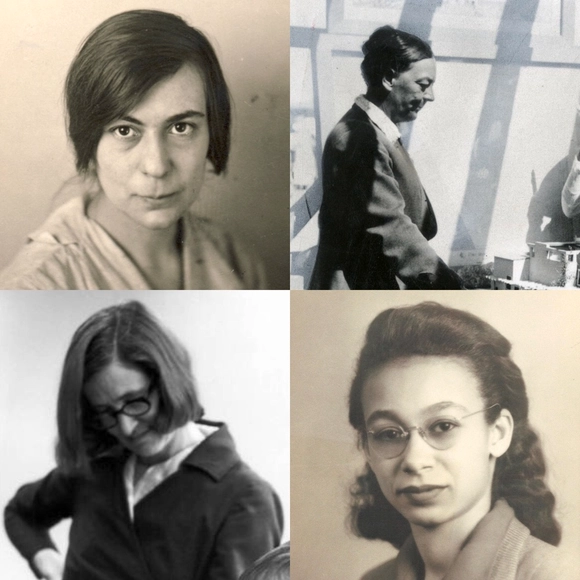
Pioneering Women in American Architecture, (clockwise from top left) Elsa Gidoni, Alice Constance Austin, Georgia Louise Harris Brown, Natalie Griffin de Blois. Courtesy Beverly Willis Architecture Foundation
In conjunction with Archtober and New York Archives Week, the Guggenheim will host its third Wikipedia edit-a-thon—or, #guggathon—to enhance articles related to women in architecture on Wikipedia, the world’s largest source of free knowledge.
Historic preservation activism in New York City did not begin in the 1960s with the fight to save Penn Station and the effort to pass the Landmarks Law—it began in the late 19th century. Little-remembered preservation pioneers like Andrew H. Green and Albert Bard, as well as various women's garden clubs, and patriotic and civic organizations laid the groundwork for the generations of preservationists that would follow. Join us to recount the triumphs, failures, and tactics of these early preservationists, and discuss what they might teach us moving forward.This program delves into the themes of our exhibition Saving Place: 50 Years of New York City Landmarks, on view through January 3.
Drawings from the private collection of Alvin Boyarsky, Chairman of the Architectural Association (AA) from 1971 to 1990, will be on display as part of Drawing Ambience: Alvin Boyarsky and the Architectural Association. Hosted by The Irwin S. Chanin School of Architecture of The Cooper Union from October 13 to November 25, 2015, the free, public exhibit will also feature panel discussions with Nicholas Boyarsky, Joan Ockman, Bernard Tschumi, Anthony Vidler, Michael Webb and Dean Nader Tehrani. Read more about this event and the drawings exhibited after the break.
Volunteers support a Build It Green project in Queens during last year's Day of Impact. Photo by Sakeenah Saleem, courtesy of AFHny.
This Archtober, join over one hundred architects and design professionals in making an impact in their local communities through AFHny’s annual city-wide service day.
Participants will work alongside some of the region’s leading community-focused organizations through hands-on painting, planting, and rebuilding projects, all of which will improve New York's neighborhoods on both physical and social levels.
An award-winning anthropological case study by designer Stephen Fan, SUB URBANISMS explores the controversial conversion of suburban single-family homes into multi-family communities by immigrant Chinese casino workers in Connecticut. Addressing the norms, cultural values, and public policies that determine how most Americans live, the exhibition juxtaposes immigrant cultural beliefs and pragmatism with suburban American social, aesthetic, and financial codes. With a regional focus and global reach, it also provides insight into the long-term effects of 9/11 on the New York Chinatown service industry as a significant factor behind the influx of Chinese labor seeking employment at the region's casinos, and the formation of this satellite suburban Chinatown. With creative implications for the future of housing design and habitation in response to cultural, social, and ecological challenges, SUB URBANISMS offers a powerful inquiry into the ways in which culture shapes our lives and homes.
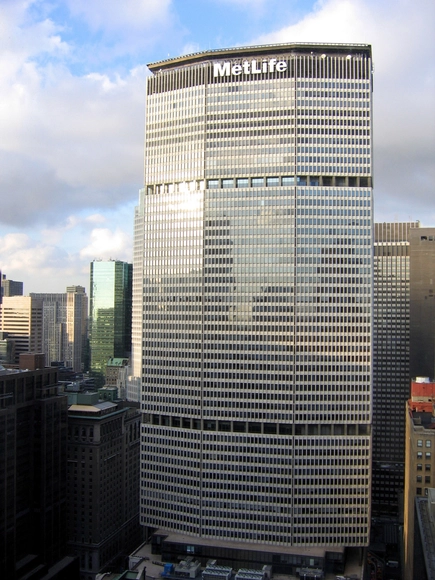
Metals in Construction magazine has launched a competition for architects, engineers, students, designers, and others from all over the world to submit their vision for recladding 200 Park Avenue, built a half-century ago as the world’s largest corporate structure, the Pan Am Building (now the MetLife Building).
The mandate is to reimagine this New York City icon with a resource-conserving, eco-friendly enclosure—one that creates a highly efficient envelope with the lightness and transparency sought by today’s office workforce while preserving and enhancing the aesthetic of its heritage. Entrants may now register on the competition's official website. The deadline for final submission is February 1, 2016.
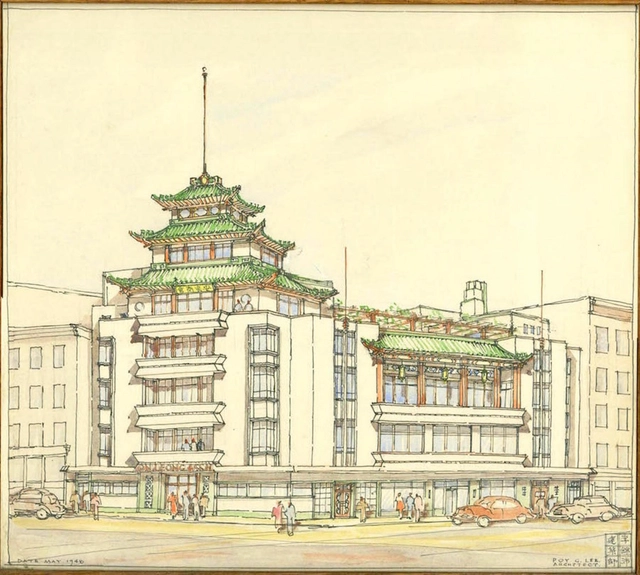
Image credit: Poy Gum Lee, "On Leong Tong", 83-85 Mott Street. Presentation Drawing., 1948, Ink and watercolor on paper, Courtesy of the Poy Gum Lee Archive.
In this survey exhibition, architectural historian Kerri Culhane documents and explores Poy Gum Lee’s (1900-1968) nearly 50-year long career in both China and New York and examines Lee’s modernist influence in New York Chinatown. This project will result in the first-ever comprehensive list of Lee’s projects in New York. Lee’s hand is visible in the major civic architecture of Chinatown post 1945, which blends stylistically Chinese details with modern technologies and materials. Lee was the architectural consultant for the Chinese Consolidated Benevolent Association’s building on Mott Street (1959) and the On Leong Tong Merchant’s Association at Mott & Canal Street (1948-50) – the most prominent Chinese modern building in Chinatown. Among his highly visible commissions, Lee designed the Chinese-American WWII Monument in Kimlau Square (1962), a modernist take on a traditional Chinese pailou, or ceremonial gate; the Lee Family Association (ca. 1950); and the Pagoda Theatre (1963, demolished).
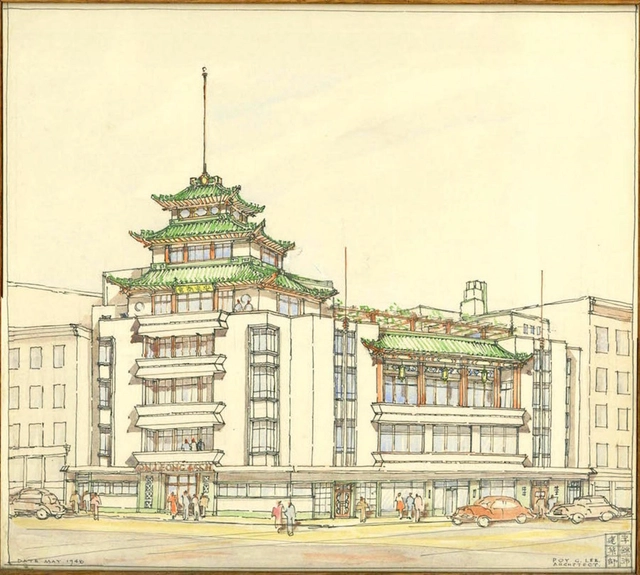
Image credit: Poy Gum Lee, On Leong Tong, 83-85 Mott Street. Presentation Drawing., 1948, Ink and watercolor on paper, Courtesy of the Poy Gum Lee Archive.
It’s hard to miss the On Leong Tong Chinese Merchants building on the corner of Mott and Canal Streets. With its pagoda façade and ornamented balconies, this iconic building designed by Chinese American architect Poy Gum Lee reveals the distinct hybrid modern architectural style often referred to as “Chinese modern.” Through Poy Gum Lee’s body of work in Chinatown and in China, guest curator of "Chinese Style: Rediscovering the Architecture of Poy Gum Lee, 1923-1968", Kerri Culhane illuminates Lee’s influence on the architectural aesthetics in Chinatown, the cultural and political impulses behind this architecture style, and the role of the built environment as an expression of identity.
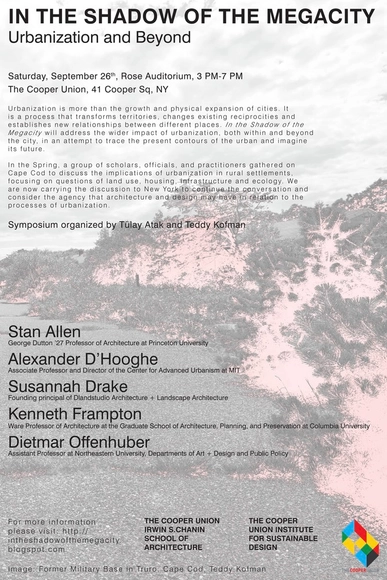
Urbanization is more than the growth and physical expansion of cities. It is a process that transforms territories, changes existing reciprocities and establishes new relationships between different places. In the Shadow of the Megacity will address the wider impact of urbanization, both within and beyond the city, in an attempt to trace the present contours of the urban and imagine its future.
On September 24, the National Academy Museum will present a conversation on architecture between 2015 AIA Gold Medal Recipient Moshe Safdie and acclaimed architectural writer and critic Nicolai Ouroussoff. This public event—presented in conjunction with the National Academy Museum’s exhibition Global Citizen: The Architecture of Moshe Safdie (September 10, 2015 – January 10, 2016)—invites audiences to enjoy a spirited discussion on art, architecture, culture and context with two leaders in the field of architecture and architectural criticism. More information and tickets are available here: http://www.nationalacademy.org/museum/programs-artalks/.
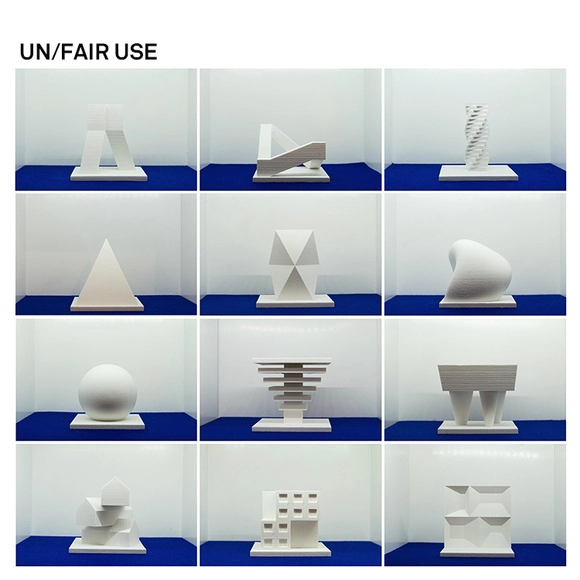
Un/fair Use is an exhibition of research and proposals related to copying and copyright in architecture.
Appropriation is as much a part of architecture as the expectation of novelty, and so it is at the very core of the discipline. Architecture advances via comment, criticism, parody, and innovation, forms of appropriation that fall under the umbrella of fair use. But what about when appropriation is deemed unfair? Where and how are the lines drawn around permissible use? Un/fair Use probes that legal boundary.
Please join us for the exhibition opening of Sea Level: Five Boroughs at Water's Edge, and a conversation with author and curator Robert Sullivan, and photographer Elizabeth Felicella. The two will engage in a wide-ranging discussion on the collaborative panorama exploring the past and future of New York City's expansive waterfront.
This day-long symposium, the first of its kind, will cover topics ranging from urban climatology to building materials, with case studies and recommendations for the future.
The threat of extreme heat will intensify. Even United States President Obama has told us that the planet’s temperature is rising and that we must come to grips with that inevitability. The last decade was the hottest on record worldwide, and large cities are warming faster than the planet. Scientists predict that extreme heat events – already more deadly than all other weather-related events combined – will become more frequent. Extreme heat reduces productivity, exhausts greenery, compromises infrastructure, destroys property, and strains the economy and resources alike.