This article was originally published on CommonEdge as "Rob Walker on the Mistakes of Brad Pitt's Make it Right."
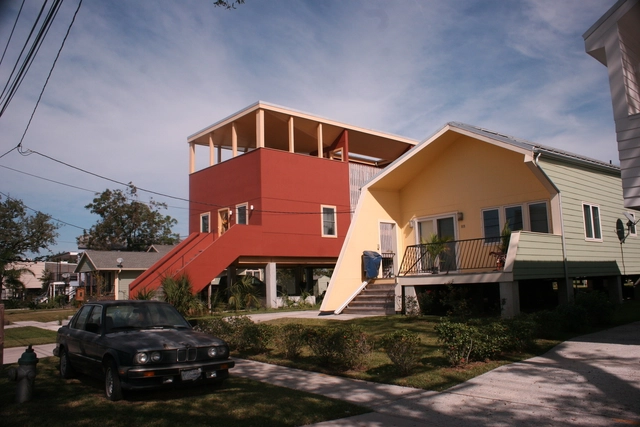
I will start with a confession: I was part of the fawning media swarm that lauded and applauded the accomplishments of Make It Right, Brad Pitt’s bold attempt to rebuild a portion of the Lower Ninth Ward in New Orleans. The project was, it seemed once, one of the few post-Katrina success stories coming out of that flood-ravaged community.
ArchDaily turns 11! To commemorate the occasion, we want to share with you the 11 projects most visited by our readers during this incredible journey. From the indisputable and timeless classics from of designers like Le Corbusier and Ludwig Mies van der Rohe, to the pioneering works of architects such as Zaha Hadid and OMA, passing through the delicate work of Gabinete de Arquitectura, these 11 examples teach us valuable lessons about architecture, most importantly: how to design for specific requirements without losing the creativity and beauty of architectural design.
On behalf of ArchDaily, we want to thank you for sharing with us the best architecture in the world, helping us to inspire professionals from all over the world to build better cities.
Sir Terry Farrell's SIS Building at Vauxhall Cross
Sir Terry Farrell to speak about his long and varied career in architecture. Farrell, who is known for his exuberantly postmodern works in Britain, tells of how he became interested in architecture, the role architects will play in our rapidly urbanizing world, and speaking openly about our cities.
https://www.archdaily.com/912911/sir-terry-farrell-speaks-to-monocle-on-design-about-his-six-decade-career-in-architectureKatherine Allen
YACademy launches the second edition of Architecture for Landscape, a high-level training course offering 8 scholarships and internships in internationally-renowned architectural firms.
101 hours of lessons, a 32-hour workshop and internships/lectures held by internationally-renowned architectural firms like Stefano Boeri Architetti, Snøhetta, Hhf Architects, Rodrigo Duque Motta, Jean Nouvel Design, Rintala Eggerston, and Jensen & Skodvin.
* Original Author: Xie Xiaofan, Vice President of the China National Academy of Painting. Xie collaborated with Arata Isozaki to build the Central Academy of Fine Arts (CAFA) Art Museum and has curated a series of large-scale exhibitions. Xie is the author of "Exhibiting the Art Museum" and "Discerning Forms: Walking Between Art and Construction", led the drafting of the state-issued "National Standards for Art Museum Construction," and previously oversaw the construction of the new National Art Museum of China. *This article is published with the authorization of Xie Xiaofan.
At 23:30 on March 5, upon receiving the first news of Arata Isozaki winning the prize, I immediately sent the following message to Hu Qian: "It would be incredibly badass if Old Iso immediately declined the Pritzker. Tell him my thoughts right away. The Pritzker is about celebrity and fashion; Old Iso is a literati avant-garde." As the person who turned Isozaki’s ideas and drawings into physical architecture, and as someone who has bickered and fought alongside Hu Qian, this was my immediate, gut-reaction response.
https://www.archdaily.com/1070430/xie-xiaofan-when-arata-isozaki-won-the-pritzker-prize韩爽 - HAN Shuang
Recently, HASSELL was invited to participate in the master planning and landscape design competition for this site, reimagining it as Hefei Central Park while preserving the memories of its past. Ultimately, HASSELL's proposal was selected as one of the two winning designs. The jury commented: "HASSELL’s proposal features a well-structured urban design framework, and the treatment of the interface between the park and the city is particularly striking. The skeletal road network is highly feasible, and the internal circulation system is thoroughly designed. While the runway is preserved intact, its potential for future adaptation is enhanced. Additionally, the 'Green Ribbon' concept at the intercity transit node is highly distinctive."
https://www.archdaily.com/1070549/hassell-unveils-master-plan-and-landscape-design-for-hefei-central-park舒岳康 - SHU Yuekang
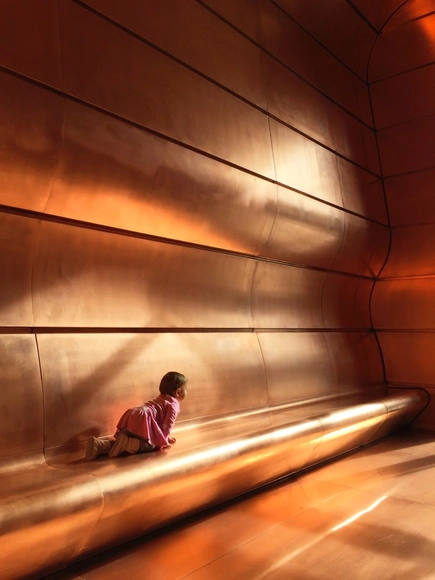
This renovation project by Peter Ebner and friends ZT GmbH is about the history of a place and changing tastes and times. It is about not needing a large scale to radically improve the space around. It is about the beauty and character of the city with its reflected sparkling life, gloomy evening sky, raindrops and lights of passing cars. It is about people who are mostly in a hurry, but who still sometimes stop for a few seconds to take note of a special, glittering room.
"Isn't it fascinating how this simple act of drawing a line on a map can transform the way we see and experience the world?" asks Ronald Rael in his December 2018 TED Talk. "And those lines on a map can create scars in the landscape and scars in our memories."
https://www.archdaily.com/912920/a-new-ted-talk-by-ron-raels-puts-architectures-power-to-divide-in-the-spotlightKatherine Allen
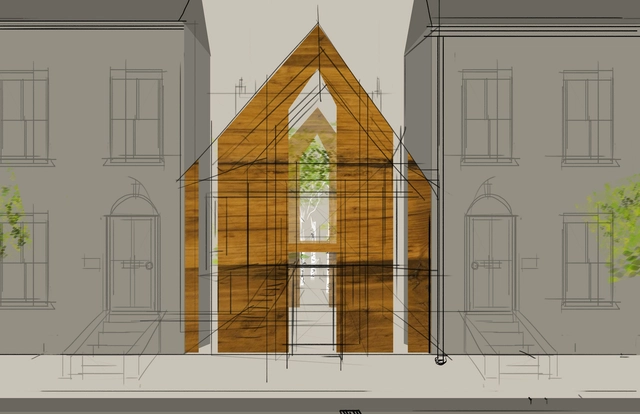
Many of the most compelling design solutions stem from site conditions—whether climate, local materials and labor, construction techniques, or, above all, the way these factors are addressed within the highly specific context of the plot. The plot is the ultimate space for putting these strategies into practice. As cities increasingly feature smaller land parcels, designing for narrow lots has become a recurring reality.
Yona Friedman is a French architect and urban planner with more than 92 years of experience that has led him to participate in numerous events, including the Venice Biennial and the Shanghai Biennial. One of his most important works was published in 1958, entitled L'Architecture Mobile, which exposed one of his most ambitious projects named: "La Ville Spatiale", a utopia that recycled mega-structures of existing cities to provide citizens with the chance to live with complete flexibility in their decisions.
Tracing the development of Chinese civilization reveals a journey that moves from the lower reaches of the Yellow River upstream. Journeying backward from Beijing of the Ming and Qing dynasties, through Luoyang of the Sui and Tang, to Xi'an of the Qin and Han, one eventually reaches Qin'an—the site of an 8,000-year-old prehistoric civilization. Recently, the Qin'an Archives, designed by WEISHE Studio, broke ground in this historic and cultural city, celebrated as the birthplace of the mythological figures Fuxi and Nuwa. The new facility will not only preserve county records and archives but will also serve as a public cultural hub, integrating research, reading, cultural exhibitions, and academic exchange.
https://www.archdaily.com/1070437/weishe-architects-unveils-design-for-qinan-county-archives-featuring-a-weathered-and-cracked-facade舒岳康 - SHU Yuekang
Most of us share childhood memories of drawing little houses—a triangular roof, a door, a window, and a tree beside it. What sets architects apart from the general public, however, is that we continue to make these drawings long after we grow up. Naturally, our skills usually mature along the way. Just as our residential architecture becomes more complex and refined, our representation of trees must also evolve (that broccoli-like scribble is unlikely to impress clients or professors). While trees are rarely the focal point of a drawing, they play a crucial role in architectural composition, establishing scale, casting shadows, and representing specific landscape designs.
This article serves as a brief introduction to a way of thinking that I assume to be foreign and new to most of the readers. It is based on some observations I’ve made during the past 5 years as part of my PhD research into the comparison between two traditions of architectural representation, between China and Europe, under guidance of prof. Li Xiaodong at Tsinghua University in Beijing. With that in mind this article has no pretension, nor the proper length, to fully convey the complexity of the representations of architectural space in drawings from China, but should be seen as a first try to communicate some of these ideas to a wider audience.
Architecture, in all its forms, has the innate ability to trigger our emotions and alter our perceptions. Consequently, a lot of light is currently being shed on the relation between architecture, landscape, and health.
Carolina Maria de Jesus, 1960. Documentary collection: Correio da Manhã. Image via Wikipedia
In this doctoral dissertation, architect and urban planner Gabriela Leandro Pereira explores the accounts and contested urban narratives of the writer Carolina Maria de Jesus, from Minas Gerais, Brazil. Carolina is one of the country's pioneering and most prominent Black female writers; her best-known work is the book Quarto de Despejo: Diário de Uma Favelada—the raw account of the harsh daily reality experienced by a Black woman, waste picker, and resident of the Canindé favela in São Paulo. Defended in 2015 at the Federal University of Bahia under the advisement of Professor Ana Maria Fernandes, PhD, the dissertation received the Rodrigo Simões Doctoral Dissertation Award from the National Association of Postgraduate Studies and Research in Urban and Regional Planning (ANPUR) in 2017. Read the abstract provided by the author below.
https://www.archdaily.com/1121419/body-discourse-and-territory-the-contested-city-in-the-folds-of-carolina-maria-de-jesuss-narrativePedro Vada
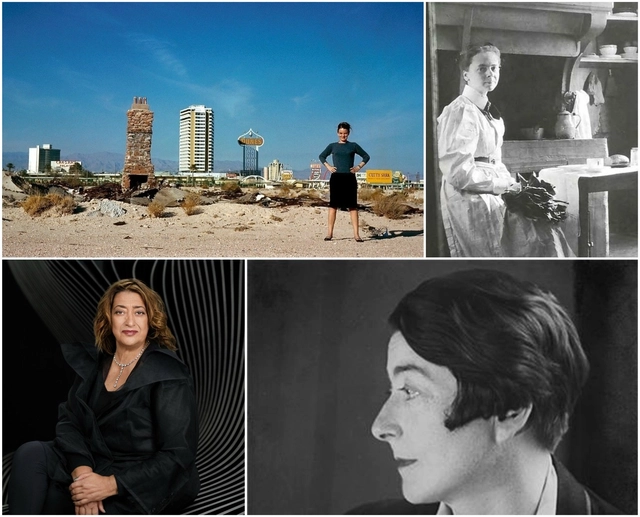
This article is an updated version of its original post on March 15th, 2016. "In the ongoing debate about women in the architecture profession, you rarely hear an argument for why equal representation is important; it's generally assumed to be an unquestionable moral imperative. However, in this article originally published on the Huffington Post as "Why Women's Leadership Is Essential for Architects," Lance Hosey argues that, regardless of your position on equality as a moral imperative, better representation of women in architecture could benefit everyone in the profession—in very tangible ways.
Today, on International Women's Day (March 8) we want to share again the American Institute of Architects (AIA) publication "Diversity in the Profession of Architecture," its first diversity report in a decade. The release follows the creation in December 2015 of the AIA's "Equity in Architecture Commission," a panel of twenty architects, educators, and diversity experts to investigate diversity and inclusion in the profession. The new report documents a survey of over 7,300 professional architects and students, including men and women, 79% of them whites and 21% people of color.
When applying for an architecture job, you need to make sure you have the perfect portfolio. While a clever and attractive business card might help you initially get a firm's attention, and a well-considered résumé or CV might help you prove your value, in most cases it will be your portfolio that makes or breaks your application. It's your portfolio that practices will use to measure your design sensibilities against the office's own style and to judge whether you match up to the talents claimed in your résumé.
After launching a call for our readers to send us their own portfolios so that we could share the best design ideas with the ArchDaily community, this selection below shows the best of the nearly 200 submissions we received, which were judged not on the quality of the architectural design they showed (though much of it was excellent) but instead the design quality of the portfolio itself. In making the selection, we were looking for attractive graphics, a clear presentation of the work itself, the formulation of a visual identity which permeated both the architectural designs and the portfolio design, and of course that elusive and much-prized attribute: "creativity."
https://www.archdaily.com/872418/the-best-architecture-portfolio-designsAD Editorial Team
Brazil currently has 167,060 active, registered architects and urban planners with the Council of Architecture and Urbanism. The majority, 63.10% (105,420), are women, while 36.90% (61,640) are men (61,400). In 2018, these percentages were 62% and 38%, respectively. This predominance is expected to grow in the coming years, as the share of female students is significantly higher: 67%.

















.jpg?1496179855&format=webp&width=640&height=580)