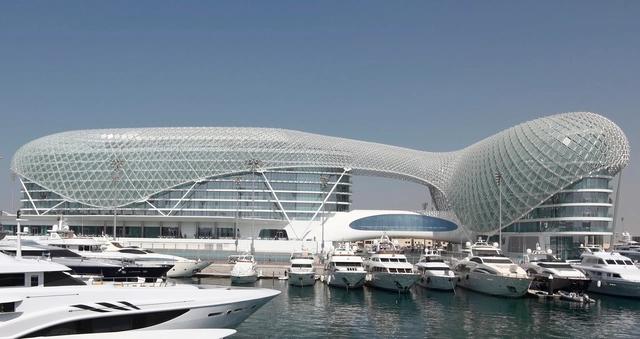
Yas Viceroy Hotel Abu Dhabi, UAE, 2010. Image Courtesy of Asymptote Architecture
Founded in 1989, Asymptote Architecture is one of those rare practices that gained their initial notoriety despite the fact that in the early years of their practice most of their designs went unbuilt. As a result, only in the last decade or so have the practice's futuristic and parametric forms truly been tested as physical architecture, with projects such as the Yas Viceroy Hotel in Abu Dhabi. In this installment of his “City of Ideas” column,Vladimir Belogolovsky speaks with Asymptote founders Hani Rashid and Lise Anne Couture about their inspirations, the creation of space and whether architecture can ever be thought of as solving problems.
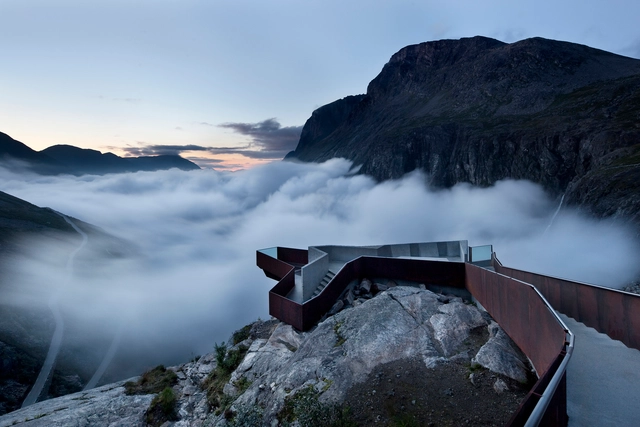
RRA's National Tourist Route in Trollstigen is among nine selected projects which will be displayed in-depth. Image via rra
The Swedish Centre for Architecture and Design (ArkDes) have revealed that In Therapy: Nordic Countries Face to Face—the exhibition for the Nordic Pavilion at the 2016 Venice Biennale, curated by David Basulto—will partly comprise "a contemporary survey of Nordic architecture." 300 projects, drawn from over 500 submissions to a recent open call, will be complemented by an in-depth study of nine projects completed post-2008 by practices including Tham & Videgård, Reiulf Ramstad Arkitekter, and Lahdelma & Mahlamäki.
"Just as Sverre Fehn’s pavilion is a crystallisation of Nordic architecture—embodying a precise and fluid articulation of structure, light, and nature—the nine we have chosen to focus in on as particularly representative of the contemporary scene have a similar gravitas and complexity – but with their own distinct identities" says Basulto, who has made the selection alongside James Taylor-Foster, Assistant Curator.
https://www.archdaily.com/782330/nine-projects-from-finland-norway-sweden-to-be-highlighted-in-in-therapy-the-nordic-contribution-to-the-2016-venice-biennaleAD Editorial Team
As a profession with the power to alter people's cities and neighborhoods - and indeed therefore their lives - architecture is often a controversial business to be involved in; many members of the public have learned to be suspicious of any plans for development in places they care about, often turning architecture into a villain to be fought. One proposed solution to this conundrum is to include public participation as much as possible, but many architects are skeptical of such an approach. At a time when the responsibilities of architects are being eroded by engineers and project managers, what would be left to architects if the public is allowed control over the design? Seeking to understand this challenge, in this interview from MONU Magazine's latest issue on "Participatory Urbanism," Bernd Upmeyer speaks to Jeremy Till, a British Architect, writer and educator who has written extensively about the need to for architects to relinquish control and involve local communities in their design process.
Bernd Upmeyer, on behalf of MONU, spoke with the British architect, writer, and educator Jeremy Till. He is the head of Central Saint Martins and Pro Vice-Chancellor of the University of the Arts, London. Previously he was Dean of Architecture and the Built Environment at the University of Westminster, and Professor of Architecture and Head of School of Architecture at the University of Sheffield. Till’s research and writing concentrate on the social and political aspects of architecture and the built environment. His written work includes "Flexible Housing," "Architecture Depends" and "Spatial Agency." In 2005 he was one of the editors of the publication “Architecture and Participation” to which he contributed a piece entitled "The Negotiation of Hope." The interview took place on September 3, 2015.
Coming off of a weekend of brutally cold temperatures in the Northeastern United States, the praising of ice might strike some as disagreeable. But seeing the aqueous creations of the Utah based Ice Castles makes a persuasive case for enduring winter’s wrath. Using a patented system, the company designs ice constructions formed through an additive process in which a substructure of icicle lattices are sprayed with liquid water, resulting in grand formations with the appearance of stalactites or sublimating gases frozen in time.
Seasonally, in four cold-climate locations in North America, the company creates castles of varying sizes that are built over the course of three to four weeks and maintained for approximately six to eight weeks thereafter. What may seem like a simple activity – after all, it’s just ice and water – is actually a complex orchestration, not unlike more traditional architecture, which involves the careful consideration of a number of strategic and site-specific factors.
I think any man who really has faith in himself will be dubbed arrogant, I suppose. I think that's what happened to me. - Frank Lloyd Wright
In this video produced by Blank on Blank, Frank Lloyd Wright shares his thoughts on New York City, religious architecture, and being labeled arrogant. The interview was taken from a 1957 episode of The Mike Wallace Interview when Wright was 90 years old. Showing his trademark fieriness even at his advanced age, Wright claims that if he had another 15 years he would be able to change the whole of the United States for the better, dismissing the judgement of those with the audacity to call him arrogant. Watch the animated video above, and read on after the break for some of the interview's most quotable moments.
Last week, ArchDaily unveiled the 14 winners of this year’s Building of the Year award. Selected by ArchDaily readers from a pool of over 3,000 candidates, these 14 projects represent the best designs published by ArchDaily in the past year, as determined by an unbiased network of 55,000 voters who took part - each of them a judge in one of the world's most democratic architecture awards.
Representing a diverse field of architects, locations and project types, each design has a very different story about how it came into being, how its design responds to its context, how it fits into an architect's oeuvre, or what it says about the direction which architecture is traveling in. But despite the many different types of story represented, each of the stories behind the Building of the Year winners is a fascinating architectural tale. Here are those 14 stories.
Starting in 2016, ArchDaily's projects team - the editors responsible for selecting the projects we publish on ArchDaily - will be selecting one exceptional project every month. We hope that this will shine a light into our selection process by allowing us to highlight projects that motivate and inspire us. Whether it’s a project that demonstrates an outstanding relationship to its context, or a building whose materials emphasize the power of architecture, these “Projects of the Month” should be seen not only as valuable architectural references, but also sources of inspiration and knowledge.
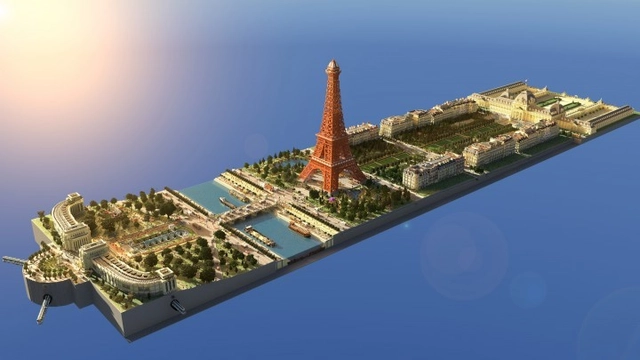
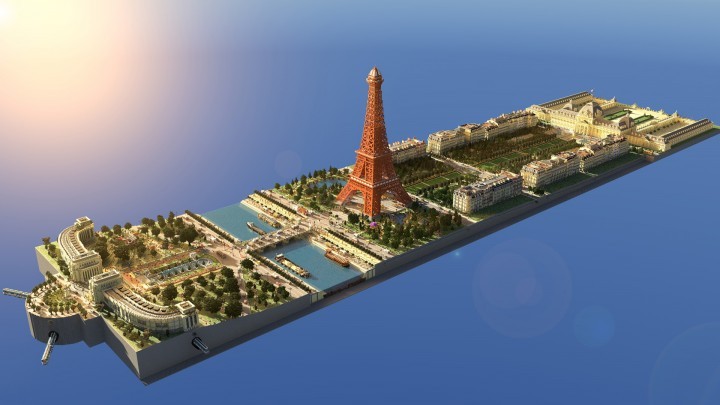
Model of the Eiffel Tower in Minecraft. Image via LanguageCraft
With more than 70 million copies sold worldwide, it would be unfair to refer to Minecraft as just a simple game of textured boxes in a pixelated 3D world. After acquiring the makers of the game (Mojang) in 2014, Microsoft announced on Tuesday, January 19 that it also acquired MinecraftEdu, the official educational version of Minecraft, which is used as a creative tool in more than 10,000 classrooms in 45 countries around the world.
The infinite possibilities that the game offers have led millions of people around the world to make and share their greatest creations: cities, buildings and even the reinterpretation of historical structures. Minecraft's impact was recognized in 2015 when the Centre Pompidou dedicated an exhibition to its creative potential for children and adolescents.
We've rounded up 15 of the best models created on the platform. And if you use Minecraft, you can download most of them (via an external link provided by the creator) to add to your own account.
After NASA’s discovery of water beneath the surface of Mars earlier this year, and the subsequent critical and popular success of the movie The Martian, it's safe to say that the planet named after the God of War is all the rage. Those revelations have led to speculative looks at how our neighboring planet could be colonized from numerous designers, such as Norman Foster.
Many of those plans, including those of SpaceX founder Elon Musk, involve dumping Earthen construction materials onto the alien surface, potentially starting an inclination for pollution of our new world before it is even occupied. Spanish architect Alberto Villanueva of IDEA Architecture Office saw this as an opportunity for design to intervene. Using Martian soil and the fungus mycelium, Villanueva proposes a strategy utilizing 3D printing and bioluminescence that has gained the attention of both NASA and the European Space Agency.
Architecture serves many essential functions in the fabric of the built environment, but it is the perpetual deficit of housing that some might argue is the field’s ultimate clarion call. In virtually every global city, growing populations and limited supplies of affordable dwellings are the major issues of twenty-first century life—and therefore are indications of the continued relevance of architecture in solving vexing urban predicaments. The last century offered early promise in addressing such issues with proposals to house the masses in immense slabs and box buildings, structures almost as large as their social ambition. But what became an asset of scale overlooked, or more probably misunderstood, the social degradation that such largeness elicited.
Aware of the fact that a one-size-fits-all approach to social housing rarely brings the desired outcomes of sociability, accountability, and community, Winnipeg’s 5468796 Architecture sought to reinvent the typology on a smaller scale. The outcome, a project in Winnipeg’s Central Park neighborhood known as Centre Village, is a 25-unit housing complex that prioritizes windows for observation and public spaces for socializing. Initially heralded as a beacon for public housing done right, the project was recently the target of vitriol in a Guardian article, claiming its secluded courtyard makes it "a magnet for drinking and drug-taking" and that its architectural vanity is to the detriment of apartment sizes and layouts. Subsequently, the Winnipeg Free Press published a response piece, "Building a better neighbourhood," and more recently on ArchDaily, 5468796 published a “letter-to-the-editor” to share their side of story and to dispel some of the negativity surrounding Centre Village. The myriad of perspectives can make you wonder: who’s right?
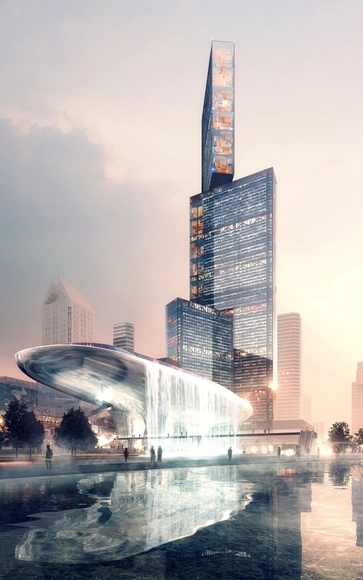
British firm PLP has unveiled their design for a large complex at the heart of the Pearl River Delta in China. The master plan comprises four buildings: the Platform for Contemporary Arts, the Lizhi Park Tower, the Concourse, and the Nexus - a 600-meter tall office and hotel tower that will be the masterplan's centerpiece and the region's tallest skyscraper.
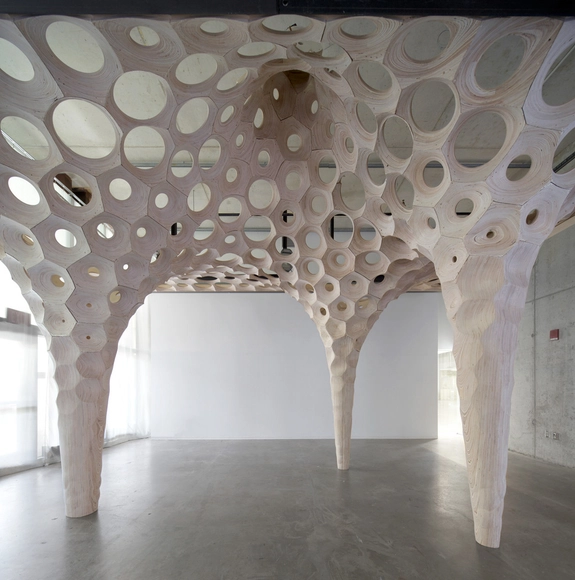
La Voûte de LeFevre sculpture. Image Courtesy of Matter Design
Craftsmanship is one of those topics which it seems almost everyone has a strong opinion. But while many lament the fact that traditional craft practices have been in decline since the industrial revolution, today a new generation of architects and designers have set about redefining and updating the notion of craft to include the most modern design and fabrication techniques around. In this article, originally published on Autodesk's Redshift publication as "5 Ways Architects and Postdigital Artisans Are Modernizing Craftsmanship," Jeff Link explores some of the traits that connect these pioneers to the craftsmen and women of a bygone era.
Craftsmanship in the digital age is hard to define. For some, craftsmanship evokes a purity of style, a preference for the handmade over the machine. For others, it recalls the Craftsman architecture of early-20th-century homes: overhung gabled rooflines, wide sheltered porches, detailed handiwork, and an ineffable Norman Rockwell sense of bygone Americana.
But regardless of one’s intuitive understanding of the term, the notion of craftmanship is evolving. Increasingly, the age-old knowledge of woodcarvers, masons, and other craftspeople is embedded in an intelligent design process using geometric computer models and machine fabrication to develop new crafts and architectural métiers—from gravity-defying furniture assemblies to complex workflows for robotic automatons. These innovations have helped place architects alongside craftsmen at the center of a revival in “maker” culture, which, for example, is in vivid display in handmade marketplaces such as Folksy and Etsy.
So what exactly is digital craft? And what does it look like in the work of top designers? Here, innovative architects identify five things postdigital artisans are doing to transform craftsmanship.
https://www.archdaily.com/781960/5-ways-architects-are-redefining-craftsmanship-for-a-postdigital-ageJeff Link
Ranjit Hoskote, Rahul Mehrotra and Kaiwan Mehta during a working session. Image Courtesy of Suresh KK (mid-day, a Jagran Group Publication)
Today, the rapidly-developing country of India is one of the key places in the world where architecture could have the most impact; in spite of this, there has been little critical reflection on the country's architectural landscape, and architecture has struggled to assert its value to the wider population. Currently, the country's first major architectural exhibition in 30 years is taking place in Mumbai, curated by Rahul Mehrotra, Ranjit Hoskote, and Kaiwan Mehta and running until March 20th. In this interview, a shortened version of which was first published in Domus India's December Issue, Mustansir Dalvir sits down with the curators to discuss their exhibition and the past and present of Indian Architecture.
Looking back to the time architectural practices first began to proliferate in India, one sees that they always operated within an ecosystem of practice, academia, and association. We can trace this to the 1930s, when the Indian Institute of Architects (IIA) was set up, which in turn emerged from the alumni of the Bombay School of Art. Teachers at the school were the most prolific practitioners in the country, and students made the easy transition from learning to apprenticeship, to setting up their own practices. Even patrons, largely non-state (in the penultimate decades before independence) aligned themselves with the architects in a collegial association. The Journal of the Indian Institute of Architects and their annual lectures became the mouthpieces of collective praxis, as the many presidential speeches show. Everyone knew what everyone else was doing, knowledge flowed centripetally.
In the years after independence, these bonds became looser as the nation-state became the chief patron. While private wealth and industry provided steady work for architects all over the country, the IIA still continued to remain the platform of discourse and dissemination – an internal professional rumination, largely distanced from changing politics and culture in the country, especially from the seventies onwards. While students of architecture did briefly take political stances during the Emergency, practice remained unaffected.
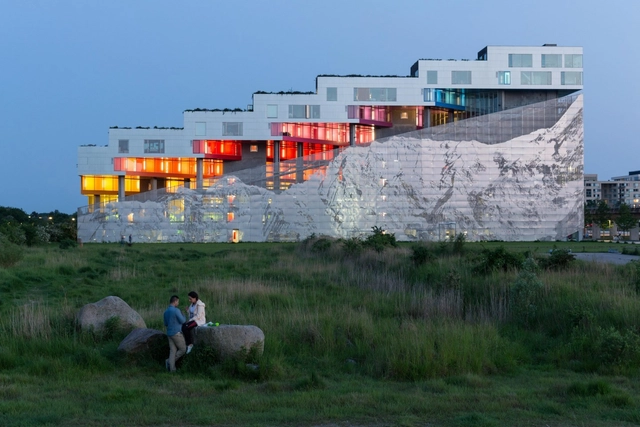
The Mountain, Copenhagen / BIG. Image Courtesy of Serpentine Galleries
The Serpentine Galleries have revealed that the 2016 Serpentine Pavilion will be designed by Bjarke Ingels Group (BIG), alongside a surprise announcement that four "Summer Houses" will also be built by internationally acclaimed practices. Kunlé Adeyemi – NLÉ (Amsterdam/Lagos), Barkow Leibinger (Berlin/New York), Yona Friedman (Paris), and Asif Khan (London) will each design a 25sqm structure inspired by the nearby Queen Caroline’s Temple, a neo-Classical summer house built in 1734 and "a stone’s throw from the Serpentine Gallery." In line with the criteria for the selection of the Serpentine Pavilion architect, each chosen to design a Summer House has yet to realise a permanent building in England.
After two weeks of nominations and voting, we are pleased to present the winners of the 2016 ArchDaily Building of the Year Awards. As a peer-based, crowdsourced architecture award, the results shown here represent the collective intelligence of 55,000 voters, filtering the best architecture from over 3,000 projects featured on ArchDaily during the past year.
By publishing them on ArchDaily, these exemplary buildings have helped us to impart inspiration and knowledge to architects around the world, furthering our mission. So to everyone who participated by either nominating or voting for a shortlisted project, thank you for being a part of this amazing process, where the voices of architects from all over the world unite to form one strong, intelligent, forward-thinking message.
And of course, congratulations to all the winners!
https://www.archdaily.com/781768/winners-of-the-2016-building-of-the-year-awardsAD Editorial Team
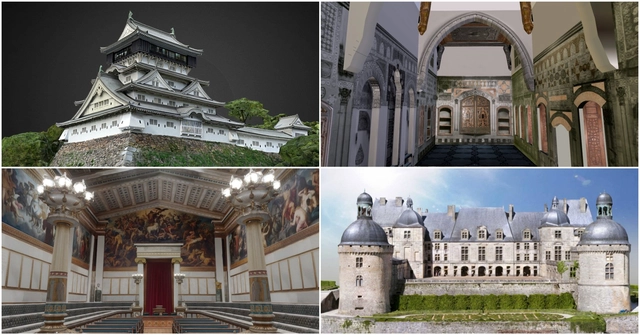
At ArchDaily, we've said before how sharing 3D models online has the potential to change architecture for the better, allowing viewers to explore a design for themselves rather than being presented only the most flattering views via photographs. At the forefront of this 3D-sharing revolution is Sketchfab, a platform which allows users to upload their model and view it directly in their browser.
In this new series, ArchDaily is joining forces with with Sketchfab, to present the best architectural models featured on their platform, as selected by staff members at Sketchfab. In this first installment, we're taking a look at some of the best scans of historical buildings - and don't forget, all of these models can be viewed in virtual reality for the maximum architectural experience!
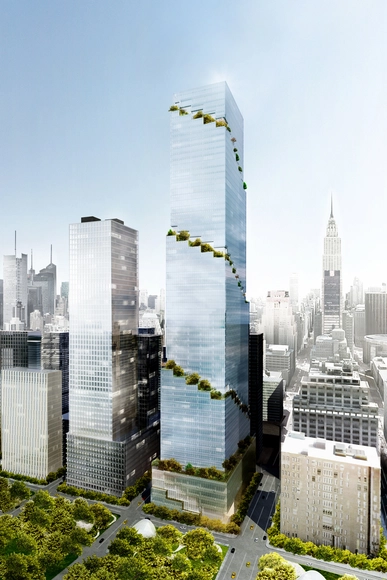
Developer Tishman Speyer has commissioned BIG to design a new office tower on the northern end of the High Line at Hudson Yards in New York City. Dubbed "The Spiral," the 1005-foot-tall tower is named after its defining feature - an "ascending ribbon of lively green spaces" that extend the High Line "to the sky," says Bjarke Ingels.
"The Spiral combines the classic Ziggurat silhouette of the premodern skyscraper with the slender proportions and efficient layouts of the modern high-rise," adds Ingels. "Designed for the people that occupy it, The Spiral ensures that every floor of the tower opens up to the outdoors creating hanging gardens and cascading atria that connect the open floor plates from the ground floor to the summit into a single uninterrupted work space. The string of terraces wrapping around the building expand the daily life of the tenants to the outside air and light.”