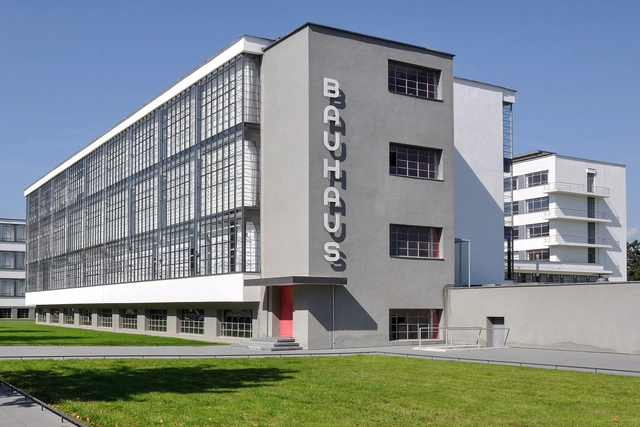
Experience the legendary Bauhaus movement on the brink of its 100th anniversary on this ten-day tour with Architectural Adventures. The Bauhaus is arguably the world's most influential school of design, revolutionizing 20th-century design, art, and architecture the world over. Founded in Weimar, Germany by Walter Gropius in 1919, the Bauhaus' activities spanned 14 years, and was relocated to Dessau and later Berlin.
TOTAL RECALL is a reference to see and feel what really is there, a sudden clearness, independent of program, with no hierarchy or status, just a hint of cultural context, like a ruin in a landscape.
Concurrent with the "Berlin Projects. Architectural Drawings 1920-1990" exhibition at the Museum for Architectural Drawing, a special event will take place on June 24th -25th by bike reviving Berlin's missing highlights. After registering, you can visit the exhibition free of charge and embark on a joyrney throught the night looking and exploring the invisible Berlin.
With Thom Mayne and Wolf D. Prix, on the occasion of the exhibition Houston: Genetic City. Envisioning a Future Post-Industry, Post-Oil, Post-Sprawl at Aedes Architecture Forum.
In 1919, at a time in which Germany was still in upheaval over its defeat in the First World War (and compounded by the loss of its monarchy), the Academy of Fine Arts and School of Applied Arts in Weimar, Germany, were combined to form the first Bauhaus. Its stated goal was to erase the separation that had developed between artists and craftsmen, combining the talents of both occupations in order to achieve a unified architectonic feeling which they believed had been lost in the divide. Students of the Bauhaus were to abandon the framework of design standards that had been developed by traditional European schools and experiment with natural materials, abstract forms, and their own intuitions. Although the school’s output was initially Expressionist in nature, by 1922 it had evolved into something more in line with the rising International Style.[1]