Serving Guangzhou, China as a distinctive emblem of China Southern Airlines’ global leadership, the winning proposal by Woods Bagot is a bold reinterpretation of the corporate campus model. A 400-hectare, mixed-use development, the three-precinct master plan integrates business, manufacturing, residential, and cultural amenities within a comprehensive open space network that supports recreational opportunity and bolsters ecological vitality. More images and architects’ description after the break.
Out of a collaboration between the Emergent Technologies and Design program (EmTech) of the Architectural Association (AA), London, and the Chair of Structural Design at the Swiss Federal Institute of Technology (ETH), Zurich, a temporary light timber construction has been designed that functions as sun shading for parts of the grand stairs in front of the architecture department of the ETH. Based on bending behavior under the self-weight of over-sized sheets of plywood of up to 11 x 2.5 m, the design activates the material properties as the defining element in the transfer of forces. More images and architects’ description after the break.
The new campus of Universidad del Isthmo is located on a beautiful hillside in the rapidly growing community of Santa Isabel near Guatemala City, Guatemala.Sasaki Associates designed the 49-hectare site, and the first phase of the plan, which consists of the heart of campus, is currently undergoing implementation. The university aims to enroll approximately 6,200 students in successive stages of implementation over 20 years. The educational objectives and mission of the university include a strong focus on the individual and the community within the learning environment. More images and architects’ description after the break.
David Chipperfield, Stirling Prize-winning architect and director of the 13th international Venice Biennale, has been commissioned by the Prussian Cultural Heritage Foundation (PCHF) to renovate the Neue National Gallery. The 20th century icon was designed by the legendary Ludwig Mies van der Rohe, who celebrated his 126th birthday this week.
Hermann Parzinger, president of the Prussian Cultural Heritage Foundation, said: “With David Chipperfield, I know this icon of modern architecture in the best hands. In working with him on the Museum Island, I learned the sensitivity in dealing with the architectural heritage and the conceptual clarity of his approach is greatly appreciated.”
Last June we announced the zHome community designed by David Vandervort Architects, a target zero-energy community in Washington that is one of many springing up across the country, changing the way communities are planned and developed. Since World War II spawned the era of suburban living, the Levittown model has been the trajectory along which so many communities across the country have gone. Now with sustainability and ecologically conscious design being at the forefront of many architects’ practices, it makes perfect sense for whole communities to take the leap as well. But what does that mean for the lifestyles of its residents? And does this make an exclusive neighborhood where only some are willing or able to comply. Follow us after the break for more.
Professors, students and practitioners such as Peter Orborn at AEDAS participated in the above video to give a perspective on a reality for the practice of bridging entrepreneurship and architecture on the Master in Architectural Management and Design at the Architecture Venture Lab at IE University.
Stop right there. Before I begin this post with a cliché dictionary definition, I direct you to what’s usually overlooked in these openings: the part of speech.
Without reading the definition, we know. Design is the act that connects the human being to the object outside him: the way in which intentions, thoughts, concepts take form.
On a basic level, design connects human beings through the shared experience of said object – be it functional or purely aesthetic. But it’s not just the object which connects us – it’s the idea that inspired it. On another level, and perhaps at its purest, design connects by inaugurating us into a collaborative spirit of innovation.
The AIA’s latest Design Conference, Design Connects, has invited bloggers to reflect how design connects us in a way that will build a better future. We at ArchDaily, biased as we may be, think we have the answer (it’s in the invitation): the Bloggers.
To read how design and the Internet connect us to thousands of elementary school kids, the sci-fi dsytopias of a NASA scientist, and a poverty-defying advocate looking to change the world - all in 24 hours – keep reading after the break.
WAI Architecture Think Thank has completed a study for an architecture, urbanism and spatial politics laboratory in the center of Beijing. Conceived as an avant-garde institution for the education of environmental and spatial design, their design creates an educational center based on the principle of open learning and cross-disciplinarity. The building arranges the multiple programs in a sequence of open spaces and sloping floors that together form a continuous loop of learning experiences. More images and architects’ description after the break.
Addicted to checking your favorite site, like ArchDaily, for constant updates, or checking in with Facebook or Foursquare? Don’t worry – you’re not alone, and Columbia’s Spatial Information Design Lab can prove it. In addition to sharing your whereabouts with friends, your geographic mark provides valuable insight in examining the psycho-geography and economic terrain of the city.
In the competition for the church of Våler, Krill Architecture focused on a concept of an open ring in the woods. Tapping on a source of collective creativity in modern architecture, their design offers the chance to bring the development of church architecture to a new level. A building combining monumentality to accessibility, openness to spirituality, is awesome, while being friendly. In short: a church fitting in this time. More images and architects’ description after the break.
Hanok Garden, a landscape project in South Korea by Y Design Office, strips one of the older Korean traditional courtyard houses into its barebones with a small deck for resting. The old house is simply turned into a public garden. More is taken away than what gets added. The project asks and challenges the very basic questions about a person, a house, a city and nature. More images and architects’ description after the break.
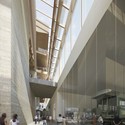
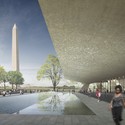
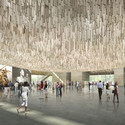
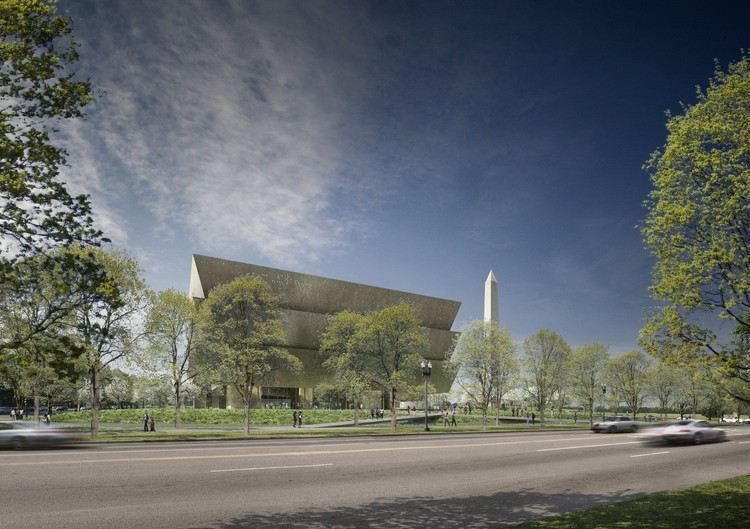
We have been covering the progress of the Smithsonian National Museum of African American History and Culture over the last several months, our most recent being President Obama’s speech at the ceremony for the official ground breaking. Adjaye Associates recently shared with us some insight into the inspiration for the design and its grounding principles. We also have several new perspective renders illustrating the internal experience. More details after the break.
After receiving a lot of compliments on our “From MadMen to Mies” graphic, we decided to let you take a little piece of Mies (the original Mad Man) with you wherever you go. Click through the gallery below to find the wallpaper for the technological device of your choosing – iPad, iPhone, Android phone, MacBook, or Samsung Tablet. Take one, or heck, take all. In this case, less isn’t more.
Last week, we received copies of two of Steven Holl’s newest publications, Scale and Color Light Time. Published by Lars Müller, the books examine Holl’s preoccupation with light and color as ways to inform the shaping of space. Holl’s architecture has consistently defined itself with formal gestures grounded in light and meaningful applications of textures and colors. While accurate to associate Holl with water color, the books shows the range such a medium has had over Holl’s career, as it has afforded the flexibility to serve as both an exploratory and explanatory tool.
Despite strong objections from the Eisenhower family, classical architects and many others, the Eisenhower Memorial Commission has issued a statement of support for Frank Gehry’s controversial Eisenhower Memorial design. The statement was signed by every member of the commission, including chairman Rocco Siciliano, vice chairman Sen. Daniel K. Inouye (D-Hawaii), both senators from President Eisenhower’s home state of Kansas, and five other members of Congress.
The commission’s letter reads, “Frank Gehry has followed the direction provided to him by this commission. He has also consulted with the Eisenhower Family. His design for the Memorial is exciting, creative and inspiring. It captures the life and the spirit – and commemorates the historic achievements – of Dwight Eisenhower as one of the greatest generals in human history and one of our finest presidents.”
The contenders: NYU and the Greenwich Village community. Let Round 2 commence.
Almost two years after we first brought you news about NYU 2031, NYU’s plans for expansion in Brooklyn, Governor’s Island, and (most controversially) in Greenwich Village, and the fight has not only continued, but escalated. A debate, hosted by The Municipal Art Society of New York, two nights ago brought about 200 NYU affiliates and community residents together, but only spatially; there was a considerable lack of willingness to compromise from either camp.
NYU’s plan, thought up by Toshiko Mori Architect, Michael Van Valkenburgh Associates, and Grimshaw Architects, has ruffled feathers mostly for the fact of its bulk. The 2.5 million square-foot development (1.1 million of which would be underground) is the largest ever proposed for the Village, and has drawn criticism for its potential to diminish light, greenery, and open space in the neighborhood.
Barcelona-based architect and scholar Alejandro Zaera-Polo has been selected as the next dean of Princeton University’s School of Architecture, where he has served as a visiting lecture since 2008. He is internationally known for his award-winning practice, Alejandro Zaera-Polo Architecture, his extensive academic experience and contributions to international publications, such as El Croquis, Quaderns, A+U, Arch+, Volume and Log.
He will succeed Brooklyn-based architect Stan Allen, who has served as the school’s dean since 2002. After the new appointment becomes effective on July 1, 2012, Allen plans to return to full-time teaching and architectural design after a yearlong sabbatical. As reported by Architectural Record, Allen stated, “We were looking for somebody who worked at a very high level as a designer-practitioner, but also approached architecture as an intellectual activity. There aren’t a lot of people like that out there.”
Here at ArchDaily, we are desperate to get our hands on the newly launched, second edition of The Modern Architecture Game. In 1999,NEXT Architects created the board game as the first project collaboration involving their four partners. Now, this revised version includes questions that “range across the breadth of modern world history”, allowing a broad and international group of architecture enthusiasts to test their knowledge of the greatest architects, their famous buildings and legendary quotes.
The project for the Macro inter-modal Terminal in the middle of Rio de Janeiro by Lucas Ramos, Priscila Bellas, and Thiago De Almeida seeks to create a new infrastructure to the city, which will create possibilities to transform an important axis of the city that nowadays is extremely undervalued and ignored into a new business center based in an efficient nodal point of different kinds of transport. In doing so, they chose to build a megastructure that possessed the ability to reorganize the different transport networks and their links with the city. More images and architects’ description after the break.
It’s June 1966. Mies’ iconic Seagram Building dominates New York City. Bob Dylan has just released Blonde on Blonde. The Vietnam War is escalating. John Lennon has yet to meet Yoko Ono. Martin Luther King, Jr. has yet to be assassinated. And Don Draper is readjusting to married life – with his 25 year-old secretary.
The excitement over Mad Men, while always eager, was positively explosive last Sunday. The season 5 premiere resulted in the show’s highest ratings to date (3.5 million viewers, up 21% from last year). While the show has always received critical acclaim, now, for whatever reason, it has reached a fever-pitch of popularity.
On a purely aesthetic level, it’s easy to explain. The show draws in audiences with a meticulous, sumptuous set design that allows a nostalgic journey back in time: when design was innovative & clean, architecture was confident (cocky even), and modernism still held its promise.
But on another level, the show is successful because of its inevitability. The very knowledge of the ephemerality of that confidence, a theme particularly relevant to audiences in the wake of the Recession, is what strikes a chord, what makes the show positively hypnotizing.
Watching Mad Men is like watching a Modernist car crash. A beautiful demise.
More on the Modernist Landscape of Mad Men and why the show has struck a chord with audiences today after the break.
In the middle of March, we attended a community meeting for the third installment of the High Line and shared James Corner and DS + R’s visions for the final stretch of the elevated rail line. While the meeting offered an in depth look as to how it would tie together the previously featured conceptual elements, perhaps the already daring project needs a little more spice…perhaps, the High Line needs Jeff Koons. The American artist has been in contact with the founders of the Friends of the High Line (the nonprofit which saved the railway from being demolished) as it is possible the public park could be outfitted with his lastest sculpture, Train, a massive replica of a 1943 Baldwin 2900 steam locomotive. Oh, and did we mention that the train would be danging dramatically in the air, suspended from a crane?
EME3 is currently seeking projects for their 7th edition of eme3 Festival that will be held in Barcelona from June 28th to July 1st 2012 in COAC (Official Catalan Chamber of Architects) while the exposition will remain open until July 15th. The theme starts from an exploratory analysis of the application of the concept “BOTTOM-UP” in architecture and its relationship with society. In a changing environment like the current, where the foundations of our system are constantly questioned and challenged, a series of actions, which to date had a fairly minor implementation in developed societies, emerge now strongly, relying on creativity and innovation to fight this moment of crisis and uncertainty. The deadline for submissions is April 15th. More information on the competition after the break.