No one puts solar panels on their house because they’re sexy—at least, not yet.
Jon Gardzelewski, an architect and associate lecturer at the University of Wyoming in the Building Energy Research Group (UW-BERG), wants to change that. He believes the fact that solar panels are usually an afterthought to the design of a building is a big barrier to integrating them into a critical mass of houses and buildings.
"Rethink the City; New Approaches to Global and Local Urban Challenges" is a free online course given by Delft University of Technology in the Netherlands, starting on March 28, 2017.
The course aims to address urban challenges in emerging countries to provide a new perspective in understanding and analyzing the southern hemisphere. For this reason, the content is structured in the following three thematic axes: "Spatial Justice," "Housing Provision and Management," and "Urban Resilience".
Enrollment is now open through the Edx.org online education platform. The course has a duration of six weeks between 3 to 4 hours per week and is aimed especially at undergraduate students, especially those in Latin America, Asia, and Africa, according to the course content.
To most people, Facebook is simple. They use it as a survival tool during never-ending university lectures. They use it to distract themselves during arguments at the family dinner table. They use it to ‘research’ that new person in the office. But when the architect signs in, everything changes. To us, Facebook is an ‘archi-forum’. Every passionate, powerful sketch of ours is uploaded. Every deep, reflective, opinion of ours is posted. Every non-architectural event is advertised with the intensity of an adventure to Narnia. Happily, we know our audience – other architects...
Our modern day, image-obsessed culture has got us consuming a large quantity of architecture through photographs, as opposed to physical, spatial experiences. The advantages of architectural photography are great; it allows people to obtain a visual understanding of buildings they may never get the opportunity to visit in their lifetime, creating a valuable resource that allows us to expand our architectural vocabulary. However, one must stay critical towards the disadvantages of photography when it comes to architecture. Jeremy Till, author of “Architecture Depends,” summarizes this in his chapter “Out Of Time”: “The photograph allows us to forget what has come before (the pain of extended labor to achieve the delivery of the fully formed building) and what is to come after (the affront of time as dirt, users, change, and weather move in). It freezes time or, rather, freezes out time. Architectural photography ‘lifts the building out of time, out of breath,’ and in this provides solace for architects who can dream for a moment that architecture is a stable power existing over and above the tides of time.”
The following tips aim to not only improve the visual strength of your architectural photography, but also the stories that they can tell—going beyond the individual images in order to communicate buildings’ relationships with their contexts, space and time.
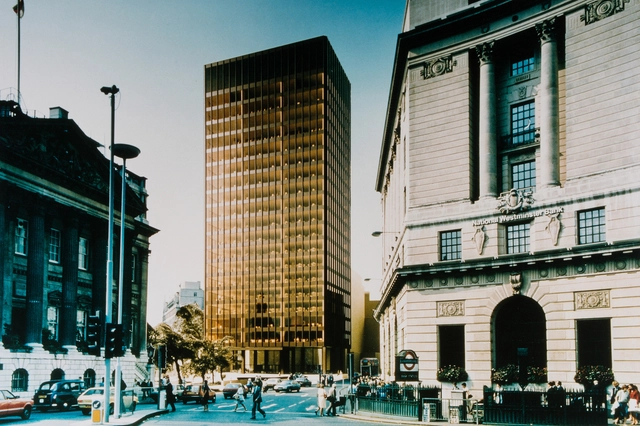
In the 1960s James Stirling asked Ludwig Mies van der Rohe why he didn’t design utopian visions for new societies, like those of Frank Lloyd Wright’s Broadacre City or Corbusier’s Cité Radieuse. Mies replied that he wasn’t interested in fantasies, but only in “making the existing city beautiful.” When Stirling recounted the conversation several decades later it was to the audience of a public enquiry convened in London – he was desperately trying to save Mies’ only UK design from being rejected in planning.
The Faculty of architecture at KU Leuven, which last year featured on QS's Top 100 Universities in the World for Architecture, is Belgium's largest and most established university. The following essay, by Dag Boutsen—Dean of the School—and Kris Scheerlinck, examines cyclical learning in architectural education. It was first published by Volumein their 50th issue, Beyond Beyond, the editorial of which is available to readhere.
Knowles’ research into environmental conditions and theories about solar envelope zoning prefigured the parametric tools architects and planners use today. This scheme for an L.A. row-housing project demonstrates how dense developments—both low- and high-rise—could still provide equity in terms of natural sunlight. Image Courtesy of Ralph Knowles
I meet architect and educator Ralph Knowles on an unseasonably warm autumn day, even for Southern California. He greets me in shirtsleeves (his shirt is a tropical pattern of vines and branches) and leads me to a seat on the balcony of his condo. The building—a retirement community—is fairly new, but mature oak trees line the quiet street. As we talk about his career, the California oaks form a poignant backdrop. For more than five decades, Knowles, 88, has argued for an architecture that hews closely to nature’s forces and rhythms.
Flagship stores excite both fashion shoppers and designers alike due to their role as visionary laboratories for the latest trends and stimulating retail experiences. Architects have developed various ways to dress haute couture stores, from distinctive icons in the day to seductive night-time images. The images accompanying this article, created by the Portuguese architect and illustrator André Chiote, help to explore the graphic potential of famous brands like Dior, Prada and Tod's. The illustrations clearly reveal the various techniques of playing with diaphanous layers, intimate views inside or the contrast of light and shadow.
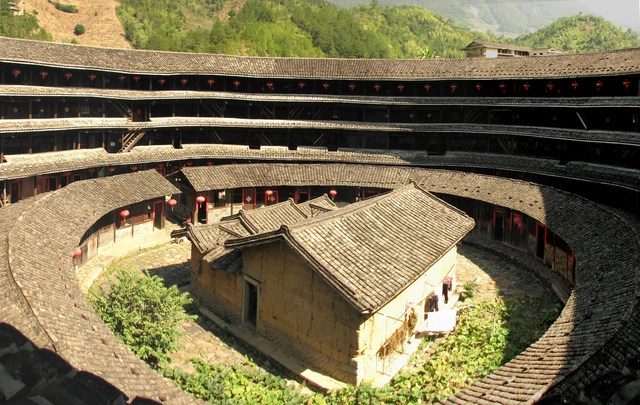
Vernacular architecture refers to designs which find their primary influence in local conditions: in climate, in materials, and in tradition. In a country as diverse as China, with 55 state-recognized ethnic minority groups and widely varying climates and topographies, many different vernacular dwelling styles have evolved as pragmatic solutions that accommodate the unique needs and limitations of their sites.
Rapid urbanization in China has favored high-rise apartment towers over traditional housing because of their ease of construction and the population density they enable, making vernacular dwellings increasingly rare throughout the country. Some firms, like MVRDV and Ben Wood’s Studio Shanghai, have taken note of the many benefits that vernacular dwellings provide, and have created projects that attempt to reconcile tradition with urbanization. Even if you aren't planning on building in China any time soon, the following housing styles have much to teach about what it means to live in a particular time and place. This is by no means an exhaustive list, but it does encompass the main types of vernacular dwellings seen throughout China.
If you’re a true Simpsons fan, you know there is a Golden Age in which every single episode does not only parody our society, but is filled with film tributes and sexual innuendos that we remember to this day.
From a faith-versus-science conflict (Lisa the Skeptic, 09x08) to the impact of online fake news (The Computer Wore Menace Shoes, 12x06); from Populism in Urban Policy (Marge vs the Monorail, 04x12) to its well-known predictions like the rise of Donald Trump to the presidency of the United States (Bart to the Future, 11x17), the show has a knack for providing the social commentary we didn't know we needed.
We had yet to notice, however, just how beautiful some of the visual compositions delivered by the show’s best episodes truly are: Springfield’s ever-changing skyline; the axonometric views that reflect the loneliness experienced by the characters; or the point-perfect generic recreational facilities that every city has.
How did we discover this? Through an Instagram account, Scenic Simpsons, which is dedicated to “showcasing the most beautiful scenes, colors, sets and abstract compositions from Springfield.” We've pulled some of our favorite images to check out below. Can you recognize which episode these scenes are from?
https://www.archdaily.com/804263/the-most-beautiful-visual-compositions-from-the-simpsonsArchDaily Team
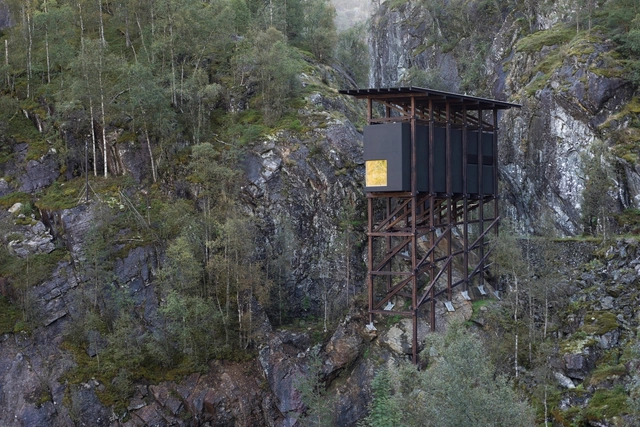
Below is an excerpt of the cover story of this month’s Surface magazine: an in-depth look at Peter Zumthor’s recently completed Allmannajuvet Zinc Mine Museum, featuring exclusive quotes from the architect himself.
The first thing you notice when you arrive at the new Allmannajuvet Zinc Mine Museum outside Sauda, Norway, is that it looks nothing like a museum—or at least, what we think of as a museum. On a steep site framed by elegantly rugged walls of dry stone, three black, shed-like and zinc-roofed structures look far too small to house exhibits, much less hordes of visitors. But this isn’t a museum in the conventional sense. Consisting of a service building with restrooms, a café, and a gallery—all perched on tall timber supports—it’s more a memorial to those who toiled in the zinc mine that operated on the site from 1881 to 1899 in the spectacularly beautiful Allmannajuvet Ravine. The mine and its accompanying trail were long ago abandoned, the original buildings a distant memory.
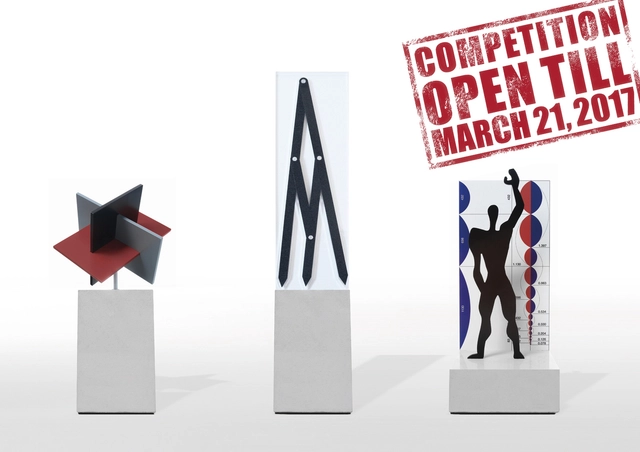
The 5th International LafargeHolcimAwardscompetition closes for entries on March 21, 2017 at 2pm UTC. It seeks projects at an advanced stage of design from the fields of architecture, building, and civil engineering; landscape and urban design; as well as materials, products and construction technologies. The Awards also feature a "Next Generation" category for visions and ideas of young professionals and students.
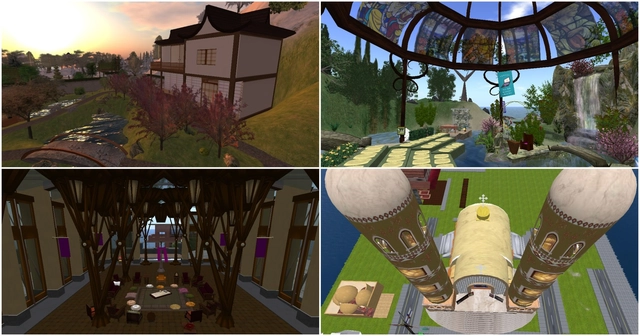
If you’ve heard of Second Life, the 2000s-era web-based online world with millions of loyal “residents” who populated it with personal avatars, you’re likely to think it has become irrelevant or obsolete. But at the peak of its popularity, the site received a lot of attention for providing users with a potentially dangerous escape from reality—one so powerful that it was not unheard of to leave real jobs, friends, and families for those found within the site.
Second Life is the ultimate democratizer in space making. The vast web of locations in the site's virtual world, called sims, are almost completely user-generated. For as little as $75 a month, anyone with an internet connection and basic CAD skills can create, upload, and maintain whatever place they dream up. Sure, sometimes this “great equalizer” spits out such venues as SeDucTions and Sinners Burlesque, but more often than not, builders have responded to the complex opportunities and challenges presented by their unique situation with innovative design solutions.
One place to observe this is in the site’s many spiritual sims, in which religious architecture often responds to the displacement of religious authority in the digital world, since a lack of official (sanctioned) ties to tradition offers a designer more agency than in the real world. Read on to discover four cases that carve out a space for spirituality in Second Life and reveal some of what works—and doesn’t—in today's virtual sacred architecture.
This essay by Alan Hess about the iconic Capitol Records building in Los Angeles was originally published as "The Architecture of the Capitol Records Tower." It is part of the book 75 Years of Capitol Records, published by TASCHEN, which is scheduled for release in February.
The president of Capitol Records was certain that a serious company could not operate out of a building that looked like the stack of records in a jukebox. So when Welton Becket, the new headquarters’ architect, showed him a model of the multistoried circular tower, Wallichs was annoyed. It would look like an advertising gimmick, Wallichs said, in a city where hot dogs were sold out of buildings shaped like hot dogs. Becket countered that the circular floor plan was more cost-efficient for the amount of usable space than a standard rectangular office building. Unimpressed, Wallichs told Becket to go back and design a conventional building.
The myth that a stack of records inspired the Tower has never died, though. As soon as the building opened, Hollywood columnist Bob Thomas wrote about it as “a monstrous stack of records.” Wallichs went on a public offensive from the start: “There was no intentional relationship between the shape of phonograph records and the circular design of the Tower” he insisted to the Chicago Tribune.
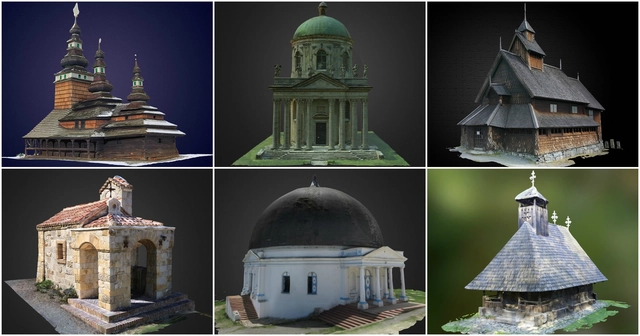
Once again, thanks to our collaboration with Sketchfab, here we have a selection of 9 virtual experiences through churches and chapels from Europe, Africa and the Americas. Each small building has its own special story, either geographical, political or structural—from one building that has experienced its own mini tour of Europe, to another which contains some rather unusual building materials. The diverse sites each seem to hold secrets, all of which can now be explored through 3D scanning technology. The fascinating variation in structural forms is also apparent, showcasing how even humble architecture has the potential to create a rich list of virtual spaces.
For a more immersive experience, all of these models can be viewed on a virtual reality headset such as Google Cardboard.
I prefer drawing to talking. Drawing is faster, and leaves less room for lies. (Le Corbusier)
Even with the evolution of technology and the popularization of advanced computer programs, most architecture projects still begin with a blank sheet of paper and the casual strokes of a pen. Rather than simply representing a project, the sketch allows us to examine the project, understand the landscape or topography, or communicate an idea to another team member or even the client. Its main purpose, however, is to stimulate the creative process and overcome the fear of blank paper. Sketches are usually made with imprecise, overlapping, ambiguous strokes, accompanied by annotations, arrows, and lack great technical accuracy and graphic refinement.
GIFs are hugely popular and are constantly being shared on the Internet by lots of people. Whether it's expressing some feeling that seems unexplainable with words, freaking out over fluffy cats, endless memes or even hypnotic scenes from movies we love (like the above scene from Jacques Tati's "Mon Oncle"). We see the use of this format increasing in Architecture, and one thing is for certain, we love it.
https://www.archdaily.com/802031/why-do-we-love-gifsPedro Vada
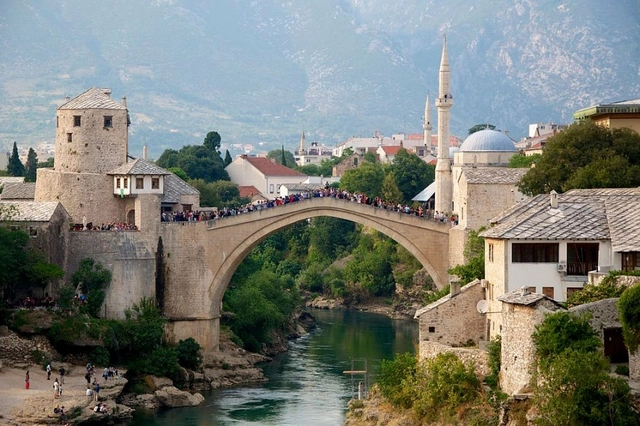
"The Old Bridge in Mostar, Bosnia and Herzegovina / Photo: ru.wikipedia.org". Image Courtesy of Strelka Magazine
This article, written by Svetlana Kondratyeva and translated by Olga Baltsatu for Strelka Magazine, examines the most interesting cases of the role of culture in sustainable urban development based on the UNESCO report.
UNESCO published the Global Report on Culture for Sustainable Urban Development in the fall of 2016. Two UN events stimulated its creation: a document entitled Transforming our World: the 2030 Agenda for Sustainable Development, which emphasizes seventeen global goals for future international collaboration, was signed in September of 2015 at the Summit in New York. Habitat III, the conference held once in twenty years and dedicated to housing and sustainable urban development, took place in Ecuador in October of 2016. The question of culture’s role in urban development, and what problems it can solve, was raised at both events. To answer it, UNESCO summarized global experience and included successful cases of landscaping, cultural politics, events, and initiatives from different corners of the world in the report.