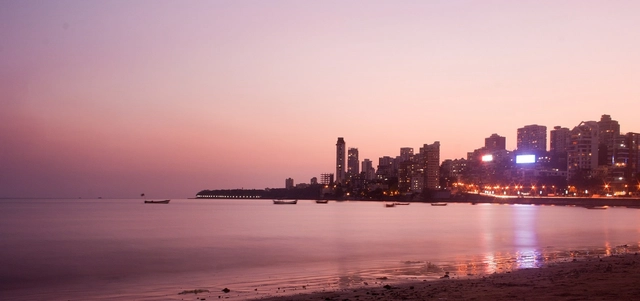
Mumbai Skyline. Image via Pixabay by user PDPics (public domain)
The Indian Government’s Smart City Mission, launched in 2015, envisions the development of one hundred “smart cities” by 2020 to address the country’s rapid urbanization; thirty cities were added to the official list last week, taking the current total of planned initiatives to ninety. The $7.5-billion mission entails the comprehensive development of core infrastructure—water and electricity supply, urban mobility, affordable housing, sanitation, health, and safety—while infusing technology-based “smart solutions” to drive economic growth and improve the citizens’ quality of life in cities.
In a country bogged down by bureaucratic corruption, the mission has been commended for its transparent and innovative use of a nation-wide “City Challenge” to award funding to the best proposals from local municipal bodies. Its utopian manifesto and on-ground implementation, however, are a cause of serious concern among urban planners and policy-makers today, who question if the very idea of the Indian smart city is inherently flawed.
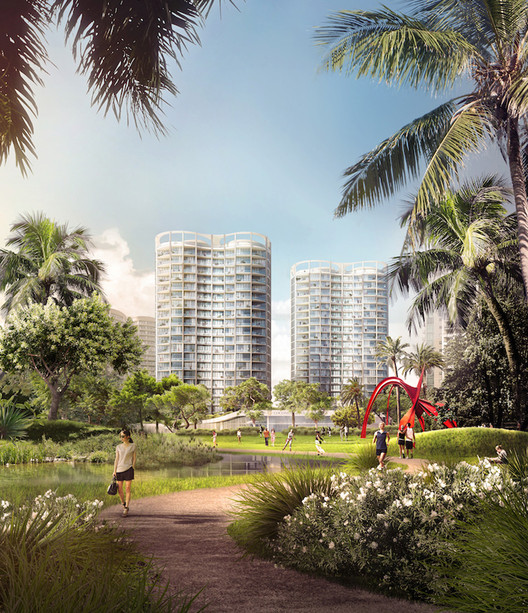
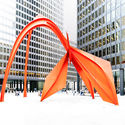
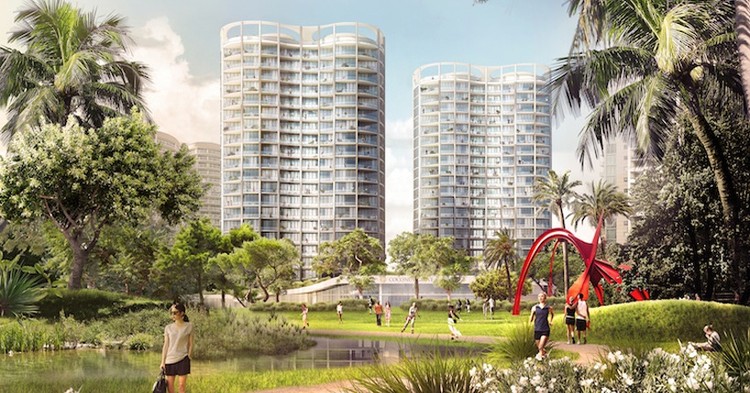
Why do so many architects use Alexander Calder sculptures in their renderings, even when the works have nothing to do with the institution or project depicted? The Calder Foundation has been tracking this phenomenon, and the results are featured in the images for this article.
A new exhibition at the Whitney Museum in New York explores mobiles—kinetic sculptures in which carefully balanced components reveal their own unique systems of movement—created by American sculptor Alexander Calder from 1930 until 1968, eight years before his death.
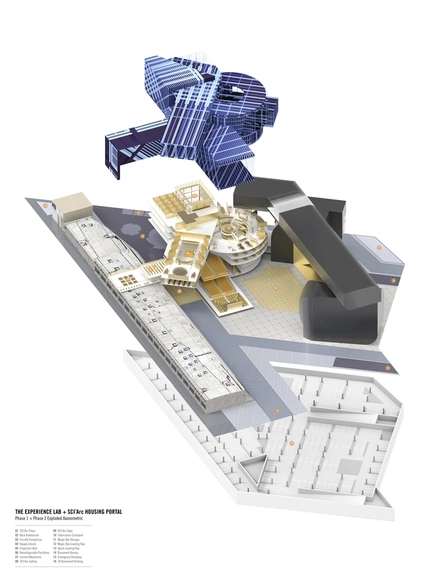
SCI-Arc< http://www.sciarc.edu/ >, the Southern California Institute of Architecture, is known for its mission to educate architects who will image and shape the future.
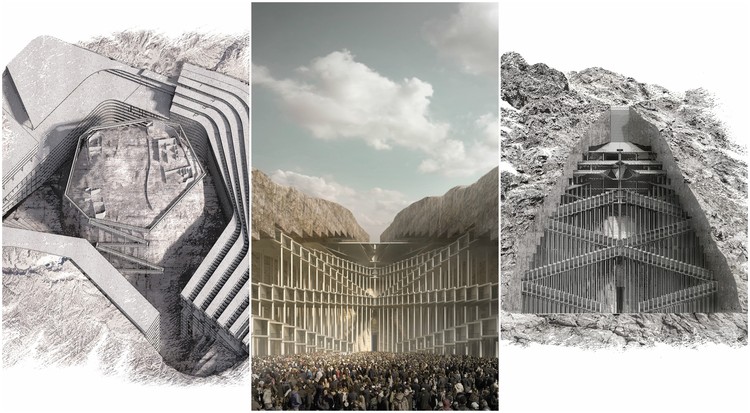
In a time of what seems to be ever-increasing religious and political conflict, Bartlett students Akarachai Padlom, Eleftherios Sergios, and Nasser Alamadi instead chose to focus on collaboration between religions in their thesis project entitled “Faith Estates,” which outlines a new method of mass religious tourism. In an area around the Dead Sea characterized by disputed boundaries and conflicting ownership claims, the group aims to reimagine the relationship between the world’s three monotheistic religions, but also to rethink the relationship between religion, tourism, and the landscape. The design consists of large-scale excavation sites which form tourist resorts along a pilgrimage route with the goal of forming a mutually beneficial relationship.
Throughout history shifting economies, disasters, regime changes, and utter incompetence have all caused the evacuation of impressive architectural structures. From the 1986 explosion at the Chernobyl Nuclear Power Plant in Ukraine that rendered a region of the then-Soviet Union uninhabitable, to the decline in public transport that saw a number of US train stations becoming superfluous, the history of architectural abandonment touches all cultures. And, without regular maintenance, structures deteriorate, leaving behind no more than awe-inspiring ghosts of the past to fuel the ever-growing internet trend for "ruin porn." Below are 8 abandoned buildings slowly being reclaimed by nature:
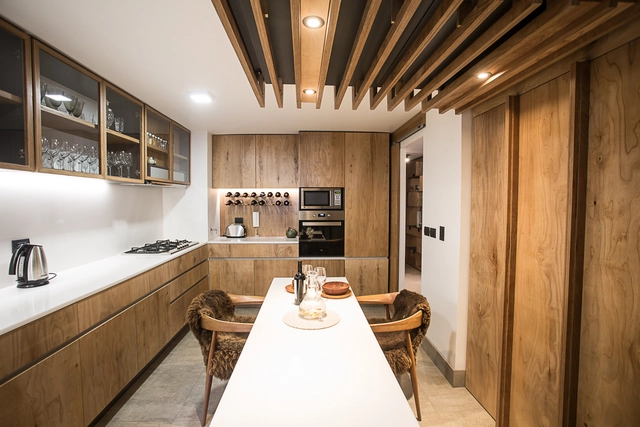
The project is a renovation of a duplex apartment located in Santiago, Chile. The clients’ requirements were to achieve spaciousness, continuity and to add light.
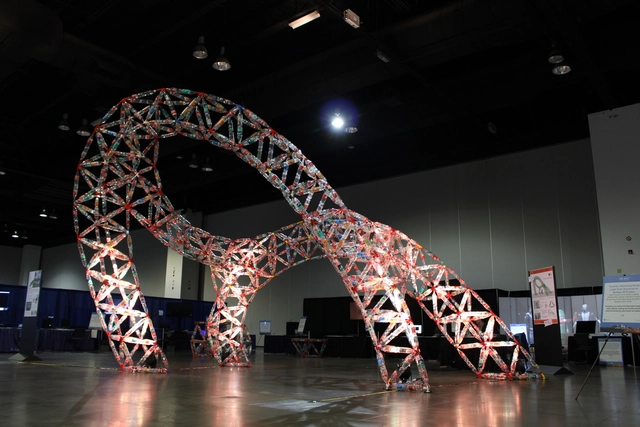
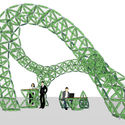
The capabilities of personal 3D printing and fabrication are only beginning to be tested, but a new system is pushing the boundaries for feasible, structurally-sound large scale structures. Unlike other structures created by 3D printing systems, Trussfab doesn’t require access to specialized equipment, nor specific engineering knowledge, to print and build large-scale structures capable of supporting human weight. Phd researcher Robert Kovacs with his team from the Human Computer Interaction Lab at the Hasso Plattner Institute in Potsdam, Germany created Trussfab as an end-to-end system allowing users to fabricate sturdy, large-scale structures using plastic bottles and 3D-printed connections, making them easy and relatively quick to construct.
On the morning of April 24th, Delhi’s architecture community reacted in shock and disgust to the news that the city's Hall of Nations and the four Halls of Industries had been demolished. Bulldozers had worked through the previous night at the Pragati Maidan exhibition grounds in central Delhi, where the Indian Trade Promotion Organisation (ITPO) razed the iconic structures to the ground, ignoring pleas from several Indian and international institutions.
The Hall of Nations, the world’s first and largest-span space-frame structure built in reinforced concrete, holds special significance in India’s post-colonial history—it was inaugurated in 1972 to commemorate twenty-five years of the young country’s independence. The demolition was met with widespread condemnation by architects and historians alike, not just because of the loss of an important piece of Delhi's heritage, but also for the clandestine manner in which the demolition was conducted.
This article originally appeared on guggenheim.org/blogs under the title "Wright’s Living Organism: The Evolution of the Guggenheim Museum," and is used with permission.
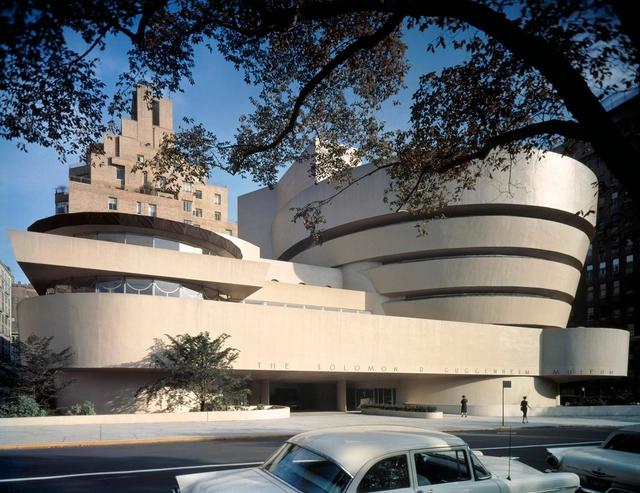
Standing on the Solomon R. Guggenheim Museum construction site in 1957, architect Frank Lloyd Wright proclaimed, “It is all one thing, all an integral, not part upon part. This is the principle I’ve always worked toward.” The “principle” that Wright referred to is the design ideology that he developed over the course of his seventy-year career: organic architecture. At its core, that principle was an aspiration for spatial continuity, in which every element of a building would be conceived not as a discretely designed module, but as a constituent of the whole.
Although not Wright’s intention per se, it is fitting that the building he conceived of as a living organism has evolved over time. The overall integrity and character-defining spiral form have remained unchanged, but there have been a series of additions and renovations necessitated by the growth and modernization of the institution.
Ch-ch-ch-ch-changes. David Bowie was right when he sang it – life’s full of so much uncertainty, variables, and excitement that half the battle is riding the wave and adapting as best as one can. Some adjustments are self-directed and others are forced upon us, but regardless of this, change allows us to reminisce, regret and reflect on what once was.
Being an architect comes with its own set of significant life changes (and that’s in addition to that major wardrobe overhaul) which more often than not, can’t be helped. Gone are days of relaxation, relationships and rendezvous, now replaced by multitasking, models and meetings. But no matter how busy you are, a moment of self-reflection never hurt anyone. So switch off that second monitor, grab a coffee, and sit back, as we take a look at how your life has changed, for better or for worse, since that fateful day you stumbled upon architecture.
This article was originally published on the blog of the Chicago Architecture Biennial, the largest platform for contemporary architecture in North America. The blog invites designers, writers and other contributors to independently express their perspectives on the Biennial across a range of formats. The 2017 Biennial, entitled Make New History, will be free and open to the public between September 16, 2017 and January 6, 2018.
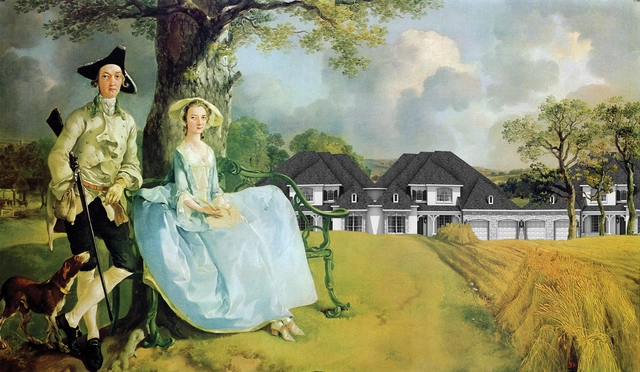
Some works of architectural writing can be taken at face value as stark manifestos for a new aesthetic. Keith Krumwiede’s Atlas of Another America is, instead, a constantly unfurling satire that offers layers upon layers of artfully imagined social commentary. Like McMansion Hell, my own long-form satirical project, Krumwiede’s “architectural fiction" sends up American ideas about economics, politics, and culture by picking apart our outrageous suburban housing types. The project will be on display at the Chicago Architecture Biennial this fall, delivering a sardonic vision of American architecture that comes out of academic theory, but has a potent message for anyone who has spent time in suburbia.
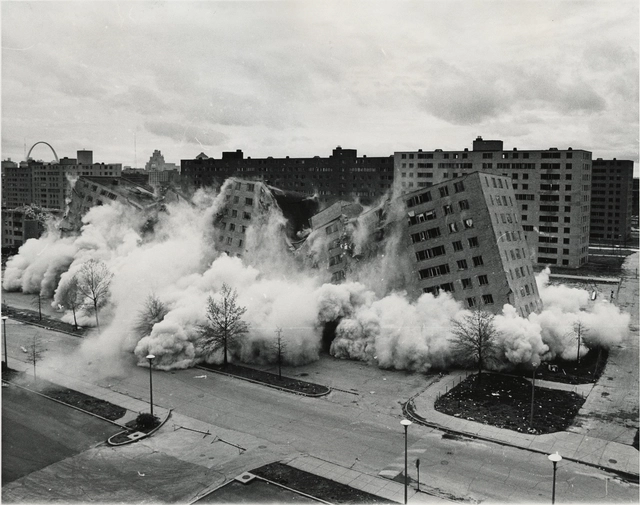
Courtesy of The United States Department of Housing and Urban Development (in public domain)
Immortalized through photographs, drawings, and stories, buildings that have been demolished or completely renovated exist in the realm known as “lost architecture.” Either for economic or aesthetic reasons, the old gets torn down for the new, often to the disdain of community members and architects. But demolished buildings tell a story about the ever-changing politics of preservation—and often, they tell it far better than buildings that were actually preserved ever could. As the architectural landscape continues to change around us, it is important to recognize our past, even if its traces have been eliminated from the physical world.
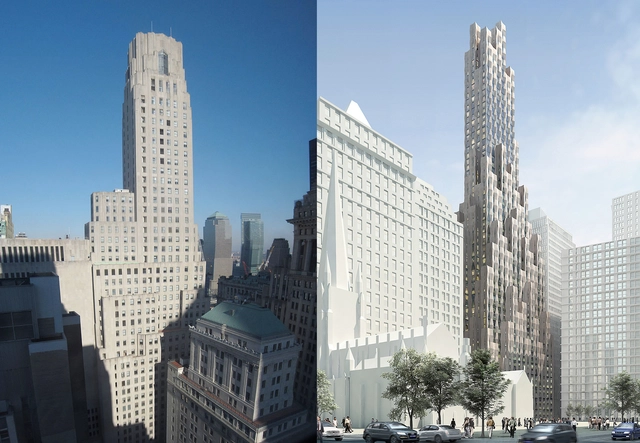
One Wall Street, before and after. Images: left, Via Wikimedia in public domain; right, Courtesy of Hollwich Kushner
The New York Timesrecently reported that over 40% of the buildings on the island of Manhattan wouldn’t be granted construction permits in 2017. Most of the culprits date back to the early 20th century when attitudes towards density, ceiling heights, column placement, and general living standards were different. This begs the question: what would modern iterations of New York’s signature structures look like today? Billed by the practice as “an obsessive-compulsive study of the city we love” HWKN’s New(er) York is a peculiar experiment that tackles this hypothetical.
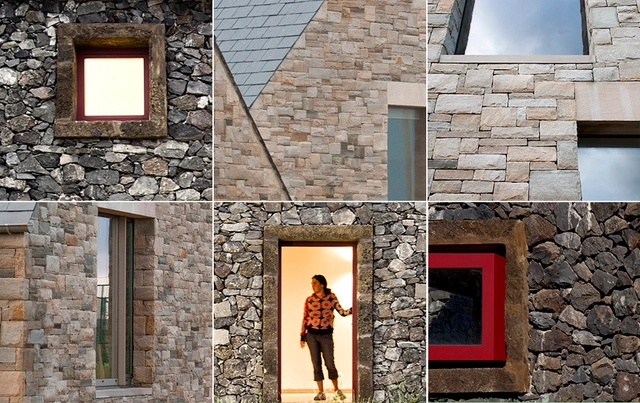
Stone is elemental to our built world. It is one of the oldest (if not the oldest) materials used in man-made habitats. The sense of timelessness in stone is attributed to its long and varied history alongside architecture. From ancient monoliths to cities to houses, the diversity of stone means that it can be used to convey a variety of expressions. Carved, polished, sedimented, stacked, preserved - the list can go on and on. The feeling stone conveys in contemporary projects usually brings with it a sense of place – a raw materiality when paired with timber or other natural materials. With that in mind, check out these 6 details of projects that stand out for their use of stone:
Had the worst jury ever? Failed your exams? Worry not! Before you fall on your bed and cry yourself to sleep—after posting a cute, frantic-looking selfie on Instagram, of course (hashtag so dead)—take a look at this list of nine celebrated architects, all of whom share a common trait. You might think that a shiny architecture degree is a requirement to be a successful architect; why else would you put yourself through so many years of architecture school? Well, while the title of "architect" may be protected in many countries, that doesn't mean you can't design amazing architecture—as demonstrated by these nine architects, who threw convention to the wind and took the road less traveled to architectural fame.
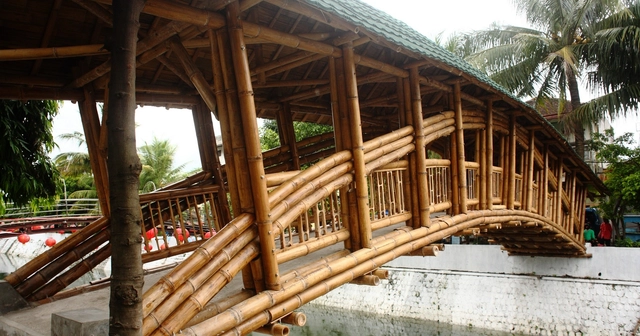
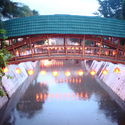
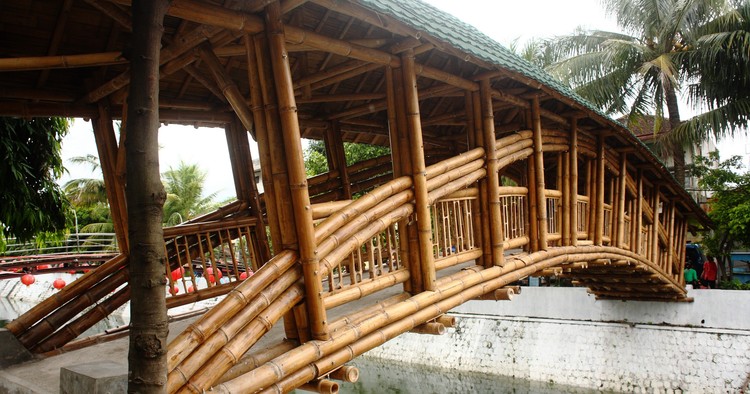
As part of the second Bamboo Biennale held in October 2016, the city of Solo in Central Java received a public Bamboo Bridge courtesy of Indonesian Architects Without Borders (ASF-ID). Connecting the Pasar Gede market and colonial Dutch Vastenburg Fort, the 18-meter bamboo structure offers a revitalization of river life in the historic Indonesian city. Spanning across the Kali Pepe river, residents of Java can traverse the pedestrian bridge on its track that varies in width from 1.8 to 2.3 meters.
Charles Thornton, one of the world’s preeminent structural engineers, once said that the greatest challenge facing the profession of structural engineering is that “I don’t think we have enough self-esteem and enough confidence in ourselves to believe that what we do is so important... Architects are trained to present, to communicate, to sell, to promote themselves, to promote their industry, and to take credit for what they do.”
As a structural engineer with over a decade of experience, I agree with Mr. Thornton—to an extent.
Despite the insistence of some, vinyl records haven’t undergone a resurgence because of their supposed superior sound quality. Instead, the impractical medium remains cherished for its quirk and ambiguity. As of late, the collage has made a has made a comeback as a representational strategy for the very same reason, sparking a recent debate around the potential emergence of "post-digital drawing."
Intentionally fantastical compilations empower architects to create clear narratives to supplement their work. In response to this growing popularity, a number of websites have popped up to bolster the trend. Image hosting hub ARTCUTOUT is a curated collection of meticulously detailed, public domain .PNGs nabbed from works of art that were “mostly created several centuries ago by European painters and cartographers.” Serving as a something akin to a “post-digital” version of famed render hub SKALGUBBAR, ARTCUTOUT has the potential to be a go-to resource for the next wave of designers.