

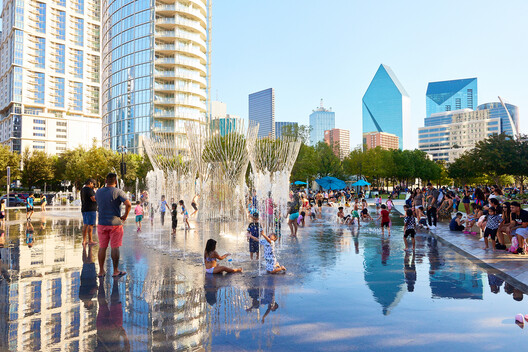
The exhibition Coming Together: Reimagining America's Downtowns, held at Washington, D.C.'s National Building Museum, explores the transformations underway in the United States' downtowns and the ways communities have organized to shape alternative urban scenarios. Curated by Uwe S. Brandes, Professor at Georgetown University, and designed by Reddymade and MGMT., it is the first of three major exhibitions within the Museum's Future Cities initiative, an interdisciplinary project examining the city as a hub, catalyst, essential building block, and reflection of society. Coming Together features examples from more than 60 U.S. cities, both large and small, highlighting lessons learned and opportunities embraced in the wake of the COVID-19 pandemic as communities adapt to lasting changes in work, housing, mobility, entertainment, and recreation. The exhibition is currently open to the public and will remain on view through Fall 2026.
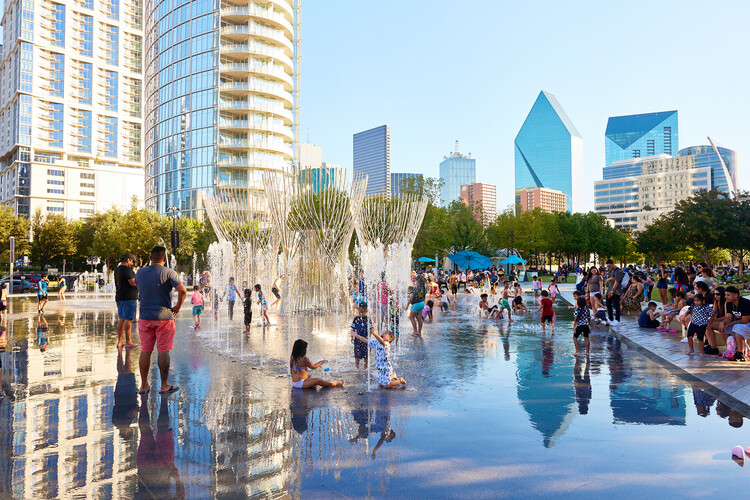
According to Aileen Fuchs, President and Executive Director of the National Building Museum, "Coming Together invites visitors to reflect on how cities are evolving and to explore bold ideas for building a more inclusive, resilient, and joyful future." Curator Uwe S. Brandes has noted that "this is a pivotal time in the history of American cities. The pandemic exposed vulnerabilities, but it also revealed the imagination and resilience of communities. Across the country, we're seeing a groundswell of innovation that's redefining what downtowns can be." The exhibition illustrates how mayors, employers, institutions, and local communities across the United States are partnering to develop strategies that improve urban spaces for all. Its central premise is that, by coming together, cities can reimagine how people live, work, play, eat, worship, learn, and heal.
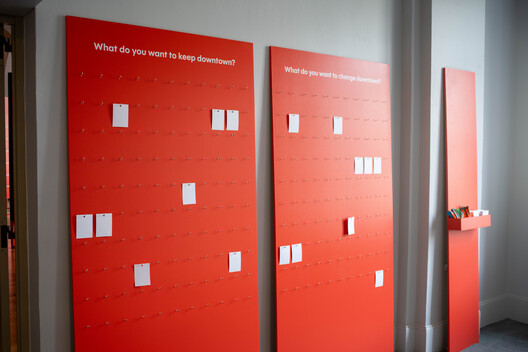
Through case studies, data infographics, large-scale video, digital interactives, and participatory voting activities, the exhibition offers a multimedia exploration of alternative urban futures grounded in community organization and collective action. It is organized into three galleries that thematically examine the evolution of U.S. downtowns. The first gallery, Social Distancing, establishes the historical and emotional context, exploring the origins of the term "downtown" and examining how public health emergencies such as the COVID-19 pandemic accelerated changes that were already underway. The second gallery, Cities Take Charge, focuses on contemporary strategies, policies, and tactics aimed at reimagining and repositioning downtown districts in the post-pandemic era. This section emphasizes collective transformation, experimentation, and resilience, showcasing examples in which office buildings are converted into housing, sidewalks become gathering spaces, and vacant storefronts are transformed into cultural venues.
Related Article
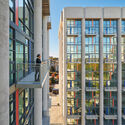
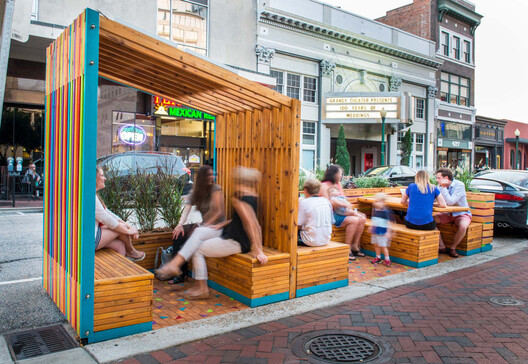
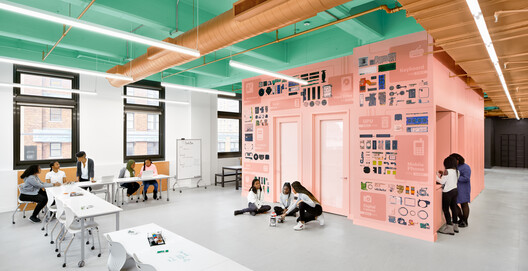
The Repositioning of Office Buildings: Creating Amenity-Rich Experiences in the Post-Pandemic U.S.Exhibited examples include initiatives from Salt Lake City, Utah, where the downtown residential population has grown since the pandemic through an emphasis on housing development; Washington, D.C.'s investment in sports and entertainment uses to offset structural economic changes; and Nashville, Tennessee's rapid adaptation of its tourism-based economy. Visitors can also explore the adaptive reuse of the 14-story Park + Ford office building in Alexandria, Virginia, which was converted into 435 residential units while retaining its concrete structure and much of its façade; the introduction of portable "parklets" in Norfolk, designed as temporary gathering spaces the size of parking spots; and the transformation of a formerly vacant Google office space in New York City into a coding academy with workshops and summer camps by the organization Black Girls Code. Beyond design interventions, the exhibition also highlights community-led strategies such as the partnership between Southwest BID and DC Central Kitchen during the COVID-19 pandemic in Washington, D.C., and the designation of Fifth Avenue in downtown San Diego as a "slow street."
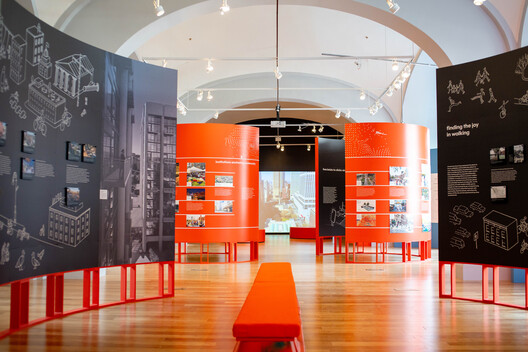
The exhibition itself gives physical form to our evolving understanding of our cities and their new potential post-pandemic. This is a space for deeply understanding our experience of public space and rethinking how we come together—across economies, geographies, and politics—to shape downtowns that truly reflect the needs and aspirations of their communities. — Suchi Reddy from Reddymade
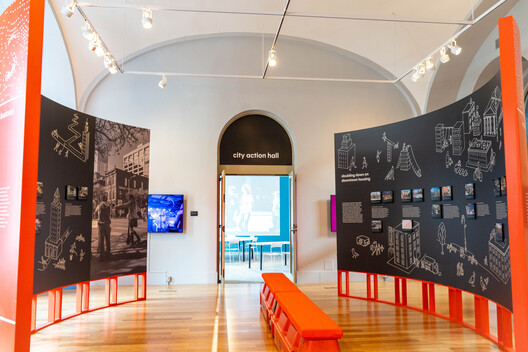
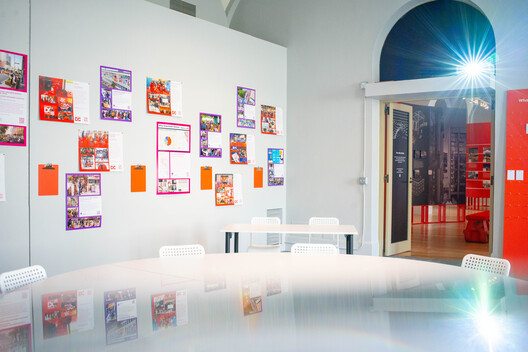
With Coming Together, the National Building Museum invites audiences to consider how collective action can help shape more inclusive, resilient, and vibrant cities. To support this aim, the exhibition includes a third space, the City Action Hall, which serves as a flexible collaboration area for meetings, strategy sessions, workshops, and public programs. Designed as a modular venue, it can accommodate up to 50 attendees in a theatre-style arrangement or up to 20 participants around a single table, and includes flexible seating, audiovisual capabilities, and pin-up boards for sharing outcomes. Participating organizations are encouraged to submit a poster highlighting their contributions to downtown revitalization, helping to build an active, national conversation throughout the exhibition's run. Groups and individuals can apply to use the City Action Hall via the Museum's application form.
Other ongoing architecture exhibitions worldwide include Architecture of Possibility: Zaha Hadid Architects at the Museum of Contemporary Art and Urban Planning (MOCAUP) in Shenzhen, China, which presents an overview of the evolution of the practice's work; the Canadian Centre for Architecture's (CCA) research project and institutional collaboration with M+ in Hong Kong, How Modern: Biographies of Architecture in China 1949–1979, on view in the CCA's Main Galleries from 20 November 2025 to 5 April 2026; and the Deutsches Architekturmuseum's (DAM) interactive exhibition on 100 years of architectural construction kits in Frankfurt, Germany, running from 25 October 2025 to 8 February 2026.


