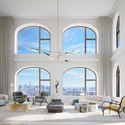
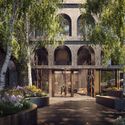
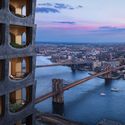
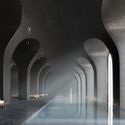
A new infinity pool offering unparalleled views of New York City is to be constructed atop KPF’s upcoming Brooklyn Point tower. At 680 feet above grade – nearly 100 feet higher than the iconic infinity pool at the Marina Bay Sands Hotel in Singapore – when completed the pool will become the “highest residential infinity pool in the Western Hemisphere."
Videos
Sex and the So-Called City. Office for Political Innovation. Storefront for Art and Architecture, 2018.. Image Courtesy of Imagen Subliminal
Storefront for Art and Architecture in 97 Kenmare St, New York, opened yesterday “Sex and the So-Called City,” an alternative version of Sex and the City (SATC) made by the architect Andrés Jaque / Office for Political Innovation with Miguel de Guzmán (Imagen Subliminal) on occasion of the show’s 20th anniversary.
The Architectural League of New York has announced the recipients of its 2018 Emerging Voices awards, spotlighting individuals and firms “with distinct design voices and the potential to influence the disciplines of architecture, landscape design, and urbanism.”
AIA New York and the Center for Architecture have announced five practices as winners of the 2018 New Practices New York awards, founded to identify and promote the city’s emerging young architects. Established in 2006, the awards are given biennially to practices headquartered in New York and in operation for 10 or fewer years.
Under this year’s theme of Consequences, firms were asked to submit portfolios containing design ideas that promoted “the capacity of architectural practice to offer transformative value within the broader context of the city.”
Courtesy of ArandaLasch + Marcelo Coelho with Formlabs
The collaboration of Aranda\Lasch + Marcelo Coelho has been selected as the winners of this year’s Times Square Valentine Heart Design competition for their 3D-printed proposal, Window to the Heart.
Envisioned as the “world’s largest lens,” the installation was in response to its location within one of the world’s most instagrammed places, Times Square. The 12-foot-diameter Fresnel lens, designed with 3D-printing manufacturer Formlabs and structural engineer Laufs Engineering Design, will capture the image of the square within the heart-shaped window at its center, bending and distorting the surround myriad lights and colors.
Miodrag Živković, Monument to the Battle of Sutjeska, 1965-71, Tjentište, Bosnia and Herzegovina. View of the western exposure. Photo: Valentin Jeck, commissioned by The Museum of Modern Art, New York, 2017.
The Museum of Modern Art will explore the architecture of the former Yugoslavia with Toward a Concrete Utopia: Architecture in Yugoslavia, 1948–1980, the first major US exhibition to study the remarkable body of work that sparked international interest during the 45 years of the country’s existence. The exhibition will include more than 400 drawings, models, photographs, and film reels culled from an array of municipal archives, family-held collections, and museums across the region, introducing the exceptional built work of socialist Yugoslavia’s leading architects to an international audience for the first time.
While the exterior of Philip Johnson’s iconic AT&T awaits its fate in an upcoming New York City landmarks designation hearing, demolition of its granite-clad interior lobby has already begun.
Citing the fact that the lobby had already been altered in the 1990s – including the removal of the “Golden Boy” statue – when the building switched tenants from AT&T to the Sony Corporation, the Landmarks Preservation Commission decided last month that the interiors were not deserving of landmark status.
Thomas Heatherwick is touching the New York Architecture Scene again, revealing his design for a pair of residential towers in a pair of renderings. The two towers will flank either side of the New York High Line, located at 18th Street, it will situate itself adjacent to Frank Gehry’s IAC Headquarters building.
The 2020 skyline, photo by Andrew Campbell Nelson, rendering by Jose Hernandez. Image Courtesy of YIMBY
2017’s building applications has seen a rise in both Brooklyn and the Bronx, according to YIMBY’s construction report on New York. Despite a drop within Manhattan and Queens, the number of new building applications over the five boroughs seems to be stabilising; 2016 saw the number of multi-family units decrease by over 40% to 19,356, a pattern which fortunately appears to have stopped as 2017 saw fillings for 19,180. After the last two years of massive drops, this couldn’t be more welcomed by New York.
Exterior View. Image Courtesy of Adjaye Associates
Plans for Adjaye Associates’ new home for the Studio Museum in Harlem are moving forward, as permits for the project have been filed with the city.
Replacing the museum’s current home, an existing century-old building repurposed in the 1980s by architect J. Max Bond Jr, the new building at 144 West 125th Street will rise 122 feet to become a new stand-out on the historic 125th Street Corridor.
Across the world, homelessness in fast-paced metropolises such as New York City is at a record high since the Great Depression of the 1930s, more than 60,000 people are in shelters every night while many others must find a place to sleep on the streets, the subway or other public spaces. The real estate industry has caused the increasing rents and a high demand for any remaining plots; many of the new builds are luxury apartments, rather than the low-cost housing that is so desperately needed. As a result, thousands of people are forced onto the streets and charities struggle to provide adequate help for everyone.
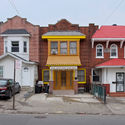
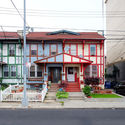
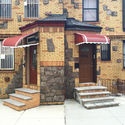
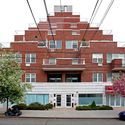
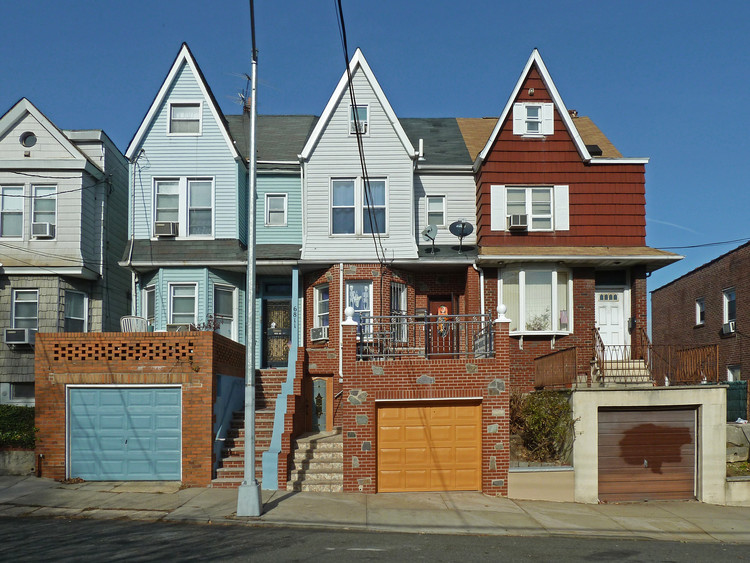
Queens, NY is one of the most diverse places in the world, so it should be no surprise that it’s residences reflect that diversity. From the Architectural League of New York comes Rafael Herrin-Ferri’s exhibition “All the Queens Houses.” An architect and artist, Herrin-Ferri compiled 273 photographs of homes in Queens. The ever growing photographic survey conveys themes of identity, differentiation, and adaptation.
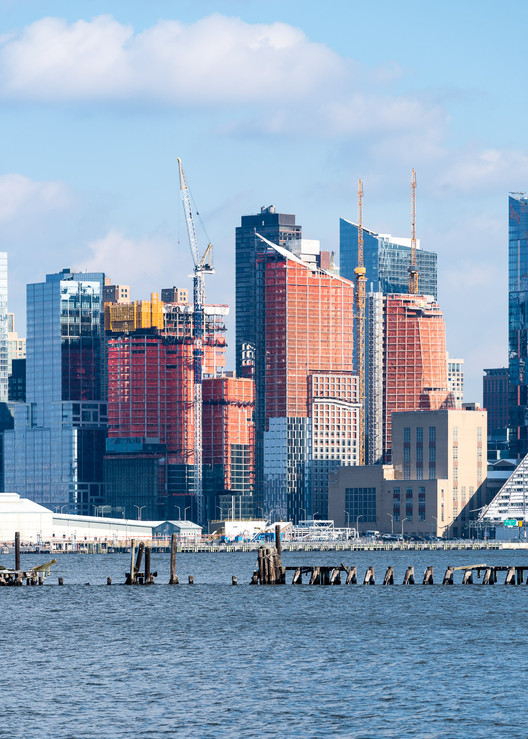
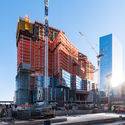
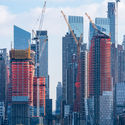
At one of the last remaining waterfront sites in Manhattan, the topping out of a luxury, five-acre, three tower mega-structure dubbed Waterline Square marks the end of a 25-year process for the 77-acre Riverside South Master Plan. Each of the three towers has been conceptualized by a different architect, with One Waterline Square by Richard Meier & Partners Architects, Two Waterline Square by Kohn Pedersen Fox Associates (KPF) and Three Waterline Square by Viñoly Architects. The towers were developed concurrently, but each reflects the vision of its architect, contributing to a harmonious complex while still remaining distinct.
Construction on the transformation of Eero Saarinen’s iconic TWA Flight Center into the new TWA Hotel has hit major milestone, as the project has now topped out.
New renderings have revealed of Adjaye Associate’s first New York City residential tower, 130 William, as foundational work on the project is underway. Located in the Financial District not far from the World Trade Center complex, 130 William will rise 66 stories to contain 244 luxury condominiums.
The idea for the vessel came from feeling that we shouldn’t just make a sculpture or a monument – it felt to us that rather than building a sculpture, it would be great if something was creating more public space.
Construction on the Santiago Calatrava-designed St. Nicholas National Shrine at the World Trade Center has halted, after the church failed to make a series of payments over a several month period to contractor Skanska.
As revealed by the Pappas Post, last week the construction company distributed a letter to its subcontractors informing them that the building contract had been terminated after The Greek Orthodox Archdiocese of America defaulted on making payment. In the letter, Skanska directed subcontractors to stop all work and to remove all tools and materials from the site, or risk not being able to recover them.
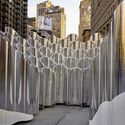
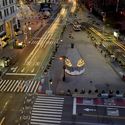
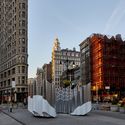
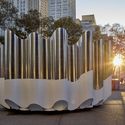
Hosted by the Flatiron/23rd Street Partnership Business Improvement District (BID) and Van Alen Institute, the temporary installation will serve as the “highly-visible centerpiece” of the neighbourhood’s holiday season programming.





.jpg?1516907284)


.jpg?1516086194)








.jpg?1513377460)
.jpg?1513377408 "Future TWA Hotel Grand Ballroom. Image © Max Touhey")
.jpg?1513377347 "Workers and partners fill the Saarinen terminal building at the topping out event. Image © Max Touhey")
.jpg?1513377471 "MCR CEO Tyler Morse and Turner Construction's Rick Faustini and Gary McAssey standing next to the north hotel tower crane with ceremonial flags. Image © Max Touhey")
.jpg?1513377418 "Workers pour concrete on top floor of north hotel structure. Image © Max Touhey")
.jpg?1513377460)