Virtual Robie House Tour / Zünpartners


© Nat Hansen

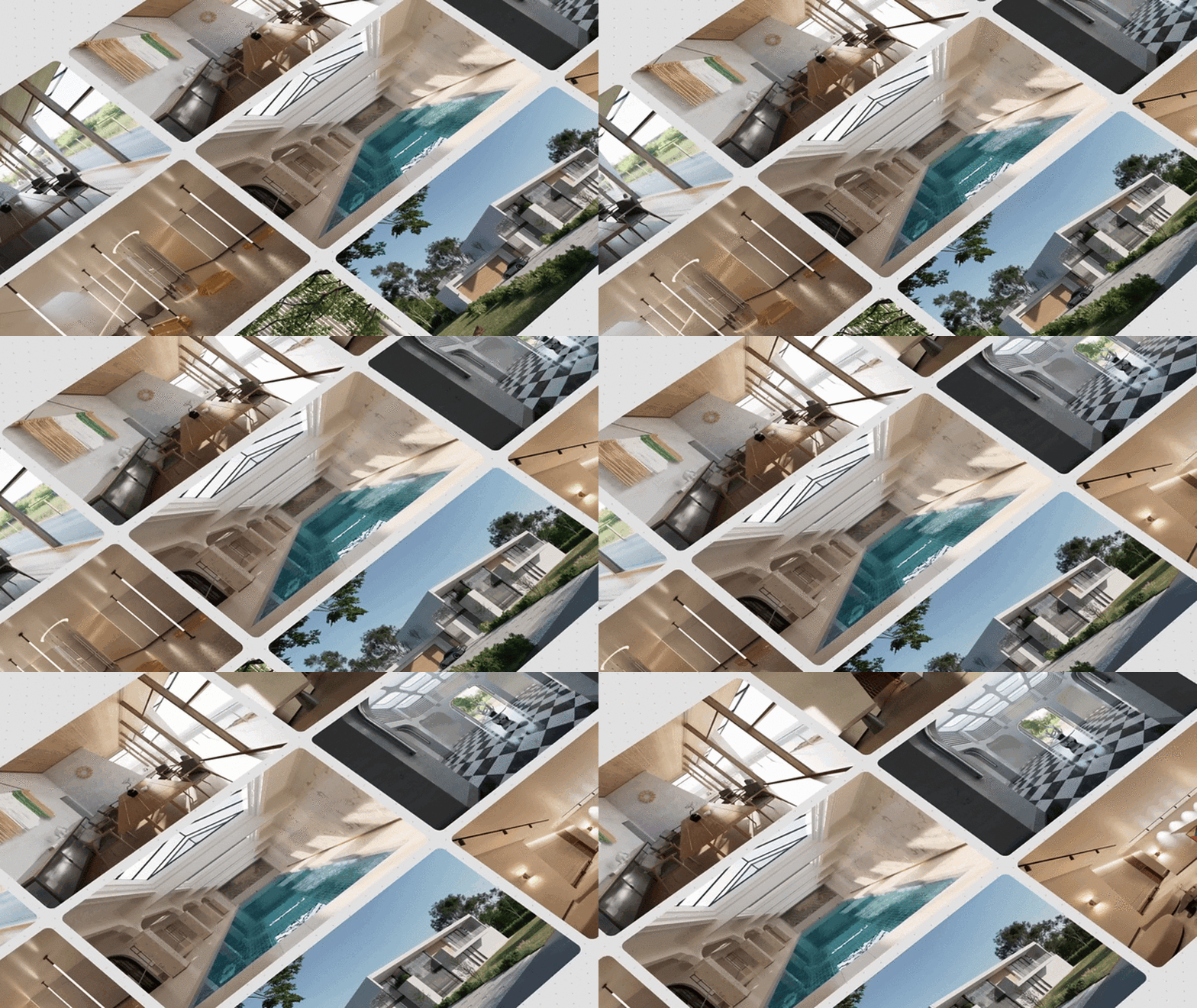
Often regarded as the greatest architect of our time, Frank Lloyd Wright has left several stunning works students, practitioners and even those unrelated to the field of architecture study, visit and appreciate.  Yet, as Wright’s projects suffer the telling signs of age, dozens of restorative efforts have tried to preserve his masterpieces.  Thanks to design firm Zünpartners, we can rest assured that Wright’s works will remain in perfect condition for years to come.  The firm, who just earned a Webby, has designed a complete virtual tour of the using a special digital restoration process.
More about the website after the break.

Gather / Katsuhiro Miyamoto & Associates

© Courtesy of

Architects: Katsuhiro Miyamoto & Associates
Location: Osaka-City, Osaka,
Principal in Charge: Katsuhiro Miyamoto
Project Team: Takenori Uotani
Structural Engineering: Masaichi Taguchi / TAPS
General Contractor: Nishimura Kenchiku-kobo
Site Area: 120.34 sqm
Built Area: 72.08 sqm
Total Floor Area: 135.05 sqm (additional area 7.23 sqm)
Project Year: 2009
Photographs: Courtesy of Katsuhiro Miyamoto & Associates

IES partners with Google SketchUp

With all the software options available, often times we jump between programs as some are suited better to certain aspects of design.  Google may be your software of choice for early design stages, as its ease of use does not limit schematic ideas from sprouting.  Yet, now, with a new partnership between the Integrated Environmental Solutions () and SketchUp, expect to use the program more frequently.

The partnership is a great balance between SketchUp’s strength for early stage design work and IES’ strength in performance analysis and simulations.  Now, users can analyze design iterations across a wide range of areas, such as energy, carbon, solar and daylight from very early in the design process, which will lead to achieving low-energy sustainable building design plus the ability to assess the economics of low/zero carbon technology and renewable energy use.

We look forward to using this new creation and we hope you do, too!

Alligator / buildingstudio

© Will Crocker

Architects: buildingstudio
Location: , LA,
Design Team: Coleman Coker, David Dieckhoff, Varuni Edussuriya, Tom Holloman, Jonathan Tate
Client: Neighborhood Housing Services
General Contractor: Evolution Builders
Project Area: 960 sq ft
Budget: US $116,000
Project Year: 2010
Photographs: Will Crocker & Undine Prohl

Condominio M / C+C04STUDIO

© Pierluigi Dessì / Confinivisivi

Architects: C+C04STUDIO
Location: Cagliari,
Collaborators: Ing. S.Pusceddu, Ing G.Meloni
Contractor: Edilizia Bandini snc
Budget: € 400,000
Project Year: 2005
Photographs: Pierluigi Dessì / Confinivisivi

Project RE:FOCUS / University of Florida

We are always excited to see what the Solar Decathlon entries bring to the table.  It is an extremely intense competition, rooted in the belief that highly efficient homes can be sustainable without sacrificing aesthetics or comfort.  Throughout the months spent preparing their final houses, students from some of the best universities in the world strive to fuse technological innovation, sustainability and design into a functional entity.

The competition challenges students to think beyond the systems and strategies that are currently in use, thus, each proposal attempts to find innovative ways to approach the issues of renewable energy and energy efficiency.  The University of Florida’s Project RE:FOCUS combines its Floridian vernacular language with a ‘back-to-basics’ approach to sustainable living.  As such, the 800 sqf house rethinks traditional practices and “hopes to communicate the need to RE:FOCUS how, and in what, we live.”

More about the project and more images, including some great construction shots, after the break.

railLA Call for Ideas/Venues

railLA, a joint effort between the Los Angeles Chapters of the American Institute of Architects (AIA) and American Planning Association (APA), has launched a Call for Ideas/Venues about High-Speed Rail and its transformative impact on society and the built environment.

Entrants are encouraged to submit new and existing ideas, concepts, designs, plans, papers, videos, models, and other studies. The Call is intended to create a wealth of information about High-Speed Rail from around the world to be exhibited at selected venues through a separate Call for Venues.

A select group of submissions will be showcased at an opening exhibit in Downtown , the railLA website, and in various publications. A $2500 prize purse for the top five submissions will be announced at the opening exhibit.

More information on the competition’s official website. Seen at Death by Architecture.

RE.FLECKS exhibition

The RE.FLECKS exhibition presents panels J. MAYER H. has derived from data-protection patterns. Developed by chance in print shops around 1900, the patterns were used as an envelope lining to protect the confidential content inside.

One of these many patterns was selected and interpreted spatially in the form of various art objects. Like the inkblot pictures by Rorschach, an early 20th century psychoanalyst, the RE.FLECKS panels support the viewer’s own interpretation and reading.

Exhibition will open June 11 at 6pm at Magnusmuller, Weydingerstrasse 10/12, 10178 .

Case for Curiosity / Itai Palti

For his degree project for the Bartlett School of Architecture, Itai Palti explored the integration of the role of imagination in the context of national reconciliation.  Based in Tel Aviv-Jaffa, the proposed film studio + public square focuses on the Jewish-Arab relationship in Israel.

Check out more images of his great model and more information about the project after the break.

AD Classics: Vanna Venturi House / Robert Venturi

© Maria Buszek

Most critics usually regard consistency in architecture an important aspect of the design. However in the Vanna Venturi House took the road less travelled and tested complexity and contradiction in architecture, going against the norm. Located in Chestnut Hill, on a flat site isolated by surrounding trees, Venturi designed and built the house for his mother between 1962 and 1964. In testing his beliefts on complexity and contradition (for which he also wrote the book Complexity and Contradiction in Architecture), Venturi went through six fully worked-out versions of the house which slowly became known as the first example of Postmodern architecture.

More on the Vanna Venturi House after the break.

AIA Convention: Follow us on Twitter and win amazing books!

The AIA National Convention 2010 will be held in from June 10 till June 12, and ArchDaily will be there to cover it! To start the engines, we decided to launch a small giveaway in Twitter starting today and finishing next Thursday. Everyday we will be giving an amazing book related to the AIA Convention. All you need to do is follow us on Twitter and RT our message. To do so, you can just click here (must be logged on to your account).

And that’s about it. Just a click, and you can win! Today’s book is “Climate Design: Design and Planning for the Age of Climate Change”. So RT our message till 6pm today, and tomorrow morning we’ll announce the winner! And remember, tomorrow we’ll have another book for you!

Leaving behind their Pritzker Mentors

Photo from the New York Times. From left, Markus Dochantschi, , and Florian Idenburg.

There’s something to be said about learning from our elders.  At least that’s the case for a select  group of younger architects who have been working behind the scenes with some of the biggest names in the profession: Zaha Hadid, Tadao Ando and .  Markus Dochantschi, Kulapat Yantrasast, and Florian Idenburg, have taken what they have learned in the almost decade working for their Pritzker Prize winning mentors and have branched to form their own practices in the United States.

More about the protégés after the break.

DETAIL Green

While DETAIL Magazine brings us the insights of buildings in terms of highly detailed drawings, DETAIL Green focuses on sustainability in architecture trough data & analysis.

The issues moves between concepts -such as lessons learned from the proposed zero-carbon Masdar City-  to case studies, on which several experts analyze a series of case studies in terms of lighting, materials, energy, etc.

More after the break.

Eco Energy Plant / Urban Design

© Courtesy of

Architects: Urban Design
Location: Donetsk,
Client: Eco Energy
Project Manager: Erik Jarlöv, Helena Glanz
Project Year: 2011
Images: Courtesy of Urban Design

Small Houses / A1 Architects

At an exhibit at the Gallery of Academy of Arts, Architecture and Design in Prague, A1 Architects produced several new housing typologies.  In the sampling of 1:125 models, and one 1:1 model, the firm explored the idea of “limitless living in a limited space.”  The challenge lay in the ability to make a residence maintain a feeling of openness and functionality, while contained in a small size.  We enjoy the work because experimenting with this small housing typology is becoming imperative as our population continues to grow exponentially with land availability decreasing rapidly.

More about the homes after the break.

House in Chaum / Prax Architectes

© Arnaud Saint-Germès

Architects: Prax Architectes
Location: Saint-Gaudens,
Principals in Charge: Marie-Pierre & Olivier Prax
Project Area: 170 sqm
Photographs: Arnaud Saint-Germès

Reblaus / BWM Architekten und Partner

© Bruno Klomfar

Architects: BWM Architekten und Partner
Location: Vienna,
Project Year: 2008
Photographs: Bruno Klomfar

Wave House / Patrick Nadeau

Our friends at Inhabitat shared Patrick Nadeau‘s with us to enjoy.  Situated in Reims, France, the house features a new take on a green roof – a  cascading green surface that blankets the artificial to disguise it as a grassy hill.   While we enjoy the addition of any green roof, Nadeau’s approach of a roof that is integrated with the overall form of the house and is then blended into the larger landscape is a nice strategy.

More images and more about the home after the break.

Oslo Triennale 2010: Man Made Reformulate Competition

The intention of the competition is to challenge the participants on how to exemplify and illustrate policies on architecture, the relationship between architecture and politics, and how architecture can contribute in solving the challenges of the future. Architecture is politics in practice. Through architecture we inflict the political landscape, our surroundings and our society. MAN MADE REFORMULATE seeks suggestions on how we can influence the society and the challanges of tomorrow in a positive matter. We want to see old, new, shown and unknown suggestions, where the aim is to find the best ideas.

The winner’s task will be to apply their concept onto , the capital of , shown as project and exhibited as part of the Architecture Triennale in September/October 2010. In this phase we ask for projects, ideas and concepts already developed, or which has been developed especially for this entry which handles the topic of MAN MADE REFORMULATE: How can architecture solve the challenges of tomorrow?

For more information, go to the competition’s official website. Seen at Death by Architecture.

AD Round Up: Classics Part I

Greg Robbins

As you may have noticed, we’ve been featuring some iconic architecture in our new section AD Classics. We will keep bringing you many more, but in case you’ve missed a few, here’s a first selection of our “classic” architecture. Check them all after the break.

The Farnsworth House / Mies van der Rohe
The Farnsworth House, built between 1945 and 1951 for Dr. Edith Farnsworth as a weekend retreat, is a platonic perfection of order gently placed in spontaneous nature in Plano, Illinois. Just right outside of Chicago in a 10-acre secluded wooded site with the Fox River to the south, the glass pavilion takes full advantage of relating to its natural surroundings, achieving Mies’ concept of a strong relationship between the house and nature (read more…)

Happy Birthday Sir Norman Foster!

Born June 1 in 1935, Sir Norman Foster is probably one of the most important architects of our time. In 1963 he set up an architectural practice  called Team 4 along with Richard Rogers and sisters Georgie and Wendy Cheesman. After they went separate ways, Foster and Wendy founded Foster Associates, which eventually became Foster + Partners.

Huge recognition for Foster began 20 years ago. He was knighted in 1990 and appointed to the Order of Merit in 1997. He was awarded with the Pritzker Architecture Prize in 1999. In he received the Order Pour le Mérite and most recently, in 2009, he was awarded the Prince of Asturias Award in the Arts category.

To honor this great architect’s brirthday, here are the links for every project we’ve featured from Foster + Partners:

Willis Headquarters at Lime Street / Elephant House / Beijing Airport / Ernst & Young Headquarters, Amsterdam / Harmon Hotel / UAE Pavilion for Shanghai World Expo 2010 / 5-Star Hotel and Conference Center / Super-Yacht / Spaceport America / Winspear Opera House / City Center Las Vegas

Also, hundreds of fans have already left a birthday message through our Facebook Fan Page and Twitter. You may want to check them and leave your own. I’ll try really hard to get them to him.