Richard Meier’s new book: “Museu d’Art Contemporani de Barcelona” giveaway winners!

Last week we told you about our interview with Richard Meier, and his opinion on the importance of white for contemporary architecture. We invited you to give us your opinion for the chance to win one of three signed copies of Meier’s book Museu d’Art Contemporani de Barcelona. The deadline is now over, and among the more than 200 comments we randomly selected the three winners! Congratulations to Madeeha Merchant, Sarah Hall, and Terry Williams! You are the winners of the three signed copies of the book! Check your emails as we will contact you to send you the books.
Fashion Hotel and Bridge / Ivan Filipovic

Live life for every moment, outreach sensations, inhale fully, and go forward with speed. There can only be one place where people can be aware of this transience, and New York is just that! Life, it lives the speed of light and brilliance, always new and undiscovered, requires constant innovation. This complex project, by Ivan Filipovic, is just this: Forms that heighten one’s sensations, where lights and functionality can only be understood by someone who lives a prestigious blend of pragmatism and lasting gratification. The combination of profitable operation and enjoyment of consumption is clearly targeted and a focused effort that leaves no doubts as to the meaning of zeal and pleasure. More images and architect’s description after the break.
Desert House / Circle West Architects

Articulating defined spaces in retrofitting a 20-year-old residence through a punctuation of natural daylight, exterior spatial relationships and a reduction in use of finishes. Desert House is a modern, sustainable intervention in the desert. The single-family residence renovation represents a forward thinking approach to desert life.
Architect: Circle West Architects
Location: 4812 E Berneil Drive, Paradise Valley, Arizona, USA
Project Team: Peter M. Koliopoulos AIA
General Contractor: Urban Edge Builders
Structural Engineer: BDA Engineers
Mechanical Engineer: Tiglas Engineering Assoc.
Electrical Engineer: CR Engineers
Landscape Architect: Arcadiascape, LLC
Project Area: 5,000 sqf
Project Year: 2008
Photographs: Courtesy of Circle West Architects
AIA New Orleans 2011 Design Awards

The AIA New Orleans welcomed a record number of entries for the 2011 Design Awards, 100 Years of Excellence in Design. The categories included Interior Architecture, Master Planning, Divine Detail, Project, Architecture, Adaptive Reuse, and Juror Favorite. A complete list of the 2011 AIA New Orleans Design Awards and jurors comments following the break.
Centre Spécialisé de Technologie Physique du Québec / bisson | associés + Carl Charron Architecte

Architects: bisson | associés + Carl Charron Architecte
Location: Québec, Canada
Engineer: Roche Sopax et Techniconfort
Collaborators: Éco op
Contractors: Kamco Construction inc.
Project area: 2,225 sqm
Project year: 2010
Photographs: Stéphane Groleau
Arthur Roger@434 / studioWTA

The architecture firm studioWTA renovated this existing space in an historic building into an art gallery. The primary concern in the design was to highlight historic elements, while providing a clean, crisp surface on which to display artwork.
Architect: studioWTA
Location: 432 and 434 Julia Street, New Orleans, Louisiana, USA
Project Area: 1,800 sqf
Project Year: 2008
Photographs: Jeff Johnston
House In Scottsdale / Allen + Philp Architects

Architects: Allen + Philp Architects / Interiors
Location: Scottsdale, Arizona, USA
Builder: Linthicum Corporation
Interior designer: David Michael Miller Associates
Project area: 7,450 sqf
Project year: 2008
Photographs: Timmerman Photography
Villa Håkansson-Tegman / Johan Sundberg

Architects: Johan Sundberg
Location: Höllviken, Sweden
Collaborator: Mattias Andréasson
Landscaping: Maria Arborgh
Structural engineer: Laine Montelin, Tyréns
Client: Håkansson-Tegman Family
Builder: Lars Benjaminsson
Project year: 2008 – 2009
Photographs: Kasper Dudzik
‘Elemental’ and ‘New Orleans Architecture Now’ Exhibitions
Thursday, May 5th the Ogden Museum of Southern Art will host the AIA New Orleans Member Preview Event for two architecture exhibitions, Elemental and New Orleans Architecture Now. Both exhibitions will open to the public on Saturday, May 7, and remain on display through Friday, May 13 during the 2011 AIA National Convention. To register and for more details of the event can be found here.
Elemental: This exhibition aims to illustrate how digital fabrication tools are indeed revolutionizing the way we think, fabricate and distribute 3D designs, and how it all together affects the practices of designers and architects. On focus in the exhibition is how digital fabrication goes from the digital world to physical reality at multiple scales. Participants will include Greg Lynn, Elena Manferdini, IwamotoScott and Florencia Pita.
New Orleans Architecture Now: This exhibition will present the work of 35 different local architects and firms in the New Orleans region. Featuring 20 physical models, and arranged by neighborhood and type, a diverse selection of projects will be presented that reflect the great variety of work, from urban farm to master planning, that is happening in New Orleans now.
ZIK / K-architectures

Located on the urban periphery of Granville, this musical school sits in a landscape that is both rural and urban. In this setting, the school brings together many of music schools that were scattered across several municipalities. Hidden by the terrain, the building borrows from the surrounding rural farms, barns, and small factories and translates them into a contemporary language. The details are simple and clean with a hint of rustication ie. the pre-patina copper green.
Architect: K-architectures
Location: 1301 Route de Vaudroulin 50400 Granville, France
Project Team: Karine Herman and Jérôme Sigwalt, Rebecca Pelayo and Sébastien Fiore (assistant architects)
Project Area: 1,305 sqm
Project Year: 2010
Photographs: Simon Deprez
Healthcare school extension and renovation in Hogeschool Gent / Marc Koehler Architects

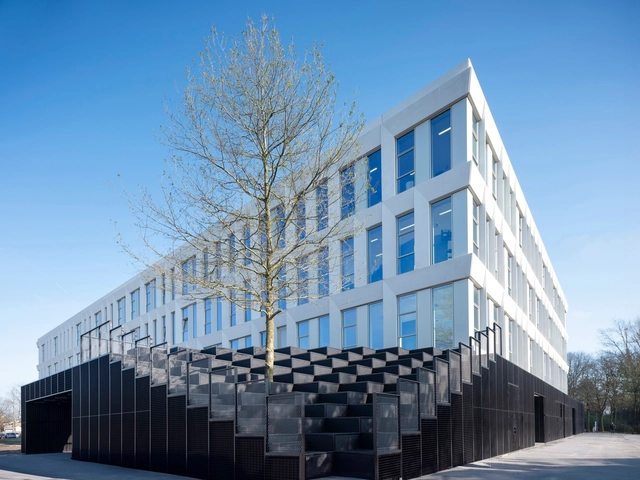
Marc Koehler Architects and their team have won the competition for the extension and renovation of Campus Vesalius at Hogeschool Gent. The project is part of Open Call 19, organized by the Vlaams Bouwmeester in 2010 and developed with Delva Landscape Architects, Import Export Architecture, Daidalos, STBViaene and Less is More engineering. More images and complete press release after the break.
Practice 2.0: Are we ready for the Challenge?

by Steve Sanderson
This is the first in Practice 2.0, a regular series of posts guest authored by our friends at CASE (@case_inc), focusing on technology and innovation in the building industry. While we all share tremendous enthusiasm for the opportunities afforded by technology, my particular interests are on gaining better, more timely access to information and improving building performance through informed decision making. Given the proximity to Earth Day (better late than never), I’m going to start things off with a related post. You can expect future posts to focus on building simulation and evidence-based design, with an emphasis on energy, validation and standards. You can also expect to hear a lot about Passive House.
Last Wednesday, I had the pleasure of seeing Ed Mazria of Architecture 2030 speak at Cooper Union. For those that don’t know, Mazria and his organization have been instrumental in raising awareness of the enormous impact of buildings on climate change. His initiative, The 2030 Challenge, has been adopted (in varying degrees) by the most influential organizations on the built environment in the United States, including: the Federal Government, US Army, State of California, AIA and ASHRAE, among others. What does that mean? It means these organizations will require (or encourage) all new construction and major renovations to be carbon neutral by the year 2030.
Sounds good right? Frankly, it sounds awesome, but when you dig deeper into how this is received by the industry, you come away with a different perspective. As a building technology consulting firm, we interact with a diverse group of stakeholders from across the industry, representing all of the organizations noted above. In conversations with these individuals about the goals set out by The 2030 Challenge, you can basically group nearly everyone into one of two groups: The Blissfully Ignorant or The Fearfully Aware.
Housing & Dining Services Administration Building / Studio E Architects

Featuring a new 8,000 sqf main catering kitchen for the campus, the Housing & Dining Services Administration Building is home to UCSD’s Catering and Housing, Dining & Hospitality staff—here everything to do with food or housing on campus is handled. The project site is in the southwestern corner of the UCSD campus and sits on the western edge of campus. The building overlooks North Torrey Pines Road which is a major thoroughfare. The neighborhood across this road to the west is a mix of small scale housing and a church. On campus, the immediate neighbors are classrooms and laboratories to the north, a student dining commons to the east and a new residential complex now under construction to the south. The site was chosen in part because the catering operations could share the loading/drop off space with the student dining commons.
Architect: Studio E Architects
Location: North Torrey Pines Road, La Jolla, California, USA
Landscape Architect: IVY Landscape
General Contractor: Swinerton Incorporated
Project Area: 43,400 sqf
Project Year: 2009
Photographs: David Hewitt & Anne Garrison
Concrete Slit House / AZL architects

Architects: AZL architects – Zhang Lei
Location: Nanjing, Jiangsu Province, China
Project Team: Zhang Lei, Meng Fanhao, Cai Menglei, Lu Yuan, Tang Xiaoxin
Collaborator: Architectural Design & Planning Institute, Nanjing University
Project area: 270 sqm
Project year: 2006 – 2008
Photographs: Iwan Baan
Cactus Tower / Eric Owen Moss Architects

The existing 30,000 sqf building was originally used for light manufacturing, constructed in the 1940′s, has walls of poured concrete, and a roof structure that is a sequence of wood bow string trusses. A large steel frame, enclosed with corrugated metal, 50 feet high, is located just outside the warehouse, where a industrial press was once housed. The now vacant tower was stripped revealing a ramshackle steel support structure, and a supporting concrete block wall. With the intention to reuse the existing structure, Eric Owen Moss Architects reinterpreted the space to create an outdoor meeting and gathering area.
More photographs and drawings of the Cactus Tower following the break.
Architects: Eric Owen Moss Architects
Location: Los Angeles, California, USA
Photographs: Tom Bonner
MVRDV to transform disused laboratory into call centre and incubator

The city of Dijon and Teletech International have chosen MVRDV to transform a disused Dijon Mustard laboratory completed in 2004 into an innovative call centre with an education centre, incubator and social program. Transformation through reuse is one of the contemporary issues in European architecture since the current crisis. Completion of the 6000m2 refurbishment is planned for 2012. More images and complete press release after the break.
Vertical Cave in Nunavut / rzlbd

The Nunavut Tower by rzlbd is a structure that aims to fulfill the human desire to conquer gravity, while challenging the modern notion of skyscrapers as vertical extrusions of a two-dimensional layout on the ground. The desire is to design a skyscraper in which each space is tailored to the inhabitant.
Read on for more after the break.
No Picnic / Elding Oscarson

Architects: Elding Oscarson
Location: Stockholm, Sweden
Client: No Picnic AB
Project area: 1,100 sqm
Project year: 2010 – 2011
Photographs: Åke E:son Lindman
Lulu Chow Wang Campus Center and Davis Garage / Mack Scogin Merrill Elam Architects

The Wang Campus Center, Davis Garage and related Alumnae Valley projects encompass most of the western half of the Wellesley College campus. They include a 50,000 sqf Campus Center, the renovation of the Alumnae Valley landscape, a 565 car parking garage, a 20,000 sqf building for the Campus Trade Shops, a 4,000 sqf building for the campus police, the renovation and re-design of the campus chilled water plant, and the re-design of the Campus Central Utility Plant environs.
Architect: Mack Scogin Merrill Elam Architects
Location: Wellesley, Massachusetts, USA
Project Team: Mack Scogin, Merrill Elam, Timothy Harrison, Christopher Agosta, David Yocum, Kimberly Shoemake-Medlock, Jeffrey Collins, Jennifer Pindyck, Barnum Tiller, Christian Rice, Michael Wirsching, Jennifer Hurst, John Trefry, Stephen Trimble, Kevin Gotsch, Andrea Korber, Jane Lee, Ashley Moore, Margaret Fletcher, Brian Bell, Trey Lindsey, Sophia Greenbaum, Helen Han, Ted Paxton
Landscape Architect: Michael Van Valkenburgh Associates
Structural Mechanical and Plumbing Engineer: Arup
Civil Engineer: Vanasse Hangen Brustlin
General Contractor: Richard White Sons
Project Managers: Genesis Partners
Lighting Consultant: LAM Partners
Project Area: 74,000 sqf
Project Year: 2005
Photographer: Timothy Hursley