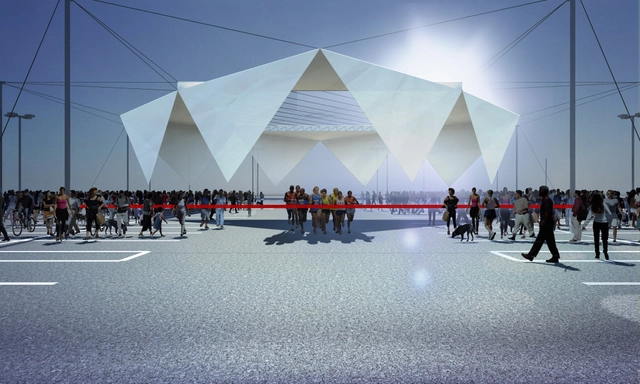
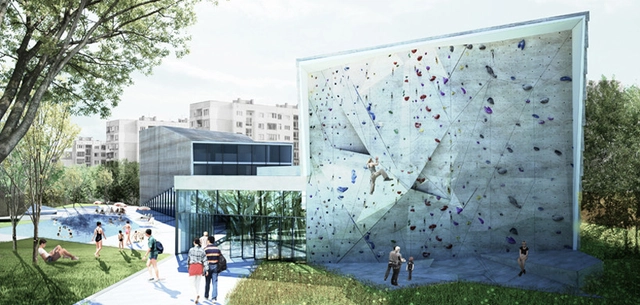
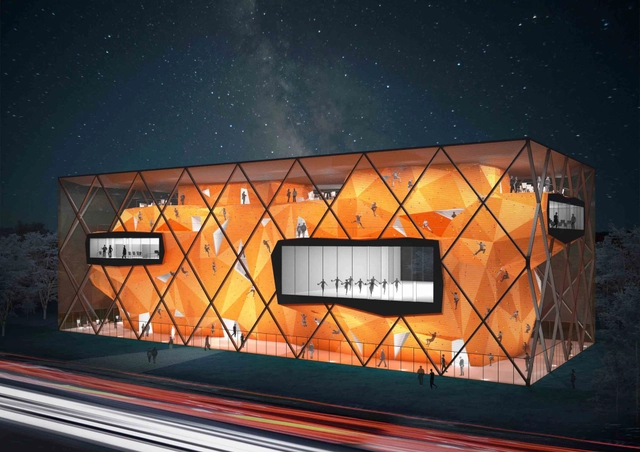
Situated in the large fun park in the suburbs of Sofia, Radionica Arhitekture's proposal for the Collider Activity Center, which won one of five first prizes, is a small artificial 'mountain'. When external conditions are favorable, the facade opens and the internal atmosphere becomes external. The second layer is the hall, a kind of a "cytoplasm". The space between the façade and the climbing surface.This is the place of entrance, where the building and the park mix, the site of overlapping where all paths intersect. More images and architects' description after the break.
The Architectural League of New York announced early this month the award of its 2013 President’s Medal to Renzo Piano of the Renzo Piano Building Workshop.The President’s Medal is the Architectural League’s highest honor and is bestowed, at the discretion of the League’s President and Board of Directors, on individuals to recognize an extraordinary body of work in architecture, urbanism, or design. This award also exemplifies the Architectural League’s 130-year history of encouraging and honoring excellence in architecture, urbanism, and design. The medal was presented to Renzo Piano, one of the world's most admired architects, by Architectural League President Annabelle Selldorf on April 9th at a dinner with over 350 guests in Manhattan. For more information, please visit here.
Designed by Ksestudio, their “Stage a lot” Flat Lot competition entry, which received an honorable mention, is a constantly transformative intervention that responds to the call for a temporary structure from the Flint Public Art Project. The project invents a ballet of ropes and pulleys animating four suspended rectangular pieces of white tyvek that in a neutral position hang vertically to form a topless cube. More images and architects’ description after the break.
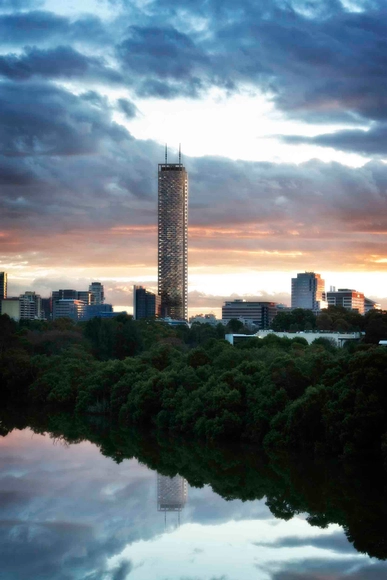
Emerging from a design excellence competition held by the Parramatta City Council, the Aspire Tower, designed by Grimshaw Architects, is a landmark mixed-use tower set to establish a new benchmark for innovative, passive-environmental design in Australian high-rise developments. Designed to act as a catalyst project for Parramatta Square, the tower provides high density, urban residential living which is not only affordable but also sustainable. More images and architects' description after the break.
The Architecture Foundation recently launched their annual international Open Call for innovative independent exhibitions and installations for its central London Project Space. Intended as an incubator for independent positions and architectural experimentation, projects selected through the Open Call will punctuate the AF’s ongoing curated program. This program, competitively selected through a jury process, will give space to individuals or organizations to activate the AF Project Space as a testing ground for modes of exhibition and 1:1 scale spatial experimentation, an open studio, a public residency or other diverse formats. The foundation's recent initiative, 'We Made That', was a project selected through the 2012 Open Call. The deadline for submissions is May 10. For more information, please visit here.
TEX-FAB recently announced the SKIN International Digital Fabrication Competition which asks designers and researchers to speculate, or if they so choose - to present existing research - on the role of the building envelope by exploring new methods to enable the performative and aesthetic qualities of a façade. A building’s skin has the potential to synchronize form and illustrates the totality of the project, while driving how the building responds to its context, its role and ultimately its utility. Design submissions may develop any context they choose, real or virtual, at any scale and on any building type so to present a complete thesis. The deadline for entries in June 30. For more information, please visit here.
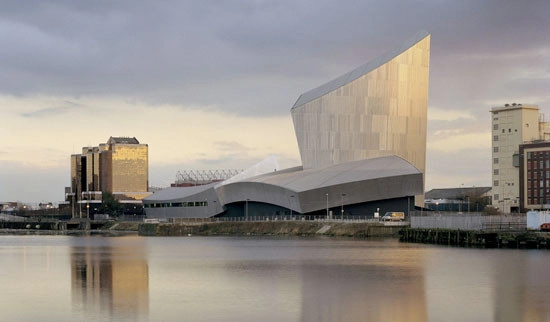
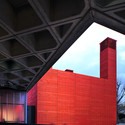
Imperial War Museum North by Studio Daniel Libeskind
A 1970 graduate of Cooper Union's architecture program, world-renowned architect Daniel Libeskind will be delivering 'The Art of Memory' lecture, a free event, on Tuesday, April 30th, at 6:00pm. The master planner for Ground Zero and the architect of one of Europe’s most visited museums, the Jewish Museum Berlin, will discuss the role that memory played in his work on those projects and others, such as the Danish Jewish Museum in Copenhagen, Denmark; the Imperial War Museum in Manchester, England; the Military History Museum in Dresden, Germany; and the Contemporary Jewish Museum in San Francisco. He will also talk about the acute sense of responsibility he feels, when accepting commissions for projects addressing Jewish history, to create work that honors not only the harsh realities, but also the resilience of the Jewish spirit. For more information, please visit here.
Located in the rapidly urbanizing Mladost area on the edge of central Sofia, the new Collider Activity Center, designed by INDEX, draws on the process of the tectonic movement and operations of geological forms as an organizational system to create architecture. The center will be one of the first new buildings to occupy the quasi Greenfield site and the broader urban structure plan for the area will eventually play host to a variety of new facilities, capitalizing on the latent potential of Bulgaria as an emerging economy. More images and architects' description after the break.
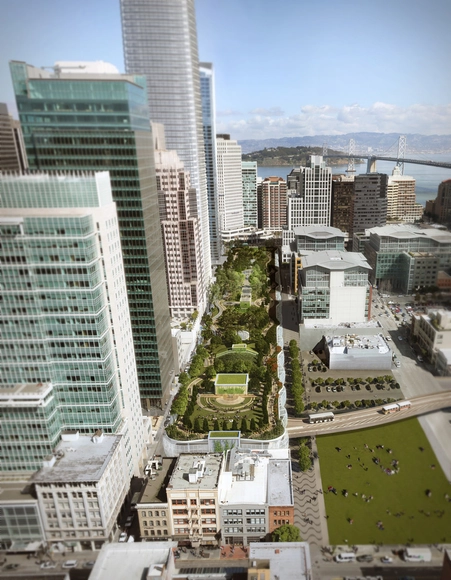
The revamped Transbay Transit Center in downtown San Francisco broke ground earlier this week, a project that will introduce a 1.5 million square foot development that will be part transportation hub, part public park and urban space, and part offices and retail establishments. The massive undertaking, designed by renowned architecture firm Pelli Clarke Pelli will bring together 11 systems of local and national transportation, serving 45 million people per year. In addition to securing access to myriad transit lines, the project will also provide downtown San Francisco with a 5.4-acre rooftop park, designed by PWP Landscape Architecture, along with numerous cultural programs. The project is budgeted at 4.2 billion dollars and is projected for completion in 2017. It is funded in part by the construction of a 1,070-foot tower that is adjacent to the Transbay Transity Center. It is also designed by Pelli Clarke Pelli and is slated to be the tallest tower in San Francisco. The tower will secure 60 stories of office space and jobs and will contribute to the projected $87 billion of revenue through 2030.
Join us after the break for more details on this project.
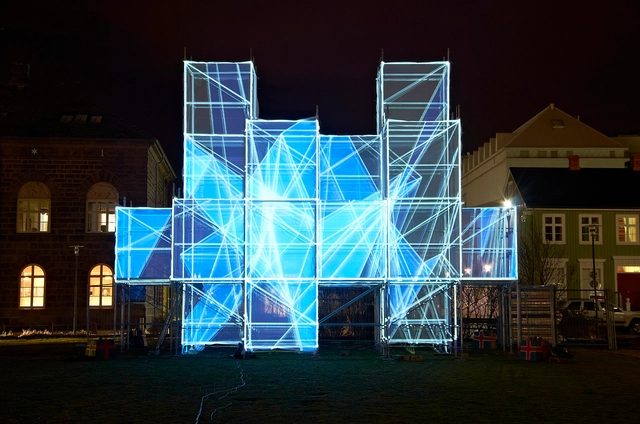
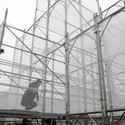
Designed and directed by Iceland based architect Marcos Zotes and his studio UNSTABLE, their Pixel Cloud installation is the winning competition entry for the Reykjavik Winter Lights Festival 2013, organized by Höfuðborgarstofa, Orkusalan and the Iceland Design Center. The installation creates an opportunity for Icelanders to reconsider the use and management of their urban public spaces. With the current financial situation leaving a permanent landscape of obsolete scaffolding structures scattered across the city, this has resulted in urban scars that remind us of the fragility of their current society. This installation takes advantage of this condition by transforming an ordinary scaffolding structure into a fully immersive environment of light and sound in the heart of Reykjavík. More images and architects' description after the break.






.jpg?1366138084&format=webp&width=640&height=580)
.jpg?1366138097 "© Luc Boegly")
.jpg?1366138113 "© Luc Boegly")
.jpg?1366138131 "© Luc Boegly")
.jpg?1366138166 "© Luc Boegly")
.jpg?1366138084)
_ORCO-photo-by-Krzysztof-Wierzbowski_08.jpg?1366124262&format=webp&width=640&height=580)
_ORCO-photo-by-Krzysztof-Wierzbowski_09.jpg?1366124261 "© ORCO photo by Krzysztof Wierzbowski")
_ORCO-photo-by-Krzysztof-Wierzbowski_03.jpg?1366124281 "© ORCO photo by Krzysztof Wierzbowski")
_Studio_Daniel_Libeskind.jpg?1366124707 "© Daniel Libeskind")
_Aldinger___Wolf.jpg?1366124743 "© Daniel Libeskind")
_ORCO-photo-by-Krzysztof-Wierzbowski_08.jpg?1366124262)