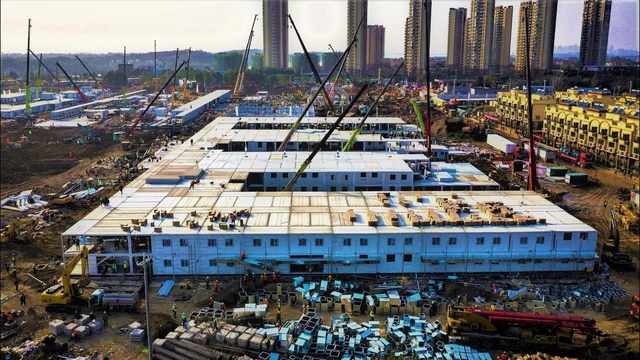
Just 2 months ago, the city of Wuhan, China announced the construction of Wuhan Huoshenshan Hospital, adding 1,000 beds, 30 ICUs, and new isolation wards to the city's medical arsenal to combat the Coronavirus epidemic. The building was completed in under 10 days by a team of 7,000 construction workers, a far cry from the reality many countries are facing as they scramble to quell the outbreak and wrestle with the shortcomings of their own healthcare systems. With over 14,000 dead and more than 300,000 infected worldwide, not to mention a shortage of medical supplies and facilities, health systems across the globe are feeling the strain of preparing for a crisis.
While the risk of COVID-19 is increasing everywhere in the world, the stable situation in Wuhan allowed officials to stop operations in the newly settled temporary hospitals to fight the Coronavirus outbreak.
China's Wuhan City has completed construction of the 1,000-bed Wuhan Huoshenshan Hospital in under ten days. Built to treat coronavirus patients, the hospital aims to build off the previous construction of Beijing Xiaotangshan Hospital in just a week's time back in 2003. The final project was finished by a 7,000-member crew, and the hospital received its first patients on Monday morning.
The government of Wuhan City in China has decided to build a 1,000 bed hospital in six days to fight the recent coronavirus outbreak. The project aims builds off the previous construction of Beijing Xiaotangshan Hospital in just a week's time back in 2003. As the quarantined Wuhan City's existing hospitals are overwhelmed, they have turned to social media for medical supplies and have begun to turn away patients.
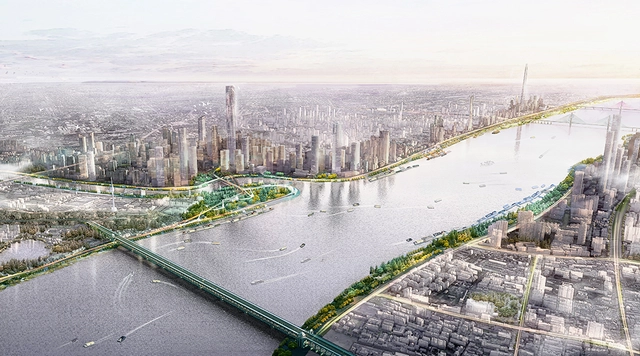
The Yangzte Riverfront is an integral part of Wuhan’s open space network, and is designed to celebrate the river’s spontaneity.. Image Courtesy of Sasaki
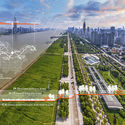
Sasaki has released details of their redevelopment proposal for the Yangtze Riverfront Park in Wuhan, China. Developed in collaboration with OMA and Gensler, Sasaki has drawn on the centuries-old symbiosis between the city and river, leveraging the river’s dynamic flooding to nurture a rich regional ecology and create dynamic recreational experiences.
The endeavor in landscape urbanism seeks to celebrate the river’s spontaneity, and incorporate flooding as an essential element. Stitching together then OMA and Gensler “urban balconies,” a series of microenvironments will host a wide variety of distinct wetland ecosystems, the characters of which evolve throughout the seasons.











.jpg?1575250164&format=webp&width=640&height=580)
.jpg?1575250587 "© Fenfang Lu")
.jpg?1575251045 "© Fenfang Lu")
.jpg?1575250132 "© Fenfang Lu")
.jpg?1575250447 "© Fenfang Lu")
.jpg?1575250164)
.jpg?1573993090)
.jpg?1573993969 "© Xiaokai Zhang")
.jpg?1573993090 "© Xiaokai Zhang")
.jpg?1573994002 "© Xiaokai Zhang")
.jpg?1573993937 "© Xiaokai Zhang")
.jpg?1574278280)




![Island Friends / Advanced Architecture Lab[AaL] + WIKI - Houses](https://snoopy.archdaily.com/images/archdaily/media/images/5c94/fa72/284d/d1fb/f300/000d/slideshow/户型三-9.jpg?1553267293&format=webp&width=640&height=580)
![Island Friends / Advanced Architecture Lab[AaL] + WIKI - Houses](https://images.adsttc.com/media/images/5c94/fe67/284d/d130/8d00/0033/thumb_jpg/户型一-2.jpg?1553268307 "Room 1. Image")
![Island Friends / Advanced Architecture Lab[AaL] + WIKI - Houses](https://images.adsttc.com/media/images/5c94/f8d3/284d/d130/8d00/0006/thumb_jpg/户型二-1.jpg?1553266877 "Room 2. Image")
![Island Friends / Advanced Architecture Lab[AaL] + WIKI - Houses](https://images.adsttc.com/media/images/5c94/fa2f/284d/d130/8d00/0011/thumb_jpg/户型三-7.jpg?1553267229 "Room 3. Image")
![Island Friends / Advanced Architecture Lab[AaL] + WIKI - Houses](https://images.adsttc.com/media/images/5c94/f9b8/284d/d130/8d00/000d/thumb_jpg/户型三-2.jpg?1553267107 "Room 3. Image")
![Island Friends / Advanced Architecture Lab[AaL] + WIKI - More Images](https://images.adsttc.com/media/images/5c94/fa72/284d/d1fb/f300/000d/newsletter/户型三-9.jpg?1553267293)












.jpg?1543848993&format=webp&width=640&height=580)
.jpg?1543849262 "© Weimin Yu")
.jpg?1543849449 "© Weimin Yu")
.jpg?1543850156 "© Weimin Yu")
.jpg?1543850705 "© Weimin Yu")
.jpg?1543848993)