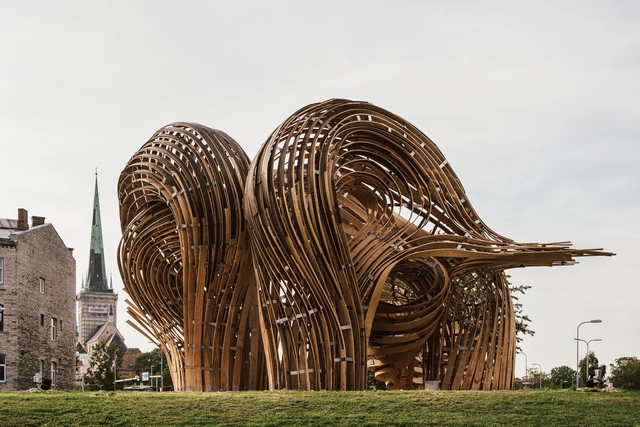
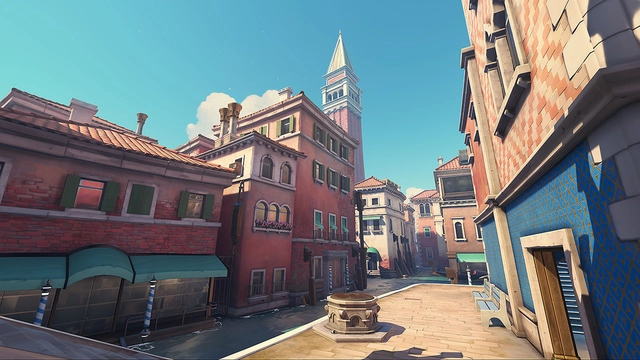
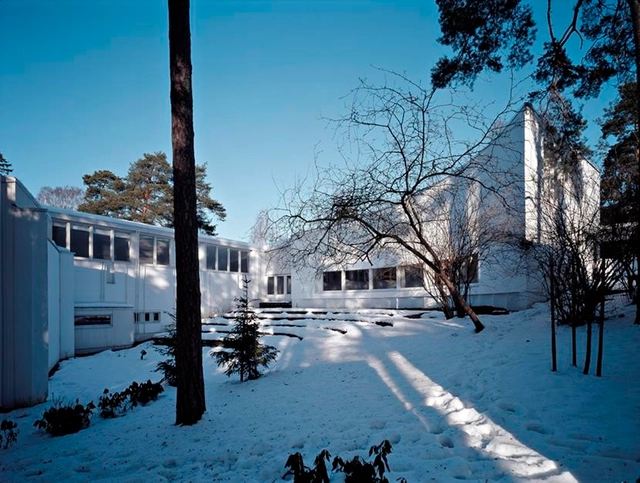
Image created using AI under the prompt: A sober and captivating visual representation of an urban environment that flawlessly captures the essence of anime and architecture. Image via DALL·E 2
World War II left a profound influence on the evolution of society, introducing significant changes in the fields of urban planning and architecture. During the 1930s, the Congrès Internationaux d'Architecture Moderne (CIAM) promoted modernism on an international scale. After the war, this architectural movement became firmly established as the dominant one, driven by the imperative of reconstruction and technological advancements. Influential figures like Le Corbusier and Alvar Aalto spearheaded this movement.
In 1959, the same year as the final CIAM meeting, Japanese architects like Kenzō Tange, Kishō Kurokawa —the designer of the Nakagin Capsule Tower—, and Kiyonori Kikutake began to explore new approaches to urban design and architecture, known as the Metabolist movement. This exploration was particularly significant in the context of Tokyo's rapid repopulation after the war and the scarcity of resources for reconstruction. Innovative concepts such as Marine City, The City in the Air, and the 1960 plan for Tokyo emerged, which proposed the city as a constantly evolving organism and emphasized the relationship between humans and their built environment. These ideas shaped the concept of "megacities" and reflected Japan's creative response to its challenging postwar situation.
https://www.archdaily.com/1007021/textures-skyscrapers-and-urban-landscapes-when-anime-meets-architectureEnrique Tovar
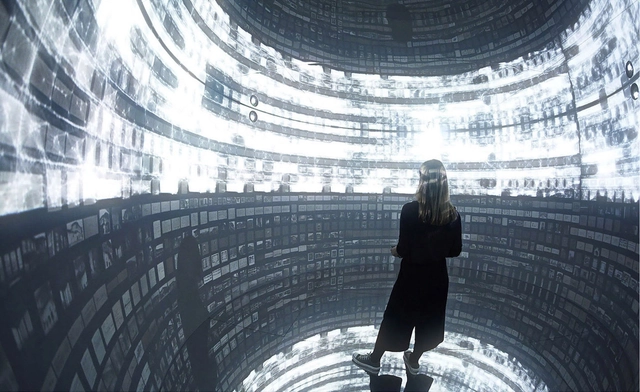
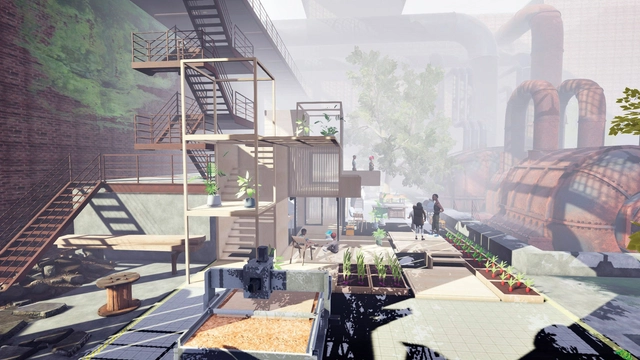
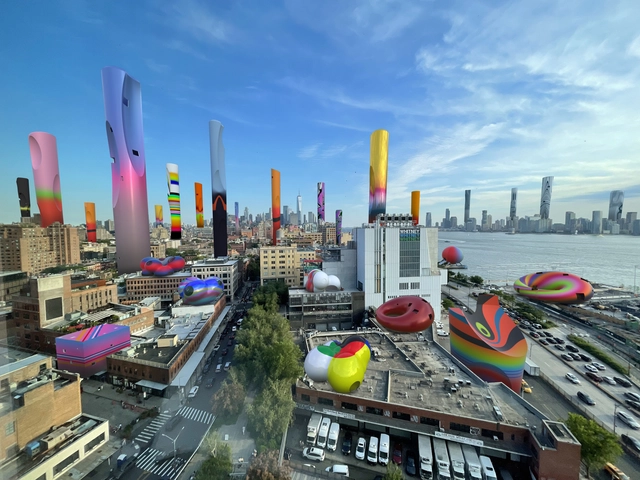
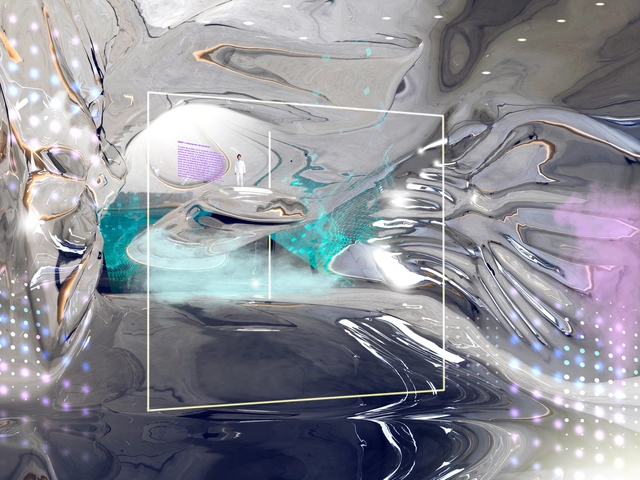
Illustrations from the Icon, where large structures provide a context for an overlapping of physical and virtual experiences. Image Courtesy of John Marx/ Form4 Architecture
This article is the fourth in a series focusing on the Architecture of the Metaverse. ArchDaily has collaborated with John Marx, AIA, the founding design principal and Chief Artistic Officer of Form4 Architecture, to bring you monthly articles that seek to define the Metaverse, convey the potential of this new realm as well as understand its constraints.
Of all the attributes that will define the Metaverse the single most important is that of experience. As we move more deeply into the Anthropocene Era humans seem to be shifting their interests from collecting things to collecting experiences. As the demand for experiences grows more intense and detailed, the need for content, and the clever and effective use of that content, will rise exponentially. From a more detailed perspective, the management and quality of those experiences will determine the initial success of the Metaverse. This is where the concept of a Responsive AI Concierge comes into play.
This article is the third in a series focusing on the Architecture of the Metaverse. ArchDaily has collaborated with John Marx, AIA, the founding design principal and Chief Artistic Officer of Form4 Architecture, to bring you monthly articles that seek to define the Metaverse, convey the potential of this new realm as well as understand its constraints.
"I had lunch on the moon, took a swim in a shadowy lake on Mars, played croquet with the clouds, and chased rainbows under the sea, all in one glorious afternoon" ... how real and meaningful these experiences felt will be greatly influenced by how and where you interact with a Metaverse opening near you soon. While in a fundamental sense, the Metaverse can be seen as a series of overlapping economic intentions, there is a unique and important opportunity for architects and designers of space and place to influence the outcome of these efforts and to create a more humane and vibrant future.
The promise of the metaverse, this new type of three-dimensional and immersive digital space, is proving to become more and more appealing to architects eager to explore the new realm of virtual creations. As it currently stands, the metaverse does not have a singular definition but is composed of many narratives and explorations. This unknown land is however fruitful ground for architects, who have to opportunity to shape not only the new environment but also the experiences of future users. The SOLIDS project represents one response to these conditions. Developed by FAR, an architect and engineer working with digital environments, SOLIDS uses a generative process to design unique, metaverse-compatible buildings.
In Childhood’s End, Arthur C. Clarke’s mid-20th century science fiction classic, a character wonders if the flattened inhabitants experiencing a far-off planet’s tremendous gravitational force are aware of the third dimension. In recent years, this hypothetical has found parallels in our growing digital universe, where we are continually drawn to our flat screens to confirm our relevance, connect with like-minded individuals, or create dating profiles. With attention spans riveted by endless digital content, walking down the street has become a delicate dance of avoiding people staring obliviously at their phones—those who, calling to mind Ada Louise Huxtable’s famous question, “Kicked a Building Lately?,” might walk right into one.
As Antoine Picon describes in Architecture and the Virtual Towards a new Materiality? : "An architectural project is indeed a virtual object. It is all the more virtual that it anticipates not a single built realization but an entire range of them. …Whereas the architect used to manipulate static forms, he can now play with geometric flows. Surface and volumes topological deformations acquire a kind of evidence that traditional means of representation did not allow.”
El poder de la Data - Mirador. Image Cortesía de Online Lab of Architecture (OLA)
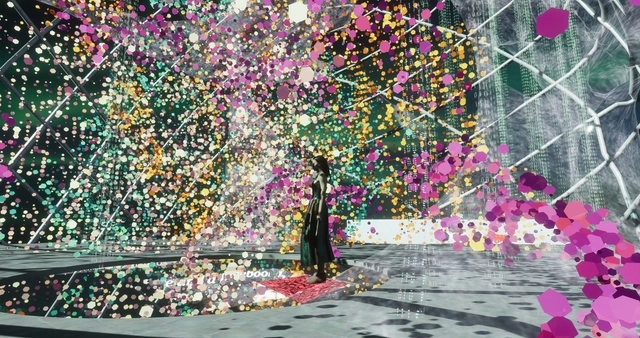
The Power of Data is an exhibition created in a virtual building, conceived by three-dimensional geometries based on various artificial intelligence algorithms. The project was created by the OLA (Online Lab of Architecture) team of research architects formed by Jennifer Durand (Peru), Daniel Escobar (Colombia), Claudia Garcia (Spain), Giovanna Pillaca (Peru) and Jose Luis Vintimilla (Ecuador).
For the past couple of years, the metaverse has been gaining prominence, prompting architects to consider its implications for our relationship with the physical environment and how can architecture contribute to this new virtual space. Architecture in the metaverse is no longer a fringe subject, having been embraced by established firms. "The metaverse is where much of the architectural action and innovation will be happening in the coming period,"says Patrick Schumacher. Unbound from restraints such as physics, material properties and construction costs, the metaverse unlocked a new realm of architectural expression. The following looks at some of the various ways the profession engages with the expanding field of digital environments.
Still from 'Spirited Away' (2001). Image Courtesy of Studio Ghibli
Writers in film and animation, specifically pertaining to the genre of anime, endeavor to incorporate varied architectural backdrops to assist them in telling their stories, with influences ranging from medieval villages to futuristic metropolises. Architecture as a subject includes a wide array of elements to study, with each architectural era further inferring its context and history through its design alone. However, in film and anime, all of the contexts behind a building’s design can be condensed into a single frame, powerful enough to tell a thousand stories.
Zaha Hadid Architects - ZHA has unveiled a virtual "libertarian micro-nation" in the metaverse titled The Liberland Metaverse, where residents can buy vacant plots centered around a curated urban core, and access them as avatars. The community features hyper-realistic districts that encourage urban self-governance and zones where the absence of urban planning "allows for a spontaneous order via a free-wheeling discovery process".
Videos
The Digital Twin . Image via Shutterstock/Videoflow
The emergence of the Digital Twin phenomenon has heralded a great change in terms of urban planning. It essentially presents the city as dynamic, in virtual form. Ensuring every element from the historic fabric, new construction, and public transit is accounted for in one three-dimensional model. Not only does it present key elements in terms of the landscape, but it also encompasses often overlooked conditions such as the presence of light throughout the day, shadows, and the presence of vegetation and trees. All of which contribute to a better preliminary process of site analysis.
Video games and virtual worlds are jam-packed with imaginative environments to explore, time periods to peruse, and invented architectural styles to thumb through within every reality we choose to engross ourselves into. With recent advancements in technology, greater than ever are we witnessing the latest PC and console generations harboring the ability to produce life-like settings for players to roam around, get lost, and explore all the nuances the seemingly authentic reality holds.
Have you ever wanted to see your un-built or fantasy project brought to life through the lens of a virtual reality headset? We’ve teamed up with IIDEXCanada and Invent Dev for the ArchDaily + IIDEXCanada Virtual Spaces Competition, which aims to find the best un-built and fantasy projects. Designers and architects can submit images of renderings of their un-built and fantasy projects across three square-footage categories. The winners will have their designs developed into virtual spaces by Invent Dev and exhibited using virtual reality headsets at IIDEXCanada 2015 in Toronto. Winners will also be featured on ArchDaily and flown to the 2015 awards ceremony.
IIDEXCanada and The Buildings Show are North America’s largest annual exposition, networking and educational event for construction, design, and real estate professionals.
Learn more and find out how to enter the competition after the break.
https://www.archdaily.com/574978/archdaily-iidexcanada-launch-virtual-spaces-competitionAD Editorial Team
The Alvar Aalto Foundation has begun a collaborative project with Google to make Aalto buildings even more accessible to the public. Using Google’s revolutionary Street View navigation tool, along with its virtual Cultural Institute, the project offers a look inside some of Aalto’s most iconic works of architecture. Learn more about this initiative and see the virtual journey for yourself after the break.
Researchers at the University of California San Diego are investigating how our brains respond to various spatial environments. Dr. Eve Edelstein, a neuroscientist, is researching how architectural designs can be manipulated through data gleaned from measurements taken from users while they experience different spatial environments in ‘The Cave’ – a controlled laboratory.