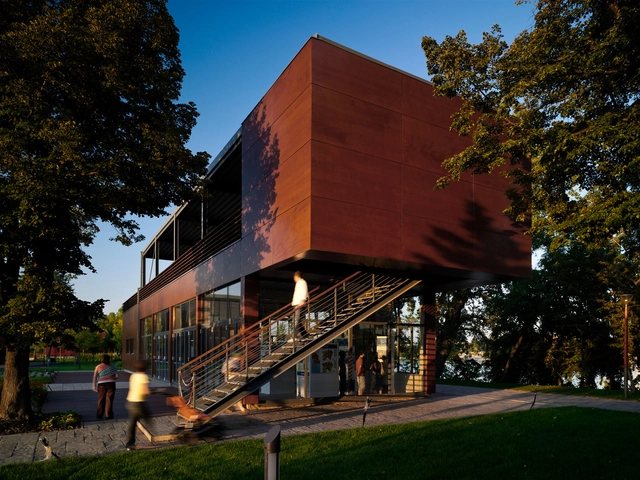
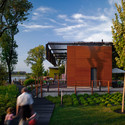
The Kuntsevo Centre, designed by The Jerde Partnership, will provide a new stage for dynamic public activity and distinct commercial offerings in central Moscow. The pedestrian-oriented center will establish a vibrant leisure, shopping, business, and residential complex reconnecting the urban fabric of the historic Kuntsevo district, while creating a new landmark for the city. Delivering a modern community gathering destination rooted in art, nature, and urban connectivity, the project’s design enhances its potential to become a continuously active public realm. More images and architects’ description after the break.
Designed by Gemawang Swaribathoro, Indra Nugraha, and Morian Saspriatnadi, their ‘Urban Sponge’ concept aims to unify, organize and manage, in one solution, the inner power of this marvelous city. Prague, an ancient city that has a long history of its own architecture style is no longer an underdog city in the European region. With the city becoming one of the most important places in this continent, the sponge concept can be described as a tool of connectivity to absorb the quality of life, to attract people, to make a better living. More images and architects’ description after the break.
Winners of the 2012 Land Art Generator Initiative Competition for Freshkills Park in Staten Island, NYC are out. With 4 placed winners and a long list of shortlisted projects, the range of ideas shows how designers are exploring many different options for sustainable energy infrastructure.
The Winners:
First: Scene-Sensor // Crossing Social and Ecological Flows byJames Murray and Shota Vashakmadze
Second: Fresh Hills by Matthew Rosenberg, Structural Engineering Consultant: Matt Melnyk, Production Assistants: Emmy Maruta, Robbie Eleazer
Third: Pivot by Yunxin Hu and Ben Smith
Fourth: 99 Red Balloons by Emeka Nnadi, Scott Rosin, Meaghan Hunter, Danielle Loeb, Kara McDowell, Indrajit Mitra, Narges Ayat and Denis Fleury
The redevelopment of Sydney’s an inner-city waterfront precinct of Barangaroo is making progress, as the Barangaroo Delivery Authority (BDA) has announced the five teams shortlisted for the master planning services for Barangaroo Central. The project will complete the long term vision for Barangaroo, which was masterplanned by Rogers Stirk Harbour & Partners, by forming the “heart of the site” that will be the transition along the waterfront walk from the southern urban and commercial spaces to the natural form six hectare of the Headland Park.
Maybe Sandy, the colossal hurricane that has barreled across the East Coast this week, will finally get the message across: "We are all from New Orleans Now."
Thanks to climate change, America's coastal cities, and particularly New York, have become increasingly vulnerable to nature's wrath. Over two years ago, MOMA asked five architects to come up with a redesign of lower Manhattan that would prevent damage in the event of major flooding. Barry Bergdoll, the Curator of the "Rising Currents" exhibit, put it to the architects this way: “Your mission is to come up with images that are so compelling they can’t be forgotten and so realistic that they can’t be dismissed.”
Unfortunately, they were. As the many images from traditional news sources and social media users reveal, Sandy's damage has been extensive - and perhaps, in many ways, preventable.
It often takes tragedy to instigate change. Let's hope that Sandy will finally get the conversation of New York's vulnerable urban landscape on to the table.
More images of Sandy's damage, as well as plans from MOMA's "Rising Currents" Exhibit, after the break...
Michael Van Valkenburg Associates (MVVA) and Thomas Phifer & Partners have been announced as winners of an international competition set to transform 15 blocks of the neglected Waller Creek in downtown Austin, Texas, into a vibrant local attraction. Co-sponsored by the nonprofit Waller Creek Conservancy and the City of Austin, the ambitious project intends to spearhead redevelopment within the city’s central business district with the 1.5 mile urban scheme that represents approximately 11 percent of Austin’s downtown.
“Today, we glimpse a transformation of Austin through a new community gathering place. This design team selection illustrates our City’s desire for great civic space, unique culture and opportunity for interaction with nature,” Austin Mayor Pro Tem Sheryl Cole said during the City Hall announcement. “We look forward to each new milestone of this development.”
Team innergy, composed of Frank Marcus, Pieter Wackers, Gerben Pennings, Gertjan Rohaan, Chris Van Der Zwet, recently won the first prize in the Energetic City 2050, competition about the sustainable future of the city of Arnhem, Netherlands. The jury felt that the vision of Innergy was “hopeful, with a strong belief in humanity & technology”, “focusing on individuals, for the city of the future will be the people themselves” and that “housing subscriptions and building material plazas will turn the city into a fluid place full of creativity “. More images and architects’ description after the break.
To celebrate the start of a seven-month land use review process, Cornell has released preliminary renderings of the first academic building planned for Cornell Tech – the new world-class technology and entrepreneurship campus in New York City that was masterplanned by Skidmore, Owings and Merrill (SOM).
The modern campus strives to rethink academic workspace, prioritize environmental performance, and exploit the unique urban condition of Roosevelt Island. In May, Pritzker Prize laureate Thom Mayne, founder of Morphosis, was appointed as architect of the first landmark building, which will set the stage for the carbon positive campus.
Designed by Space Group + Superunion Architects, their winning proposal for Ruten competition reflects the city of Sandnes’ development and establishes Ruten as a natural center and Sandnes as a future city with strong roots and a proud local history. The proposal, titled ‘Lysning’, consists of a ring that connects and creates the new transport hub and public space below for an attractive unifying roof. As the Central Park in New York was built before the Manhattan grid was condensed around it, Ruten has remained as a buffer in the urban development in anticipation of something bigger. More images and architects’ description after the break.
As the winner of ‘Environmental Quality Mention’, the proposed scheme for the HOf – Horizontal Farm International Ideas Competition is conceived of an intricate weave of the ‘farm’ and the ‘dwelling’. Drawing from the traditional Indian courtyard typology, the project, designed by ETT Architecture, enables community living (and farming) through a modular, scalable model that offers residents the benefits of low purchase cost, flexibility to expand as per means, and the potential of skill development and employment through self-build. More images and architects’ description after the break.
With last year’s opening of the 9/11 Memorial at Ground Zero and the near-completion of the World Trade Center One, Daniel Libeskind’s vision for the World Trade Center site is close to presenting the future of NYC’s downtown financial center, 11 years after the attacks. Studio Daniel Libeskind was selected to develop the master plan for the site in 2003, and since has been coordinating with NYC’s numerous agencies and individual architects to rebuild the site. The project, in Libeskind’s words, is a “healing of New York”, a “site of memory” and “a space to witness the resilience of America”.
Follow us after the break for more on the elements and progress of the master plan.
As part of the masterplan, ‘Bassin a Flots’ designed by ANMA/Nicolas Michelin, Barcode Architects and Habiter Autrement recently presented the Pôle de Compétences (Center for New Businesses). The 7,000m2 project will be a part of the masterplan, which aims on a phased transformation of the present introvert industrial harbor area into a new lively precinct with an urban mixture of living, working, and recreation. The slender 90 meter long and 21 meter tall building presents itself as a pure monolith volume stretching out over the entire length of the site. More images and architects’ description after the break.
The architecture firms of Kunckel Associates and Stefan Gzyl joined forces under the Glocalstudio platform to develop their entry to the recently completed ideas competition for La Carlota park in Caracas, Venezuela. They propose that the new park is an opportunity for a lot more than supplying a quantifiable amount of park space: they understand it as an opportunity for the (re)foundation of the city. The park will become the city’s new vital nucleus, a space from which to (re)conquest and (re)claim a preexisting and often hostile territory. In a city in which nature is in constant decline and hardly available as public space, the 100 hectare military airfield site constitutes a unique chance for a metropolitan-scale park in the very heart of the city. More images and architects’ description after the break.
Our friends at Design Observer’s Places Journal have shared with us two fascinating articles, written by architects Jonathan Massey and Brett Snyder, that explore the physical and virtual evolution of Occupy Wall Street (#OWS) as it transformed from the privately owned public space of Zuccotti Park into the bustling micro-city of Liberty Plaza sustained by online media.
To learn how OWS has influenced architecture and urbanism, Massey and Snyder asks the following questions: What’s the layout of this place? What are its rules, and who owns it? How does its design shape possibilities for individual and collective action?
The Research and Documentation Centre in Technology, Architecture and City in Developing Countries (CRD-PVS) at the Politecnico di Torino (Italy) has launched an international Student Design Competition tur(i)ntogreen – Farms in A Town. Sponsored by the UN-HABITAT within the “I’m a City Changer” campaign, participants are invited to apply their creative talents in developing new multidisciplinary solutions for a sustainable and inclusive city reflecting new forms of urban management and regeneration through agro-housing and urban-farming models.
By invitation of Director David Chipperfield, MVRDV and The Why Factorywill participate in the 2012 Venice Biennale. The main contribution consists of the collaborative project ‘Freeland’ forming part of the single exhibition in the Central Pavilion at the Giardini. Further contribution is made by Winy Maas and The Why Factory with ‘Porous City’ to the EU CITY Program, initiated by the European Forum for Architectural Policies (EFAP) representing Europe for the first time at the Venice Architecture Biennale.
More details on the two exhibitions after the break.