
.jpg?1366060339 "Courtesy of SIC Mostovik")

-
Architects: SIC Mostovik
- Area: 96115 m²
- Year: 2012
-
Professionals: Inforce Project, SIC Mostovik


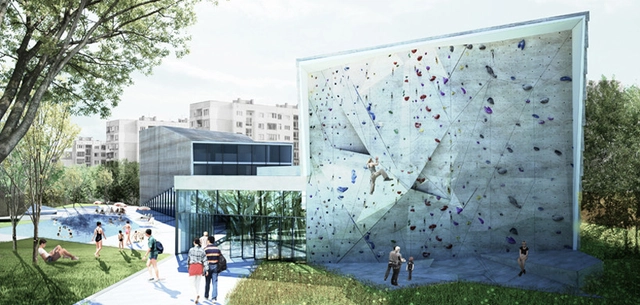
Located in the rapidly urbanizing Mladost area on the edge of central Sofia, the new Collider Activity Center, designed by INDEX, draws on the process of the tectonic movement and operations of geological forms as an organizational system to create architecture. The center will be one of the first new buildings to occupy the quasi Greenfield site and the broader urban structure plan for the area will eventually play host to a variety of new facilities, capitalizing on the latent potential of Bulgaria as an emerging economy. More images and architects' description after the break.

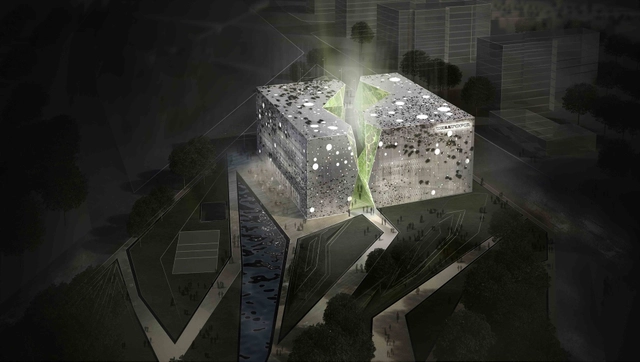
Located between two very different poles that have a great tension between them, architects Ignacio Gias, Jesús Lorenzo Garvín, and Ana Vida (Fissure Team), designed the building of the Collider Activity Center to appear as a flow connector in the territory. In doing so, they create a transition from the urban to nature, from the stability to the unpredictable, from colonized to wild territories. It is broken by an organic geometry, by the adventure, by the representation of the natural world, that cuts the building and makes the users 'break it, break it through, to the other side' as a door to adventure. More images and architects’ description after the break.

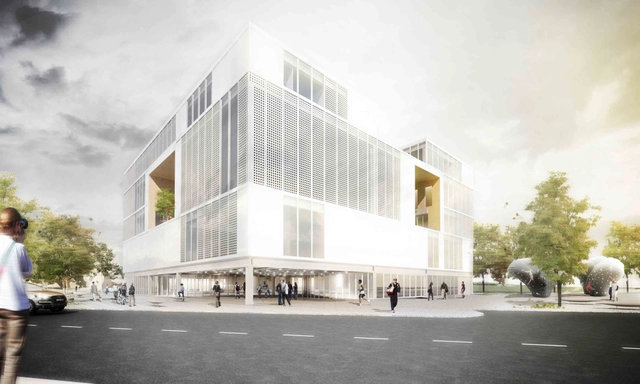
By creating a space which is open onto the city and welcoming for visitors, the proposal for the Collider Activity Center by SO-AP Architects intends to be a place of importance in the city of Sofia. The objective is to propose a building designed to meet the expectations of a wide audience motivated by the challenge and keen on using a place offering multiple combinations of sports and rest, while being able to enjoy views on the city and its surroundings. More images and architects' description after the break.
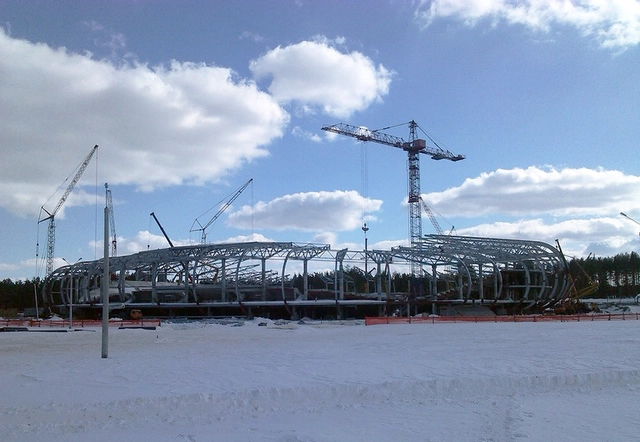
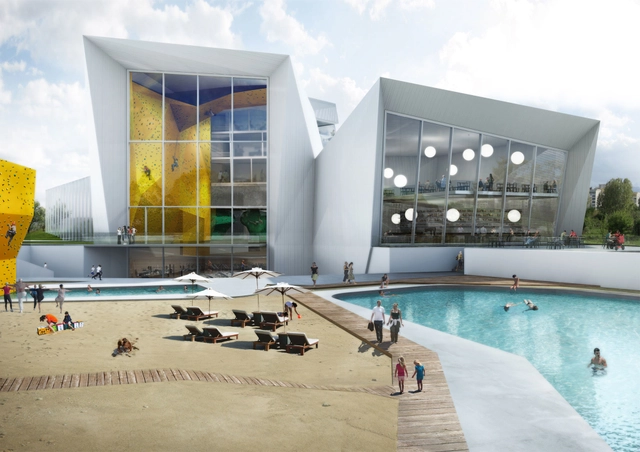
Designed by STRATO, the project proposal for the Collider Activity Center has two primary objectives: visual identity and vitality. Conceived as a sort of natural formation, the entire building is emphasized by the folding panels of the walls, the placement of the volumes and the power that this arrangement represents. Since it is placed in a context of ongoing evolution, their version of the activity center aims to be the driving force of the transformation of the whole district of Sofia, Bulgaria by becoming a symbol for the entire city. More images and architects’ description after the break.
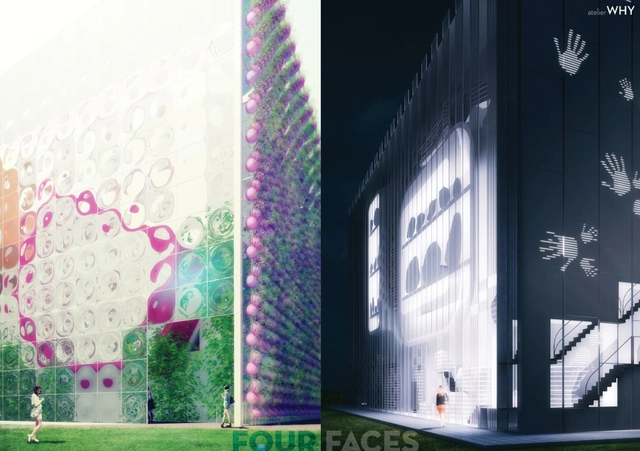
Designed for the Collider Activity Center competition, Atelier WHY's ‘Four Faces’ proposal presents a diversity of images rather than one unified experience. With the building containing many different activities, the architects were interested in branding activities with different concepts. They focused on how to convey the variety of activities happening inside to those who are outside though the shape of the building. More images and architects’ description after the break.
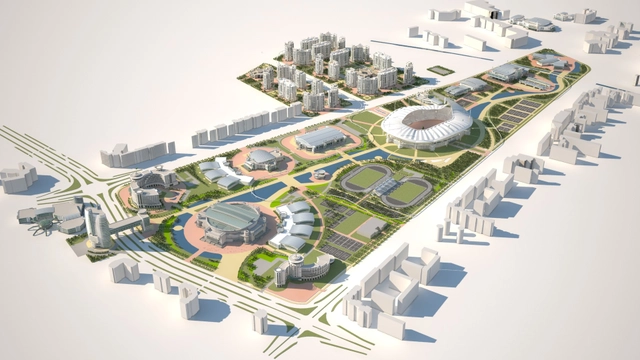
Developed by Arup and built to international sports federation standards, the Ashgabat Olympic Complex in the heart of Turkmenistan will be one of the largest building projects on which Arup has delivered the ‘total’ design and includes 750,000 square meters of sports and social buildings. Having just signed the contract for phase two of the project, which will add an aquatics center, indoor athletics arena, and a tennis center, the venues also include a velodrome, training halls, hotels, offices, a medical center and media facilities. More images and their description after the break.

As the main ice sports facility for the 2018 Pyeongchang winter olympic games, the master plan proposal by Idea Image Institute of Architects (IIIA) has expressed local natural specific characteristics which is very beautiful and clean based on the New horizons, which is the vision of 2018 Pyeongchang Winter Olympic games. Their design concept for the speed skating arena has beautiful shapes inspired by dynamic movement of speed skaters. More images and architects’ description after the break.
.jpg?1364390899)
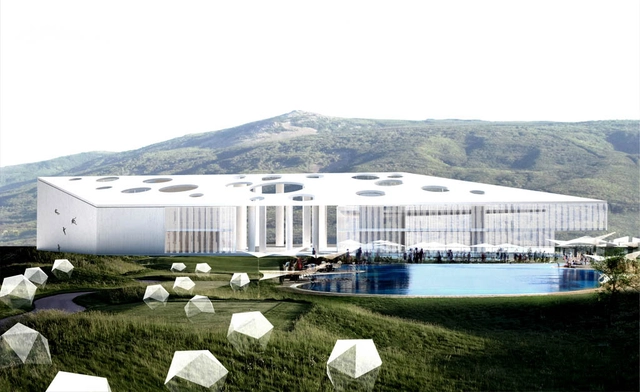
Inspired to create a landmark in Sofia for the Collider Activity Center, the form of this building volume emerges from the striking rock columns, which are planted underneath the layer of earth and extend up into the open landscape. Instead of literally being rocks, this design by Gojko Radić and Nataša Stefanović metaphorically has an analogy in this natural Bulgarian setting around its stunning cliffs. More images and architects’ description after the break.
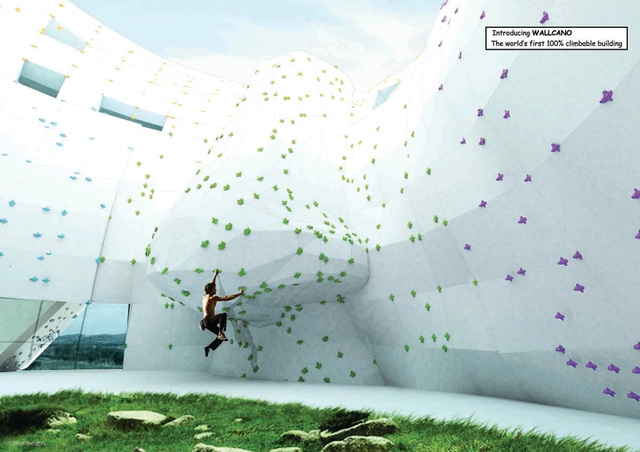
Walltopia, a global leader in the design and manufacturing of artificial climbing walls and grips, organized the Collider Activity Center competition located in Sofia, near the foothills of Mount Vitosha - one of Bulgaria’s most popular tourist destinations. The proposal by Zohar Architects is a 100% climbable structure: a donut-shaped courtyard building informed by the diversity of context. Its volume is extruded using ‘grafts’ of the world’s most famous mountains as formwork to create a patchwork of alpine geo-diversity, with a perfect cast of Abraham Lincoln’s nose from Mount Rushmore prominently positioned to satisfy curious climber fantasies. More images and architects' description after the break.

Designed as a city fragment, not only as a sports stadium, the design by MenoMenoPiu Architects + FHF Architectes is an attractor: innovative and a generator of vitality. Given the name The Twist, their proposal for the Tokyo Olmpic Stadium is expanding in order to better reach users requirements: proximity, diversity, and accessibility. Their conept, unlike other conventional stadiums, is an elliptical spiral which is gradually unrolling and forming. More images and architects’ description after the break.


The Odate Jukai Dome in the Akita Prefecture of Japan was completed by Toyo Ito in June 1997. The project is another example of the architect's impressive canon, making use of cutting edge technology and bringing architecture closer to people. Seemingly floating a few meters above the ground, the dome leaves space for the people to flow in comfortably, while the use of wood is itself a way of bringing nature into architecture while adopting the latest technological advancements.