Earlier last week, the City Council of New York City decided to move forward with Rafael Viñoly Architects’ master plan for the New Domino in Brooklyn. While the historic sugar refinery complex, with its familiar yellow signage, has achieved landmark status and will be preserved, the 11.2 acre-site will be outfitted with 2,200 new apartments – 660 of which are affordable housing – and four acres of public park space including a riverfront esplanade along the East River in Brooklyn.
Set for completion this October, NORD Architecture’s Shingle House will be part of the Living Architecture vacation houses, a project aimed to enhance the public’s appreciation of architecture. For their project, the young practice responded to the site’s strong winds and incorporated a modern take on the typical shingle homes that are scattered across the area.
More images and more about the home after the break.
Although Peter Zumthor’s success is undisputed in the architecture world, it was interesting he would tackle a residence for Living Architecture as his past works have gracefully unfolded after years of development. For Zumthor’s project, entitled A Secular Retreat, the architect employs his signature strategy of using nature as a source of relaxation. The hill-top retreat is a quiet and passive design, truly taking the backseat to the surroundings. The home is designed to exploit the beauty of its location, capitalizing on views and providing perfect places for reflection. The home, Zumthor’s first project in the UK, is the perfect residence of the Living Architecture projects to visit for some peaceful downtime.
With all the projects we feature, it becomes second nature to envision yourself occupying that space if not only to critique its success, but also to merely imagine what it would be like to live there. But, what if, instead of just daydreaming about living in a certain residence designed by your favorite architect, you could actually spend a week or two in a house designed by Peter Zumthor, or JVA, or even MVRDV? Living Architecture, a new not-for-profit organization, offers the chance to rent houses in different areas of Britain for a vacation starting at £20 per person per night. ”We are dedicated to introducing you to the best of contemporary architecture, as well as to curating unique and enjoyable holidays,” explained the organization.
Not onlydid Laura Alvarez Architectureplace in Europe’s top 40 architects under 40, but the young firm also just received a unanimous first prize standing from the jury of the Customize Me! competition sponsored by the Heijmans Vastgoed & Woningbouw. Asked to provide a new vision for contemporary housing, Laura Alvarez responded with a housing model that can be aadjusted for different kinds of families and if a person suddenly changes his way of living. Entitled 4D LIFE | Space and Time – four dimensions of living, space and time are linked entities so that how the space is used directly correlates to time. ”We want to offer a house that fits all moments of life and to all kinds of standards of living. We want to offer space for personal input, for all kinds of people, independently from their origin, social status or age.” explained the architect.
We featured Chilean firm Supersudaka several times previously on AD because we enjoy their architectural philosophy – especially their claim that, “We don’t want to change the world with architecture, we want to change architecture with the world.” For their Mirage House, the client could not make a decision about what to build on his 5000 m2 plot, leading Supersudaka to think up an interesting solution.
Not so long ago, we featured Cyril-Emmanuel Issanchou’sMaison Eco-rce, a timber residence, and today, we share his EC*-Cocoon, a low energy house. Designed for the competition BETWIN, the low energy houses are prefabricated modules that are installed upon a set of walls and plinths made from locally gathered stones.
Text description provided by the architects. Originally known as Case Study House No. 8, the Eames House was such a spatially pleasant modern residence that it became the home of the architects themselves. Charles and Ray Eames began designing the house in 1945 for the Case Study House Program in Los Angeles' Arts and Architecture Magazine published and built these case study homes that had to focus on the use of new materials and technologies developed during World War II. The intention was for the house to be made of prefabricated materials that would not interrupt the site, be easy to build, and exhibit a modern style.
Dimos Moysiadis + Ioannis Oikonomou+ Xaris Tsitsikas, young Greek architects, have designed a conceptual house where a canal brings the ocean water both next to and underneath the house. Residents can enjoy a dive off the veranda into their natural swimming pool, or an artificial sandy beach just a few steps down from their front door of the house. The eastern concrete side of this canal stands as a strong edge against the property line, as an attempt to “create a “safe” border between our environment and the other properties.” With the long side of the villa parallel to the north coast, and vertically to the canal, the home creates a sense of enclosure around the landscape.
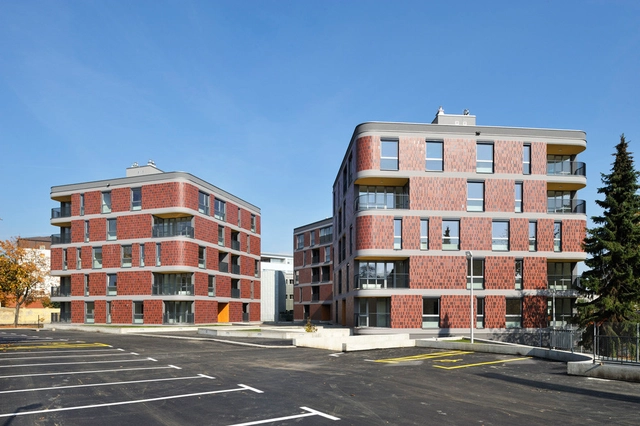
OBRA Architects shared with us their project Spiral Housing: IBA Hamburg Smart Price Houses, a 3000 m2 residential apartment complex with community outdoor space. See more images and architect’s description after the break.