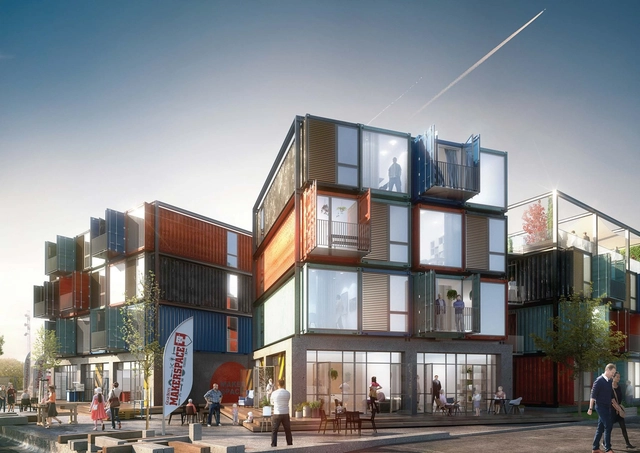
Beat Box: 30 apartments in 48 containers to transform the Danish neighborhood of Musicon, adjacent to the famous Roskilde Festival area. Designed by Arkitema Architects and constructed by Container Living, Beat Box is an integral part of Roskilde’s goal to revamp Musicon over the next 15 years by adding 1,000 jobs and 1,000 homes.
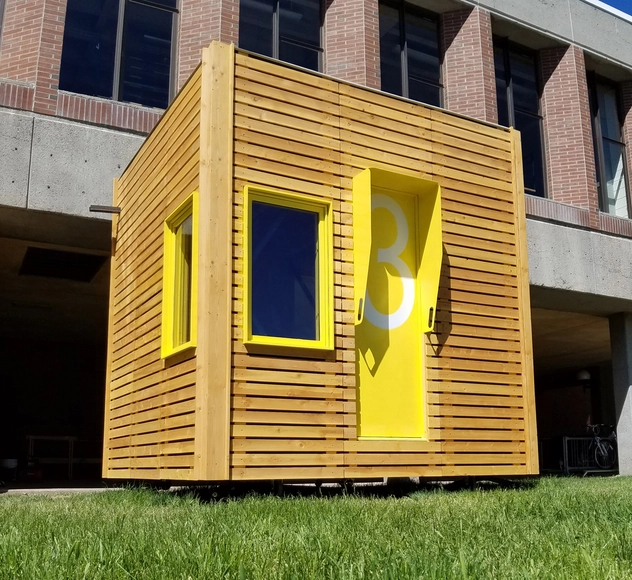
Three M. Arch. candidates at Montana State University, Jonathan Chavez, Kimball Kaiser and Adam Shilling, won an Undergraduate Scholars Programresearch grant which they used to fund their design-build project: B.O.B., the Backyard Office Box. B.O.B. is a kit of parts which, when put together, create a 150-square-foot dwelling space. The design team, also known as Tr3s, wanted their project to be adaptable to a variety of sites and users. B.O.B. can function as an additional space to already existing projects or standalone as a temporary shelter.
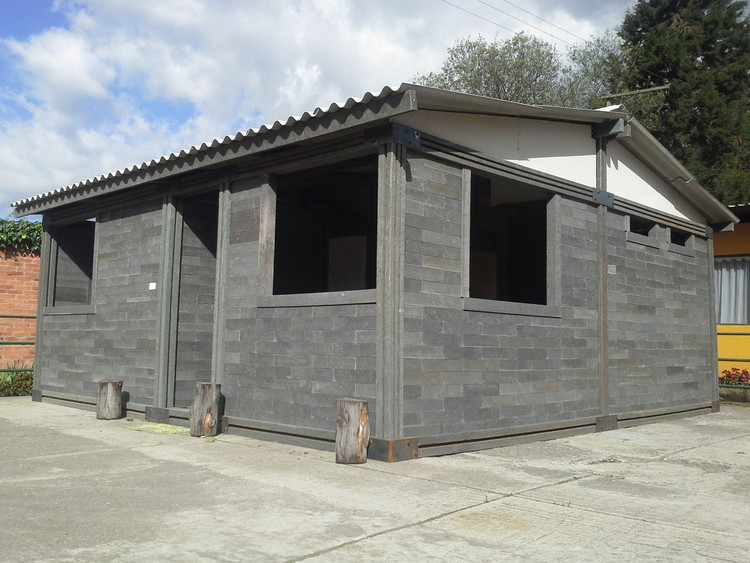
Ten years ago when Colombian Fernando Llanos tried to build his own house in Cundinamarca, he realized that moving the materials from Bogota was going to be very difficult. After mulling it over, he decided to build his house out of plastic, and after a series of trials and errors, he ended up meeting architect Óscar Méndez, who developed his thesis on the same subject, and together they founded the company Conceptos Plásticos (Plastic Concepts) in 2011.
The innovative local company managed to patent its system of bricks and pillars made of recycled plastic, which is then put together like Lego pieces in a construction system that lets you build houses up to two stories high in five days.
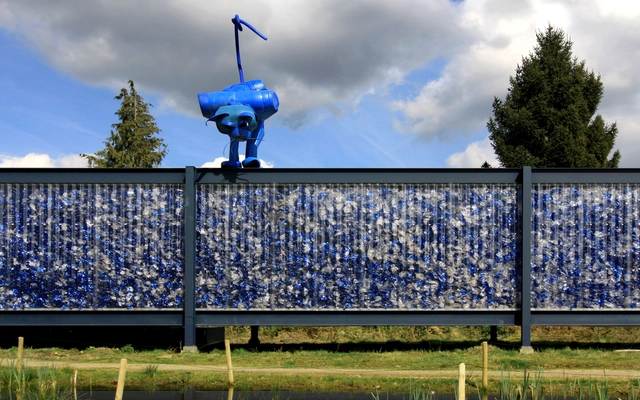
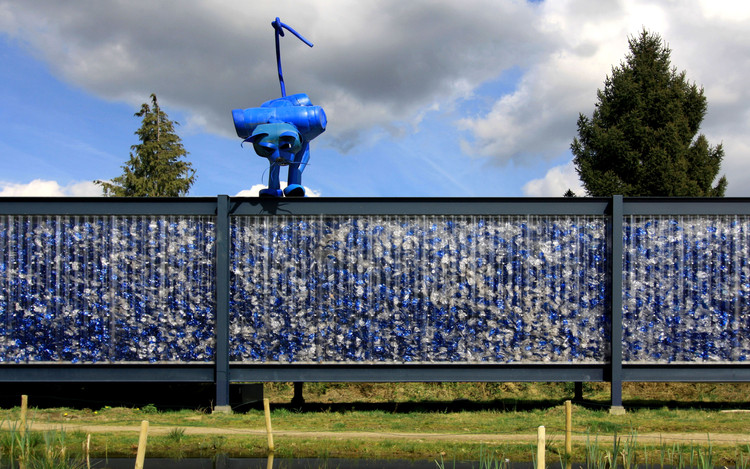
Project.DWG and LOOS.FM have unveiled their PET pavilion, a temporary structure in a community park in The Netherlands that focuses on issues of sustainable building, recycling, and waste by rethinking the ways that buildings are developed, built, and used. Specifically, the pavilion is a study of the use of plastic waste as a building material.
Using the elevated framework of Ludwig Mies van der Rohe’s Farnsworth House, the structure consists of two monumental slabs in a steel framework. “From floor to ceiling, double-walled transparent corrugated sheets hold over 40,000 plastic bottles,” with bottle caps attached to bottlenecks supporting the system.
Videos
Courtesy of Team Aesop (Josh Draper, Lisa Ramsburg, Powell Draper, Edward M. Segal, and Max Dowd)
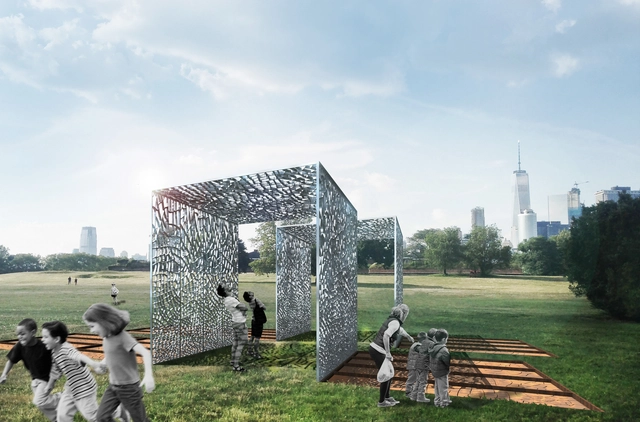
Cast & Place has been announced as the winner of the 2017 City of Dreamscompetition to create a pavilion for New York City’s Governors Island. Held by not-for-profit arts organization FIGMENT, the AIANY Emerging New York Architects Committee, and the Structural Engineers Association of New York, the competition called for a design to be the hub of FIGMENT’s free community arts festival during Summer 2017, based on questions of the future of New York, how design can confront environmental challenges, and how architecture can be built from recycled or borrowed material.
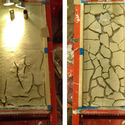
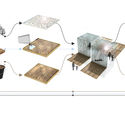
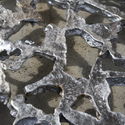
With these questions in mind, Cast & Place was conceptualized as a pavilion made entirely from waste. 300,000 recycled aluminum cans, cast into the cracks of dried clay, will form structural panels that assemble into shaded spaces for performance and play.
The Unmentionables Symposium is an inaugural two-day event hosted by the Department of Interior Architecture at Woodbury University School of Architecture and held at Helms Design Center in Culver City, April 7-8, 2017. Coinciding with the 85th anniversary of the university’s Interior Architecture program, the event highlights critical latent issues within the discipline today. Registration is open on the Unmentionables website.
A soaring new skyscraper dubbed the "Brickell Flatiron" is set to rise 213 meters above the skyline in Brickell, Miami. Designed by Luis Revuelta, the tower features an organic floorplate profile with wide elliptical terraces, maximizing sweeping views of Biscayne Bay and downtown Miami.
These curvilinear, flowing lines are complemented by the interiors, designed by acclaimed Italian architect and designer Massimo Iosa Ghini of Iosa Ghini Associati. The Italian craftsmanship and renaissance-revival air of Iosa Ghini's design together with the clean functionality of Revuelta's architecture, presenting two harmonious elements of design in Miami; old school glamor, and contemporary luxury.
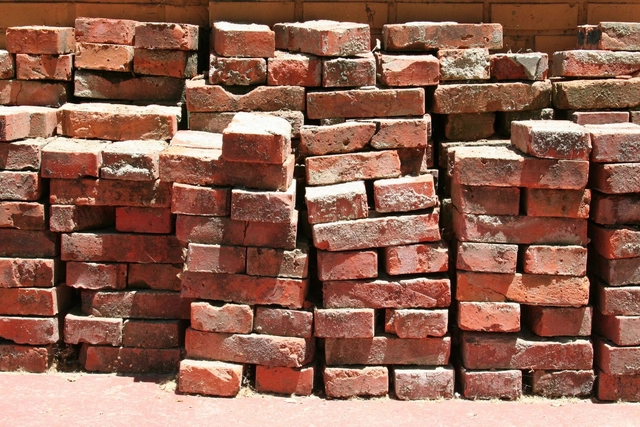
One man’s trash is another man’s building material. Researchers from the Royal Melbourne Institute of Technology (commonly known as RMIT University) have developed a technique for making bricks out of one of the world’s most stubborn forms of pollution: discarded cigarette butts. Led by Dr. Abbas Mohajerani, the team discovered that manufacturing fired-clay bricks with as little as 1 percent cigarette butt content could completely offset annual worldwide cigarette production, while also producing a lighter, more efficient brick.
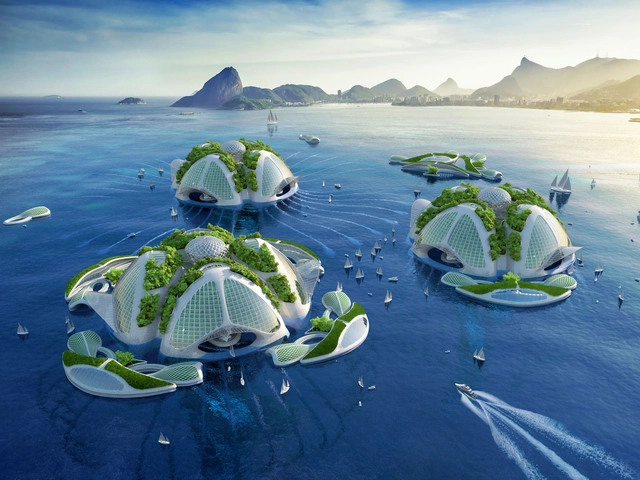
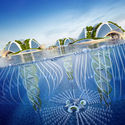
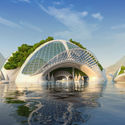
Vincent Callebaut Architectures has envisioned a radical underwater colony for "climate change refugees" 3D printed from recycled materials taken from the ocean's floating garbage patches. This particular proposal of "oceanscrapers" is sited off the shore of Rio de Janeiro. It's aim is to provide a sustainable habitat with 10,000 housing units, office and work space, sea farms, gardens, community orchards and much more, while fostering marine life.
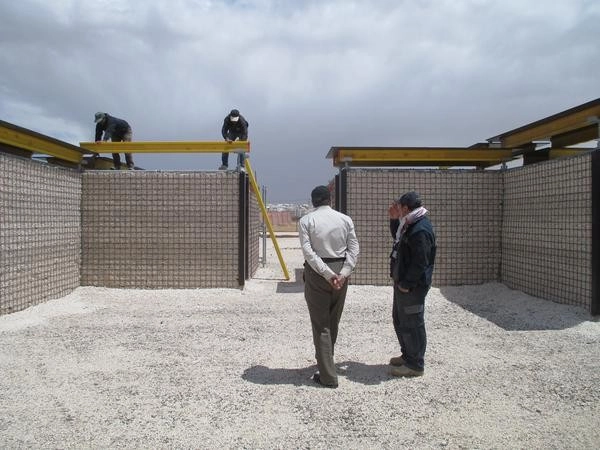
Designed and developed by Pilosio Building Peace, RE:BUILD is a construction system for building refugee camps and facilities for emergency assistance. The temporary modular structures can be used as houses, schools, clinics, dining areas or any other space that is urgently needed.
Shigeru Ban Architects has released images of their first emergency shelter prototype designed for Nepal. Planned to be built by the end of August, the simple shelter is designed to be easily assembled by almost anyone. Using connecting modular wooden frames (3ft x 7ft or 90cm x 210cm), salvaged rubble bricks are used to infill the wall's cavities while paper tube trussing supports the roof. This, as Shigeru Ban says, will allow for "quick erection and nearly immediate inhabitation."
International architecture non-profit Shelter Global has announced the winners of its 2015 Dencity Competition. Out of 300 entries from 50 different countries, three winners and six special mentions were selected.
The competition’s goal was “to foster new ideas on how to handle the growing density of unplanned cities and to spread awareness of the massive problem,” and jury members sought out project designs that empower communities and allow for self-sufficiency. Read about the three winners, after the break.
Izaskun Chinchilla Architects have made their recycled, upcycled, and bicycled “Organic Growth Pavilion” a reality on New York’s Governors Island. One of two winners of the “City of Dreams” pavilion competition (hosted by AIANY Emerging New York Architects Committee and the Structural Engineers Association of New York), Izaskun Chinchilla Architects carried out a kickstarter campaign to fund the pavilion’s construction.
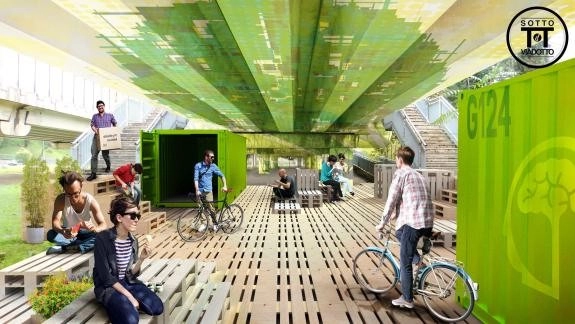
A group of six young architects under the leadership of Renzo Piano have been hard at work transforming unused spaces within Italy's suburban framework. The team, known as G124, focuses its efforts on injecting life back into overlooked and forgotten areas of its built environment and stimulating the local economy through design. This most recently entailed transforming a long abandoned area under a viaduct in northeast Rome into a bustling cultural hot-spot.
The following article is presented by ArchDaily Materials. In this article, originally published by Metropolis Magazine, Lara Kristin Herndon and Derrick Mead explore seven innovative architectural materials and the designers behind them. Some materials are byproducts, some will help buildings breathe and one is making the leap from 3D printing to 4D printing.
When Arthur C. Clarke said that any sufficiently advanced technology is indistinguishable from magic, he was speaking from the spectator’s point of view, not the magician’s. As our list of smart materials shows, technology solves difficult problems, but getting there requires more than just a wave of the magic wand. Each of the following projects looks past easy answers. Whether it’s a new way of looking at old problems, a new material that maximizes the efficiency of an old technique, or a new method to tap the potential of an abundant or underutilized resource, here are seven innovators who take technology out of the realm of science fiction.
























.jpg?1434637677&format=webp&width=640&height=580)
.jpg?1434637707 "Organic Growth Pavilion. Image © Sergio Reyes")
.jpg?1434637587 "Collaborative Construction of Organic Growth Pavilion. Image © Sergio Reyes")
.jpg?1434637645 "Organic Growth Pavilion. Image © Sergio Reyes")
.jpg?1434637551 "Organic Growth Pavilion. Image © Sergio Reyes")
.jpg?1434637677)