1. ArchDaily
  2. photovoltaic

photovoltaic: The Latest Architecture and News

Perkins + Will's Prismatic Facade Scheme Wins Competition for York University Building in Toronto

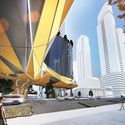
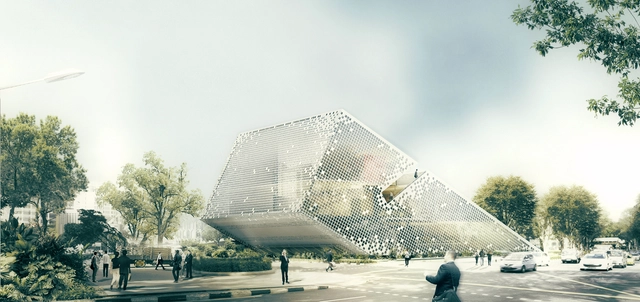
Perkins+Will’s triangulated facade scheme has won an international competition for the design of the new School of Continuing Studies at York University’s Keele campus outside of Toronto, Canada.

Beating out proposals from top firms, including finalists HOK andGow Hastings Architects with Henning Larsen, Perkins+Will’s design twists as it rises, both reacting to solar optimization studies and opening up the building to create a new gateway at the campus’ southeast entrance.

Perkins + Will's Prismatic Facade Scheme Wins Competition for York University Building in Toronto - Featured ImagePerkins + Will's Prismatic Facade Scheme Wins Competition for York University Building in Toronto - Image 1 of 4Perkins + Will's Prismatic Facade Scheme Wins Competition for York University Building in Toronto - Image 2 of 4Perkins + Will's Prismatic Facade Scheme Wins Competition for York University Building in Toronto - Image 3 of 4Perkins + Will's Prismatic Facade Scheme Wins Competition for York University Building in Toronto - More Images

60 Storey Tower Maximizes Energy Capture with Photovoltaic Facade

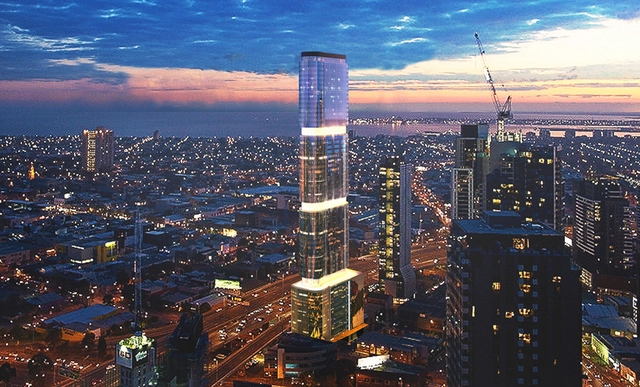
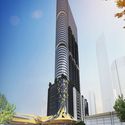
Peddle Thorp Architects have submitted their proposal for the Moray Street Residential Tower in Melbourne for approval. At 1173.5 square meters, Sol Invictus is wrapped entirely in solar panels, attaining 10 times more solar surface area than a traditional roof covering. The facade can achieve up to 5000 square meters of solar panel array and is connected to a battery storage system.

60 Storey Tower Maximizes Energy Capture with Photovoltaic Facade  - Image 1 of 460 Storey Tower Maximizes Energy Capture with Photovoltaic Facade  - Image 2 of 460 Storey Tower Maximizes Energy Capture with Photovoltaic Facade  - Image 3 of 460 Storey Tower Maximizes Energy Capture with Photovoltaic Facade  - Image 4 of 460 Storey Tower Maximizes Energy Capture with Photovoltaic Facade  - More Images+ 15

New Wave Architecture Designs Sustainable Office Building for Turbosealtech in Iran

Located in Pardis Technology Park in the suburbs of Tehran, the new Turbosealtech office by New Wave Architecture is a small, but complex building with a site of 1,300 square meters. Envisioned as an “incubator,” the project will provide a platform for people to research and innovate. Pardis Technology Park is made up of developments by young architects from Iran, and this project continues this pattern of expressing the vision of young Iranian architects through its design team. Read more about the project after the break.

This 3D-Printed Building by SOM is Powered by a 3D-Printed Car

Skidmore, Owings & Merrill LLP (SOM) has unveiled their design for the U.S. Department of Energy’s Oak Ridge National Laboratory (ORNL): a 3D-printed building powered by a 3D-printed vehicle developed by ORNL. Dubbed AMIE, the project was developed in collaboration with ORNL, University of Tennessee (UT), Clayton Homes, General Electric, Alcoa, NanoPore and Tru-Design. SOM was able to take the design from concept to completion in less than a year.

Combining mobile power with energy-efficient design and photovoltaic (PV) panels, the AMIE presents possibilities for human shelter off-the-grid. Following previous work by SOM, demonstrating the use of 3D printing for complex, organic geometries, the new building combines structure, insulation, air and moisture barriers, and exterior cladding into one shell.

This 3D Printed Pavilion Provides Shade During the Day and Illuminates at Night

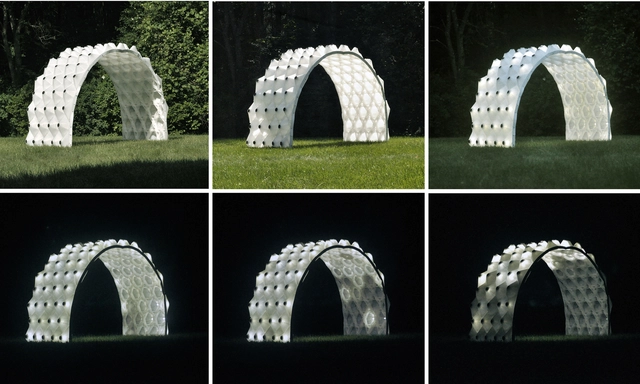
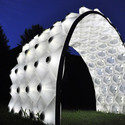
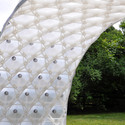
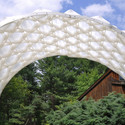
The Solar Bytes pavilion, designed by assistant professor at Kent State University Brian Peters, is a temporary structure which highlights the potential of new techniques available to architecture: robotic arms, 3D printing, smart technologies such as lighting sensors, and solar energy.

Leveraging the strength and range of motion of a robotic arm, the pavilion was printed in three dimensions with an experimental extruder, resulting in a structure composed of 94 unique modules that capture energy during the day, and shine at night. After their initial function, the plastic modules making up the pavilion will be completely crushed and reused in a new structure.

This 3D Printed Pavilion Provides Shade During the Day and Illuminates at Night - SustainabilityThis 3D Printed Pavilion Provides Shade During the Day and Illuminates at Night - SustainabilityThis 3D Printed Pavilion Provides Shade During the Day and Illuminates at Night - SustainabilityThis 3D Printed Pavilion Provides Shade During the Day and Illuminates at Night - SustainabilityThis 3D Printed Pavilion Provides Shade During the Day and Illuminates at Night - More Images+ 10

House in Elie / WT Architecture

House in Elie / WT Architecture - HousesHouse in Elie / WT Architecture - HousesHouse in Elie / WT Architecture - HousesHouse in Elie / WT Architecture - HousesHouse in Elie / WT Architecture - More Images+ 7

  • Architects: WT Architecture
  • Area Area of this architecture project Area:  275
  • Year Completion year of this architecture project Year:  2014

Central Art Depository Freiburg / Pfeifer Kuhn Architekten

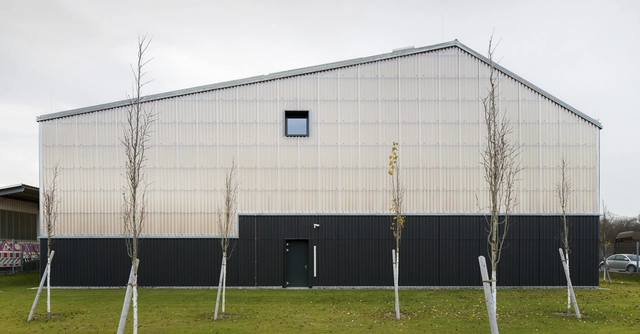
Central Art Depository Freiburg  / Pfeifer Kuhn Architekten - Industrial ArchitectureCentral Art Depository Freiburg  / Pfeifer Kuhn Architekten - Industrial ArchitectureCentral Art Depository Freiburg  / Pfeifer Kuhn Architekten - Industrial ArchitectureCentral Art Depository Freiburg  / Pfeifer Kuhn Architekten - Industrial ArchitectureCentral Art Depository Freiburg  / Pfeifer Kuhn Architekten - More Images+ 24

Ohio State Researcher Team Invents Combined Solar Cell and Battery

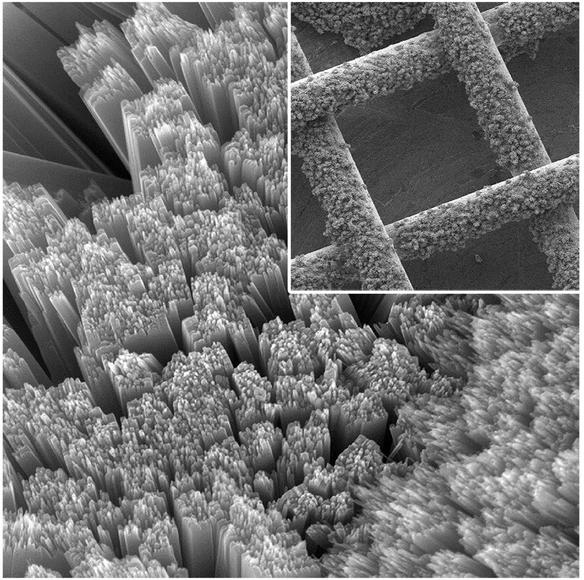
A new technology developed by researchers at Ohio State University has the potential to increase the efficiency and decrease the cost of generating and storing the sun's energy. Led by professor of chemistry and biochemistry Yiying Wu, the team has created a combined solar cell and lithium storage battery with an efficiency of electron transfer between the two components of almost 100%, in a design which they believe will reduce costs by up to 25%.

“The state of the art is to use a solar panel to capture the light, and then use a cheap battery to store the energy,” Wu said. “We’ve integrated both functions into one device. Any time you can do that, you reduce cost.”

Read on after the break for more on the news

Ohio State Researcher Team Invents Combined Solar Cell and Battery - Image 1 of 4

Milan Design Week 2013: Energetic Energies for Panasonic / Akihisa Hirata

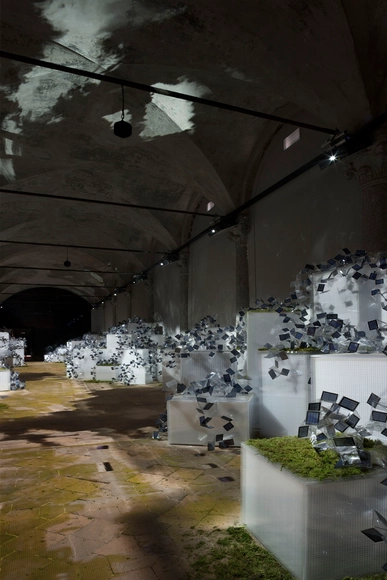
Envision a future where undulating “solar plants” transform the rectangular masses of our cities into a vibrant metropolis where technology aids in the coexistence of humans and nature. Represented in the conceptual installation “Energetic Energies” at the Milan Design Week 2013, this notion of redefining our relationship with the sky through photovoltaics is based on years of technological research and development by the Panasonic Corporation, who commissioned Japanese architect Akihisa Hirata to imagine the possibilities.

The exhibition features a 30 meter-long makeshift city, whose “hills” of photovoltaics overtake clusters of white, translucent buildings while shadows of clouds move in and out of the space. 

A video interview with Akihisa Hirata and more images after the break...