Wave Dilfert: Wave (moves in wave-form oscillations) + Dilfert (geek-like intelligence, absorbs information like a sponge).
Wave Dilfert is a new kind of space that reads the changes in light and shadow occurring within it, catalogs and calculates them, then pulses, contracts or expands in reaction. The installation was inspired by the work of Ushahidi; a non-profit, crowdsourcing disaster relief, tech innovator. Much how Ushahidi de-mystifies the complexities of war-torn or disaster ridden locales, The Principals developed a system that could de-mystify the complexities of space through sourcing the information of its users and making it accessible through interaction.
Co-sponsored by The Irwin S. Chanin School of Architecture of The Cooper Union as part of the program put on by the Architectural League, Mike Taylor of Hopkins Architects will be delivering a lecture on his current work at the Cooper Union in New York. Taking place on Tuesday, October 30th, the leader of the design team for the London 2012 Velodrome, and a senior partner at Hopkins Architects is “guided by deeply-rooted architectural, environmental, and social convictions.” Widely lauded for its elegant carefully engineered form, the Velodrome’s sustainable and flexible design has won awards for its architecture and engineering, as well as its civic presence from the RIBA, the Architects Journal, and the BCI, among others. For more information, please visit here.
As an entry for the Land Art Generator Initiative Competition 2012 – Freshkill Park New York, ‘Wind Fountain’ is based on an adaptation of the piezoelectric effect – a well known property of certain materials to produce electrical power when they undergo strain and stress. Designed by Gembong Reksa Kawula, the project is shaped as an artificial tree, with each unit consist of 450 flexible thread 30 meters high made of carbon fiber reinforced resin pole that will sway in the wind. More images and architects’ description after the break.
ArchDaily’s previous coverage of Herzog & de Meuron‘s 56 Leonard Street was around the time when construction was just about to begin. Now four years later, construction seems about ready to restart, according to bdOnline. Join us after the break for more details.
Foster + Partners is about to break the mold of New York’s static Park Avenue skyline, as they have been announced as winner of the highly publicized competition to replace the aging tower of 425 Park Avenue with a new world-class, sustainable office tower.
Lord Foster said: “I have a personal connection with New York, which has been a source of inspiration since my time at Yale, when the new towers on Park Avenue and its neighborhoods were a magnet for every young architect. Seeing first-hand the works of Mies van der Rohe, Gordon Bunshaft, Eero Saarinen and Philip Johnson was tremendously exciting then – I am delighted to have this very special opportunity to design a contemporary tower to stand alongside them. Our aim is to create an exceptional building, both of its time and timeless, as well as being respectful of this context – a tower that is for the City and for the people that will work in it, setting a new standard for office design and providing an enduring landmark that befits its world-famous location.”
Continue after the break to learn more about Foster’s winning proposal and to review the existing condition of 425 Park Ave.
The Battery Conservancy Americas Design Competition 2012: Draw Up A Chair is a unique open call to design students and design professionals living in the North America, Central America, South America and the Caribbean. Design an iconic, movable outdoor seating element for NYC’s 25-acre historic Battery Park, AKA The Battery. The winning design will be fabricated for use in The Battery, which annually welcomes six million visitors. They are offering an earlybird registration rate for all who register by this Sunday, Sept. 30. All design entries are due October 30. To register and for more information, please visit here.
With last year’s opening of the 9/11 Memorial at Ground Zero and the near-completion of the World Trade Center One, Daniel Libeskind’s vision for the World Trade Center site is close to presenting the future of NYC’s downtown financial center, 11 years after the attacks. Studio Daniel Libeskind was selected to develop the master plan for the site in 2003, and since has been coordinating with NYC’s numerous agencies and individual architects to rebuild the site. The project, in Libeskind’s words, is a “healing of New York”, a “site of memory” and “a space to witness the resilience of America”.
Follow us after the break for more on the elements and progress of the master plan.
Storefront for Art and Architecture is opening up its fall exhibition season starting September 25th with ‘Past Futures, Present, Futures’. The exhibition, which will be up until November 17th, presents 101 unrealized proposals for New York City, with 101 reenactments by invited artists, architects, writers, and policy-makers to create alternative visions for the present and future of the city. The exhibition is curated by Eva Franch and designed by Leong Leong. An opening reception will take place on September 25, 2012 from 7pm to 9pm. For more information, please visit here.
In an article published by The Wall Street Journal called For Creative Cities, the Sky Has Its Limit, Richard Florida discusses the development of urban environments and their relative successes. As human migrations are trending towards big cities, the design and appropriation of space within these cities is increasingly important. Florida cites that trends indicate that by 2050 cities will make up 70% of the global population. With so many people, elevate density within cities will be unavoidable, but what Florida emphasizes is that it isn’t just density that makes a vibrant and thriving city. Citing Shanghai and New York City as examples of dense urban environments, Florida explains the differences in their relative architectural and urban developments and the prosperity that follows. The fundamental difference? The prevalence of mixed-use neighborhoods in New York City that overpower the innovation of strictly financial districts of either New York or Shanghai.
R 20th Century is pleased to present AFTER, curated by Kelly Behun and Alex P. White of kelly behun|STUDIO. AFTER, which is on view September 19-October 27, will feature works from kelly behun|STUDIO, one of the most innovative, experimental design studios working today, and R 20th Century, one of the leading galleries for the exhibition of historic and contemporary design.
Designs in the exhibition draw inspiration from methods of sampling, appropriation, and deconstruction and how these ideas relate to postmodern notions of authorship. AFTER acknowledges “reference” in ways that are alternately direct, irreverent, poetic and oblique. More information on the exhibition after the break.
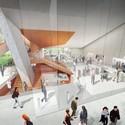
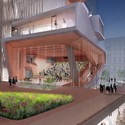
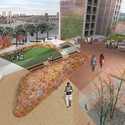
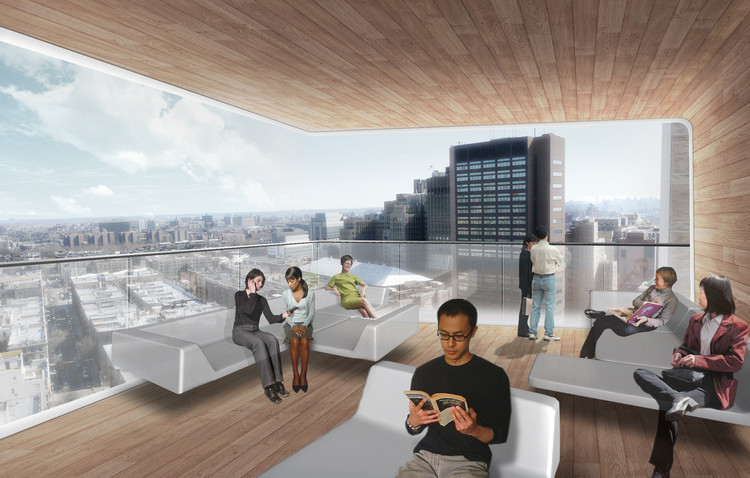
Columbia University has been at the forefront of medical education for more than two centuries, as it was the first medical school in the United States to award the M.D. degree in 1770. Now, the Columbia University Medical Center (CUMC) has announced plans for a new, state-of-the-art medical and graduate education building that reflects how they believe medicine is and should be taught, learned and practiced in the 21st century.
Located on the CUMC campus in the Washington Heights community of Northern Manhattan, the 14-story facility will aim to achieve LEED Gold certification and incorporate technologically advanced classrooms, collaboration spaces, and a modern simulation center. The design is led by Diller Scofidio + Renfro, in collaboration with Gensler as executive architect.
In a call for a Sustainable New York City, Mayor Bloomberg stated: “Given that buildings account for more than 80 percent of all municipal greenhouse gas emissions, constructing buildings with energy-efficient features is essential to reducing those emissions, and DDC plays a critically important role in that work.”
This is a great idea for new construction, but what about the existing, aging buildings? Most older buildings were built in a time when energy costs were low and the exterior walls were used less for energy performance and more for structural integrity. Knocking these buildings down to start over would cause a greater environmental impact due to the tons of waste material that would need to be discarded. So, what is the solution? REskin. DesignByMany‘s challenges you to cleverly reskin a decaying urban building on the corner of Broadway and Reade St in New York City. Submissions can range from a focused investigation to an entire reskinning of the building.
The REskin challenge is sponsored by Autodesk and media partners ArchDaily. Winners will receive a full license of Autodesk Revit Architecture 2013. Check out the building and learn more after the break!
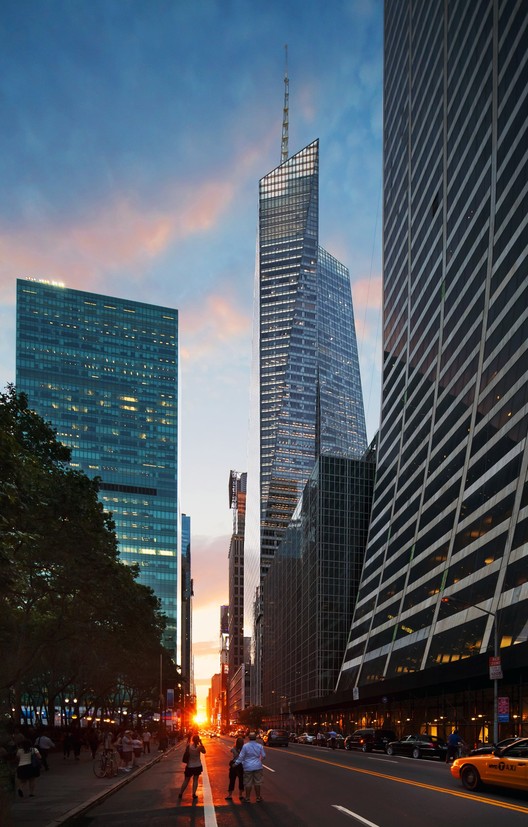
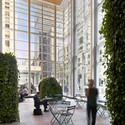
The Bank of America Tower at One Bryant Park in midtown New York, designed by Cook + Fox Architects, is the first commercial high-rise to achieve LEED Platinum certification. The design and high performance of this building is intended to set a new standard for commercial construction and for the office-work environment. By focusing on ways to emphasize daylight, fresh air and a connection to the outdoors, the architects redefine the parameters of the skyscraper as more than a glass box.
More on the strategies implemented in this project after the break.
In an effort to make New York City’s built environment “more livable and hospitable” the Department of Design and Construction (DDC), Health and Mental Hygiene, Transportation (DOT), and City Planning have developed the Active Design Guidelines: Promoting Physical Activity and Health in Design to be referenced in conjunction with the DOT’s Street Design Manual and other guidelines produced by NYC. The guidelines are written for urban planners, designers and architects and are driven by the need to address health concerns such as obesity and diabetes through intelligent design. Our built environments give us cues as to how to inhabit them and have tremendous effects, sometimes subconscious, on our lifestyles. Do you walk, drive, or bike to work? Do you take the stairs or the elevator? We make these types of decisions, which are largely based on comfort, on a daily basis. But the guidelines established in this manual are intended to give designers the tools to encourage healthy lifestyle choices to address the social concerns of NYC. So, what can planners, architects and designers do to create an active and healthy city? Find out after the break.
The New York Economic Development Corporation and Mayor Bloomberg of NYC announced the completion of the final plan for Willets Point - a peninsula on the Flushing River in Northern Queens, New York. The development of Willets Point is part of the urban renewal project associated with Citi Field – the Mets’ new stadium. Nicknamed the Iron Triangle, the project will include housing for mixed incomes, retail and entertainment amenities, a hotel, a convention center, office space, parks and open space, and a new public school, all of which falls under the umbrella of LEED-certified buildings and infrastructure. As with every redevelopment plan, there are positives and negatives to restructuring the community.
The Green Carceri, designed by TARQUITECTOS, arises as a natural extension of the High Line Park, connecting himself with the High Line and flying over the river, thus enabling a continuation of the public space underneath with the neighborhood to the height of the street and the docks. Winding around a series of vertical communication cores, the building allows both internal transit users and visitors to descend to the level of the street without having to enter the building. More images and architects’ description after the break.
Despite all of the preconceived notions about New York City being overpopulated, noisy and constantly bustling, there are numerous pockets within the five boroughs that offer respite from the city. This design strives to be one such pocket – or island. Governors Island has a long military history that dates back to 1776. It was controlled by the U.S. Government first for the U.S. Army and later for the Coast Guard. In 2002 the island was “sold” to the people of New York and declared a national monument. In 2010, Mayor Bloomberg and Governor Paterson agreed on the future operations, planning and redevelopment of the island through the Trust for Governors Island. Since then, the island has been open during the summer months for visitors to enjoy the unique seclusion offered by the the old military grounds. But the Trust had bigger plans. Choosing a team of architects, urban planners, designers and landscape architects that include Rogers Marvel Architects, Diller Scofidio + Renfro, Mathews Nielsen and led by West 8, plans began to unfold that would reimagine the island as a getaway for New Yorkers. Playing up to its isolation, its abundance of lawns and trees, and the views that it offers, the first phase of the plans have officially broken ground and are scheduled for completion in Fall 2013.