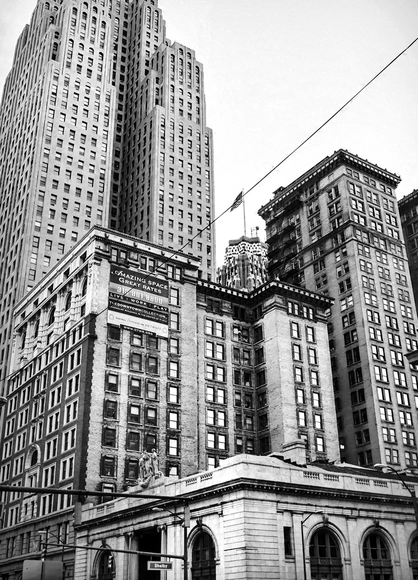
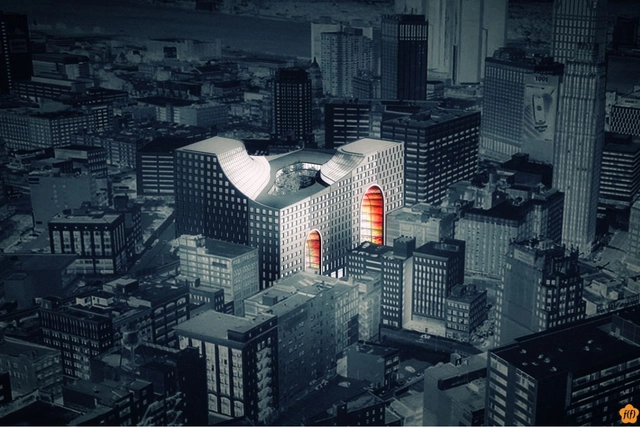
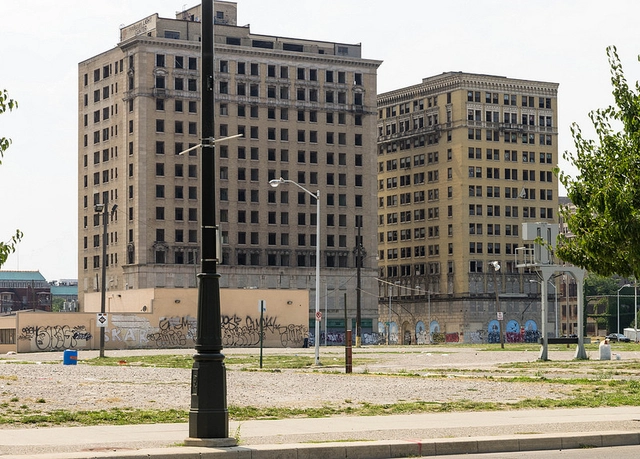
For nearly 100 years, the JL Hudson's Department Store in downtown Detroit stood as a mecca of shopping – the 25-story structure at one point holding the record for world’s tallest retail building. Then in 1983, following a downturn of the Detroit economy, the department store was closed. Its implosion followed in 1998. In the years since, the important site has laid mainly vacant, save for an underground parking structure inserted into the store’s former underground retail levels. But now, plans have been revealed to return the site to its former glory.
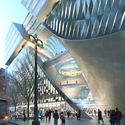
Announced yesterday by Detroit-based development group Bedrock, the site is set to receive a brand new 1.2 million-square-foot development designed by SHoP Architects and consisting of a nine-story retail podium and a 52-story, 734-foot tower that would claim the title of Detroit’s tallest building.
Due to the redevelopment of Detroit and the surging popularity of mid-century design, home prices and cost of living in the neighborhood have dramatically increased in just 5 years time – leaving the community on the cupse of turnover. Seeing the need to document Lafayette Park before it changes for good, Clancy uses his camera to capture the diverse group of existing residents in their homes, highlighting their relationships to the timeless architecture.
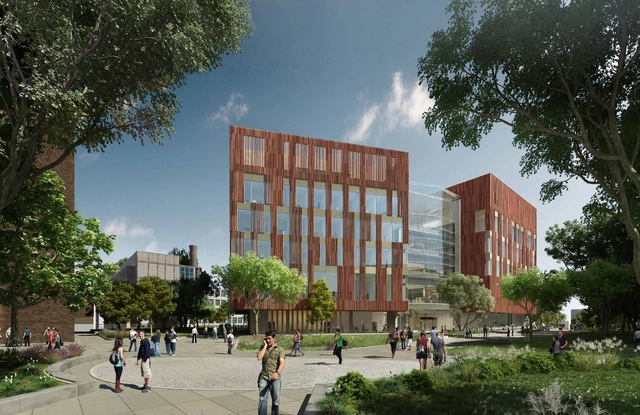
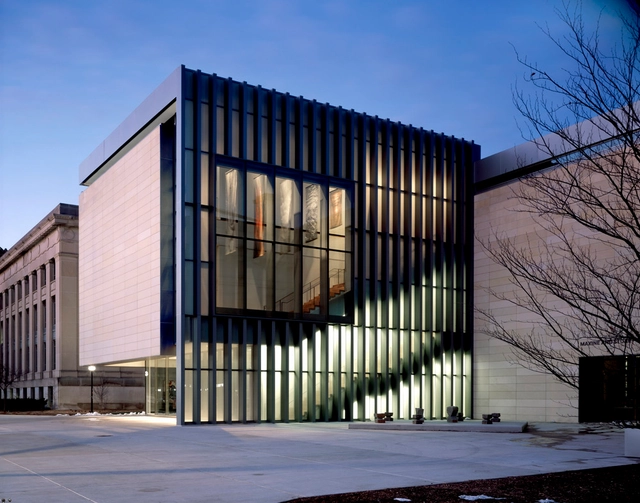
Ennead Architects has recently celebrated the completion of the steel core of a new 295,000-square-foot Biological Sciences Building (BSB) and Museum of Natural History with a topping out ceremony at the University of Michigan. Due to open in 2018, the BSB will bring together the departments of Molecular, Cellular and Developmental Biology, Ecology and Evolutionary Biology, the Research Museums of Paleontology and Zoology, and a re-envisioned Museum of Natural History.
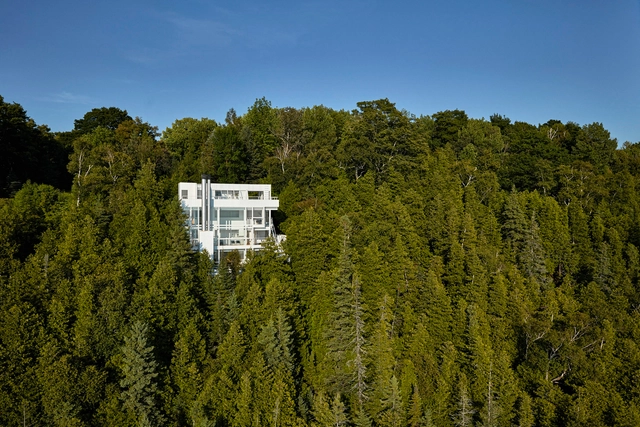
Today, one of Richard Meier’s most notable and acclaimed residences, the 1973 Douglas House, has been named to the National Register of Historic Places, the federal list of cultural resources worthy of preservation across the United States. The announcement comes after an extensive renovation to the property was completed in 2011, and will grant the home the legal status to help ensure the building is maintained for generations to come.
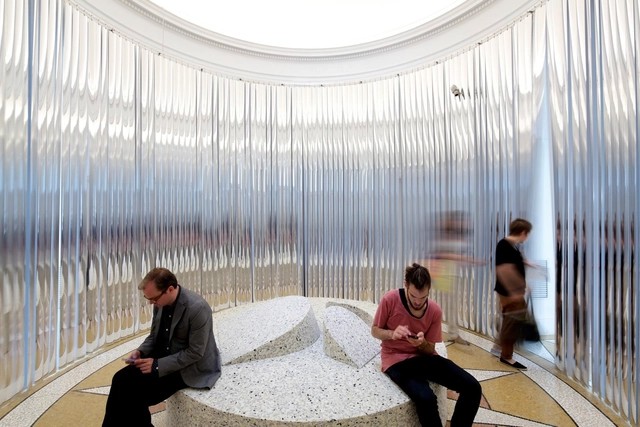
Twenty postcards depicting Detroit have been selected for “My Detroit,” part of The Architectural Imagination,” the exhibition for the US Pavilion at the 2016 Venice Biennale. Selected from among 463 entries by curator Cynthia Davidson and sociologist Camilo José Vergara, the 20 winning postcards --- taken by 18 different individuals -- were selected as a group, for helping to tell the story of Detroit today. Ten of the 18 winners are Detroit-area residents.
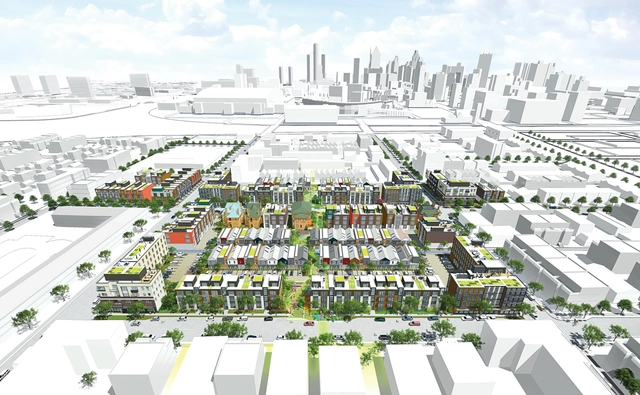
Five US firms - Lorcan O’Herlihy Architects (LOHA), Hamilton Anderson Associates (HAA), Merge Architects, Studio Dwell, and Christian Hurttienne Architects - have been commissioned to design a new walkable community in Detroit's historic Brush Park neighborhood. The project is being referred to as "Detroit's largest residential development in decades." It will include the construction of up to 400 new residential units, ranging in size from apartments to townhomes, and the renovation of four historic mansions, all within a dense four-block community that aims to be a "catalytic" development for the city.
This fall, the teams will travel to Detroit for site visits and community meetings, as well as to meet with faculty and students at the University of Michigan’s Taubman College of Architecture and Urban Planning. Curators Cynthia Davidson and Monica Ponce de Leon hope to have selected a team that produces creative and resourceful work to address the social and environmental issues of the 21st century.
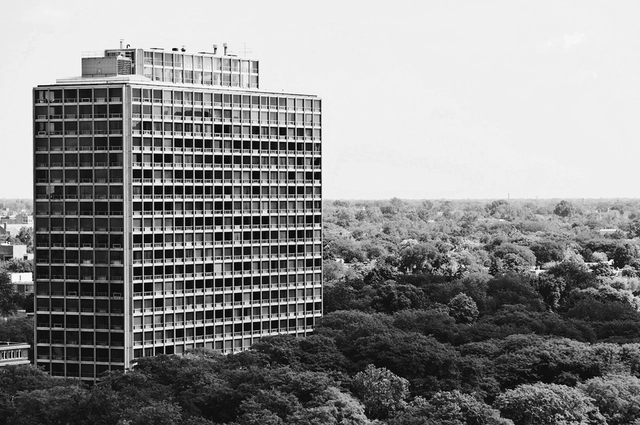
One of the first and most successful examples of urban renewal, Detroit's 78-acre Lafayette Park is known for being the world's largest collection of works by Mies van der Rohe. Now, the mid-century modern "masterpiece" is the first urban renewal project to be declared a National Historic Landmark. This is partially due to the fact that, as Ruth Mills, architectural historian for Quinn Evans Architects told the Detroit Free Press, "Lafayette Park was one of the few urban renewal projects that's done it successfully." It is now Michigan's 41st landmark.
University of Detroit Mercy's Dichotomy Journal has issued an open call for submissions to its 21st edition on the theme of "Odds," inviting discussion on projects that "defy the status quo and aim for greater fortune." Risk takers rejoice: Dichotomy 21 will shine a spotlight on architectural anomalies and the "implications of defying the odds and embracing the strange."The journal aims to stimulate a new discourse on extraordinary and unconventional designs that push the architectural envelope. Submissions are invited to discuss ideas defying the odds in design, architecture, urbanism and community development.
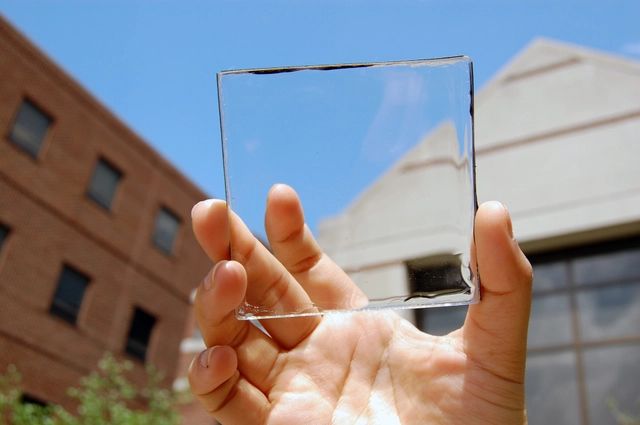
Solar harvesting systems don’t need to be glaringly obvious. In fact, now they can even be invisible, thanks to researchers at Michigan State University (MSU) who have developed a transparent luminescent solar concentrator (LSC) that can be applied to windows or anything else with a clear surface.
LSC technology is nothing new, but the transparent aspect is. Previous attempts yielded inefficient results with brightly colored materials, and as researcher Richard Lunt, an assistant professor of chemical engineering and materials science at MSU, puts it, “No one wants to sit behind colored glass.” To learn how Lunt and the rest of the research team achieved transparency, keep reading after the break.
The University of Michigan (UM) has commissioned Preston Scott Cohen and Integrated Design Solutions to design a $28 million expansion for its 40-year-old design building. Primarily planned to be used by the school’s architecture program, the new addition will include classrooms, studios and offices, as well as the renovation of existing studios. The news comes five years after schematic designs for the original expansion were abandoned. More information, here.
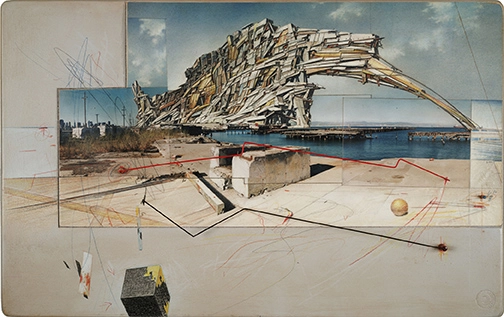
From November 22 through March 2, 2014, the Eli and Edythe Broad Art Museum at Michigan State University presents Lebbeus Woods, Architect, bringing together over 100 works from the past 35 years by one of the most influential architects working in the field. Recognized beyond architecture, Lebbeus Woods (1940–2012), who was born in Lansing, Michigan, has been hailed by leading designers, filmmakers, writers, and artists alike as a significant voice in recent decades. Notably, Zaha Hadid, architect of the Broad’s newly inaugurated building, cities Woods as a key influence.
Courtesy of Chung Whan Park, Terry Park, Jeong Jun Song, Hyuntek Yoon, Kyung Jae Yu
The mission in the proposal, titled ‘The Grand Opening,’ for the Redesigning Detroit: A New Vision for an Iconic Site competition is to create a vision for a 24/7 timeless, vibrant and walk-able urban neighborhood in downtown Detroit with a catalytic impact on the retail activities of Woodward Avenue Corridor. Designed by Chung Whan Park, Terry Park, Jeong Jun Song, Hyuntek Yoon and Kyung Jae Yu, The Grand Opening will connect the different contexts of the existing urban settings and bring every hour of excitement, crowd and memorable identity to the street life of downtown Detroit. More images and architects’ description after the break.
Detroit, Michigan; Courtesy of Flickr User DandeLuca, licensed via Creative Commons
Young entrepreneurs gravitate to places where they can become the founders of a revitalized culture; where land is cheap and available and innovation is uninhibited by a status quo. Detroit, Michigan has become one of those places. The media gives us a portrayal of a wasteland, a post apocalyptic landscape of dilapidated homes and infrastructure. But there is plenty opportunity for start-ups to redefine Detroit's future. That it why young innovators and risk-takers are needed to bring new energy and awaken new markets within the city. A recent article by Chuck Salter for Fast Company identifies six entrepreneurs who have started businesses in Detroit. They vary from grassroots campaigns to inform people of opportunities within the city to small scale enterprises that bring retail and infrastructure to the downtown area and surrounding neighborhoods.
Update: Our friends at Two Islands have launched a Kickstarter campaing so you could also be part of the project. By pledging £5, you can have your own photo used in the ceiling of Mark's House (or £20 for a bigger one). You can send a photo, a sign, a collage or even a QR code, so get creative! Click here for all the information.
Occupying no more than eight parking spaces on Flint, Michigan’s central downtown parking lot, this temporary summer pavilion designed as an abstract, reflective and floating representation of a Michigander, Tudor-style home has been chosen as the winning scheme in the inaugural Flat Lot competition presented by Flint Public Art Project and the Flint Chapter of the American Institute of Architects.
More information on the winning scheme after the break...
Aiming to create a riverfront like none other in the world, landscape architect Matthew Edward Getch and architect Maciej Woroniecki shared with us their proposal in the Detroit by Design 2012 competition where they received the 2nd overall prize and the first prize for the People’s Choice Award. The goals of their proposal were born from Detroit’s apparent weakness. They established linear interventions which recognized the severed parks and green networks and utilized them to reconnect the citizens of Detroit back to the riverfront through pedestrian friendly portals. More images and architects’ description after the break.