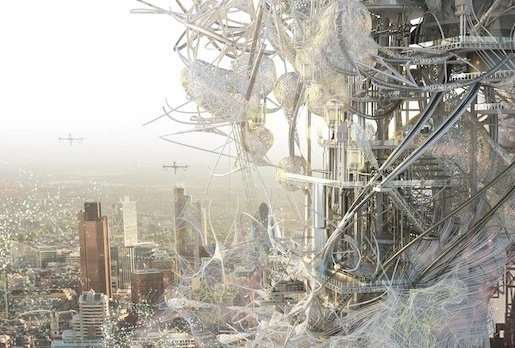
Opening October 4, The Architecture Foundation in London is delighted to present 'Futures in the Making,' a group exhibition showcasing prospective architectural futures explored in the work of recent architecture graduates. From spectacular pollution capturing facades to innovative agrarian settlements, projects will include a global range of case studies that test new ideas for architecture and infrastructure by a rising generation of architectural talent. The exhibition will be on display until November 13. For more information, please visit here.
A recent profile in Architectural Record highlights the career of Peter Wynne Rees, the chief planner of the City of London: the famous 'square mile' which contains the major financial district of Greater London, as well as some of its great tourist attractions, such as St Paul's Cathedral.
The profile focuses on the new crop of skyscrapers which Rees has ushered in in his 27 years as chief planner, something which has been contentious for preservationists. When he came to the job in 1985, the City of London had just one skyscraper: Tower 42, built in 1980. With the success of the Gherkin in the early 2000s, the surrounding area has seen many more high profile skyscrapers, such as the Heron Tower, 122 Leadenhall Street (The Cheesegrater) and 20 Fenchurch Street (The Walkie-Talkie).
After a government report earlier this month found that the London Olympics had brought a £10-billion-boost to the UK's economy - effectively breaking even with the initial investment after just one year - the architectural community has begun to question whether the built legacy of the games will be worthwhile in the long run.
Guardian critic Olly Wainwright is scathing about the Olympic park, particularly the developments at the edge of the site: "At every junction of this roaring A-road sprouts a steroidal tower, each clad in ever more lurid colours, transforming the street into a gauntlet of competing ambitions. Looming over adjacent council estates, these brash totems are a monument to Olympian greed... Strip away all the festive colours, though, and you'll find that these are actually mean-minded silos of tightly packed one-bedroom flats, mostly sold overseas for buy-to-let."
Find out more about Wainwright's investigations, and other opinions of the Olympic legacy, after the break.
London-based United Visual Artists (UVA) has brought Sou Fujimoto’s “cloud-like” Serpentine Pavilion to life with an “electrical storm” of LEDs. With the intention of making the architecture “breathe” from within, UVA seamlessly integrated a network of LED lights into the latticed, 20mm steel pole structure that mimics the natural forms of an electric storm. In addition, carefully conducted auditory effects further enhance the experience, transforming Fujimoto’s “radical pavilion” into an electrified geometric cloud.
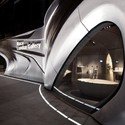
On September 28, 2013, Zaha Hadid Architects will be celebrating the completion of the Serpentine Sackler Gallery. An extension to London’s famous Serpentine Gallery, the new innovative arts venue will be housed in a 208-year-old, Grade II-listed building, formerly known as The Magazine, in Kensington Gardens just north of the main gallery.
This project will be Zaha Hadid’s first permanent structure in central London and second commission from the Gallery, as she designed the inaugural Serpentine Gallery Pavilion in 2000.
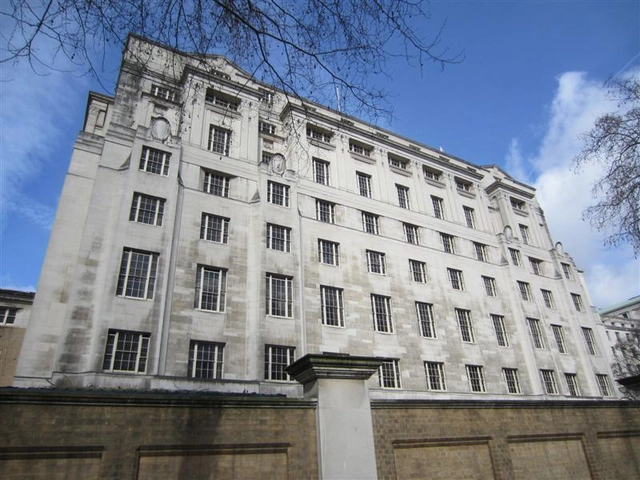
Metropolitan Police Service Headquarters; Courtesy of RIBA Competitions
Five London-based firms - AHMM, Allies & Morrison, Foster & Partners, Keith Williams Architects and Lifschutz Davidson Sandilands - have been selected to compete for the “Scotland Yard” redevelopment of the abandoned Curtis Green MPS building on the Victoria Embankment. As reported by BDOnline, the shortlisted firms will each propose a “landmark building for London” that will provide a “modern and efficient working environment” for the new Metropolitan Police Service Headquarters. The judging panel, spearheaded by architect Bill Taylor and RIBA Adviser Taylor Snell, will review the proposals in September.
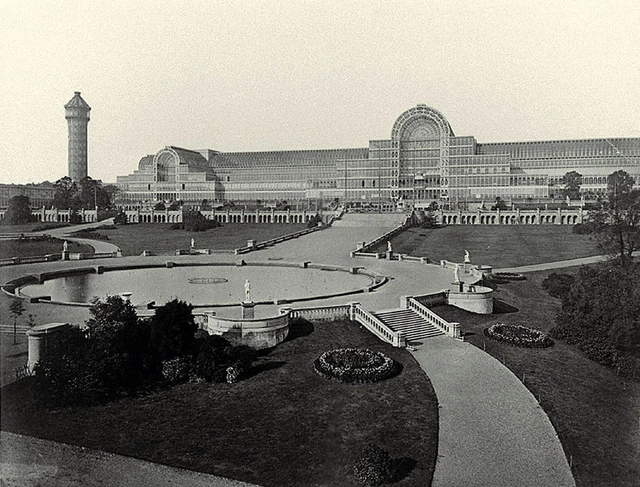
Shanghai-based developer ZhongRong Holdings is working with Arup on an ambitious proposal to reconstruct Joseph Paxton’s Crystal Palace in London. Originally built to house the Great Exhibition of 1851, the 80,000 square-meter cast iron and glass structure was relocated from Hyde Park to south-east London in 1854 where it was ultimately destroyed by fire in 1936.
Currently on view until August 30, Unit Architects is presenting their 8-week exhibition in the entrance space of Buro Happold's 17 Newman Street offices as part of Buro Happold’s Emerging Architects event program. A great way to show off some of the upcoming talent in architecture and design, the contribution by Unit Architects to this series focuses on a selection of their work that shares a common approach of engagement with scale, contextual symbology, material presence and considered detailing. More images and architects' description after the break.
Norman Foster’s Swiss Re Headquarters, a.k.a. “The Gherkin,” has been selected as the Council on Tall Buildings and Urban Habitat’s (CTBUH) first 10 Year Award recipient. The uniquely-shaped skyscraper, as described by CTBUH, “cleared the way for a new generation of tall buildings in London and beyond. Ten years on, its tapering form and diagonal bracing structure afford numerous benefits: programmatic flexibility, naturally ventilated internal social spaces that provide user comfort while reducing energy demand, and ample, protected public space at the ground level.”
The New London Awards, which recognize the best projects in London - both recently completed and on the drawing-board - were held at London's Guildhall on the 12th of July. Richard Rogers took the top prize of "New Londoner of the Year" in recognition of his life-long commitment to raising the quality of urbanism in the UK capital. The award coincides with his 80th birthday and a major retrospective at the Royal Academy.
See all the winners of the 17 different awards after the break.
IE School of Architecture & Design through its unique combination of design, innovation and management, expands the boundaries of traditional architectural education. IE welcomes students who seek challenges and aspire to become leaders in the dynamic world of architecture and design.
"I have a lot of big plans for the gallery, but every idea is an experiment; I don't necessarily want to enforce what it will be, but rather find out what it wants to be." This is how Thomas Ermacora described his vision of the Lime Wharf Gallery, a largely hidden series of spaces squeezed between Vyner Street and Regents Canal in the middle of Hackney's burgeoning creative quarter.
Ermacora hopes the gallery will become an "accelerator of change through culture", bringing arts, technology and social enterprise together for projects which generate optimism for the future. All of these traits made Lime Wharf Gallery the perfect space to present "Future Fitting." This evening of talks, orchestrated by Ermacora and Lucy Bullivant (editor of the new webzine Urbanista), focused on urban design that has the foresight and flexibility to deal with the needs of the future.
Read about the ideas presented at the Future Fitting event after the break...
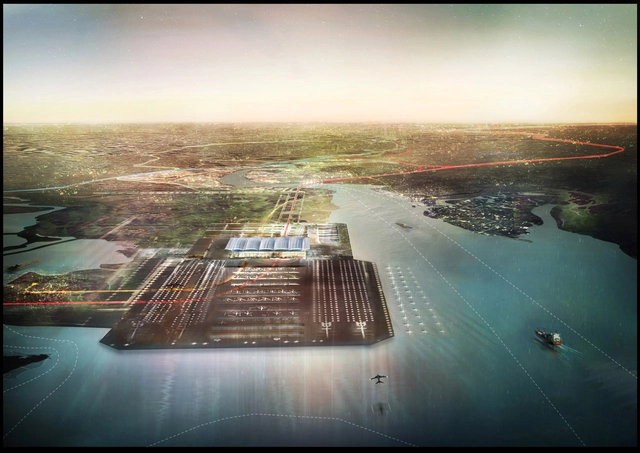
Identifying connectivity as the key to prosperity within the 21st century, London Mayor Boris Johnson acknowledged the wider economic and regeneration potential of a new hub airport at a City Hall meeting today.
In his speech, Johnson recommended three optimal locations for the new airport: the Isle of Grain in north Kent; Stansted; or on an artificial island in the middle of the Thames estuary. These three suggestions come as a result of a year-long, independently peer-reviewed investigation by the Transport for London, which confirmed the inability of London’s current major airport, Heathrow, to meet demands by expanding.
More on London’s future hub airport after the break...
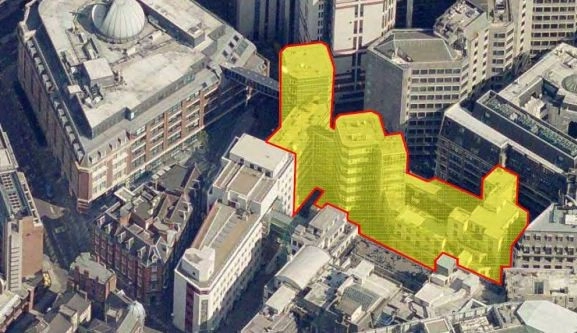
Southwark planners have recommended an ambitious proposal by international practice Kohn Pedersen Fox (KPF) and engineer Adams Kara Taylor (AKT II) to add 11 floors to an existing 30-story tower in London. The “incredibly complicated” feat, which would be the world’s first of its kind, would extend Richard Seifert’s 1972 King’s Reach Tower on the South Bank by 44 meters, more than a third its original height.





nigel_young.jpg?1374697284&format=webp&width=640&height=580)
nigelyoung.jpg?1374696725 "© Nigel Young")
nigelyoung.jpg?1374696751 "© Nigel Young")
foster_partners.jpg?1374697174 "© Foster + Partners")
nigel_young.jpg?1374697622 "© Nigel Young")
nigel_young.jpg?1374697284)