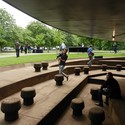
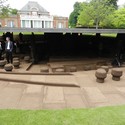
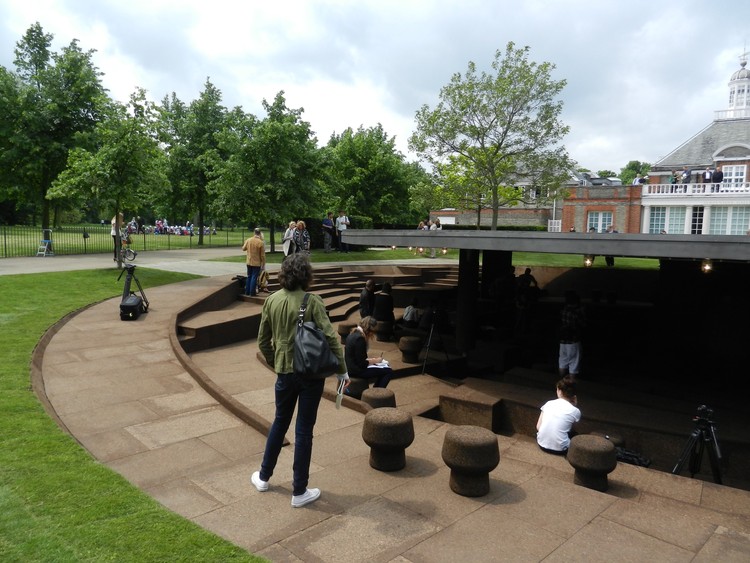
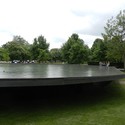
Starting tomorrow, the 12th version of the Serpentine Gallery Pavilion will be open at the Hyde Park in London. As we announced some months ago, the design was commissioned to Herzog & de Meuron and Ai Weiwei. The final proposal was published just at the beginning of this month, showing an interesting ground work. This year’s pavilion is half sunk into the landscape, as if it were carved in the terrain and covered with a liquid layer, reflecting the the surrounding light and landscape.
More info and images after the break

This year’s Pavilion will take visitors beneath the Serpentine’s lawn to explore the hidden history of its previous Pavilions. Eleven columns characterising each past Pavilion and a twelfth column will support a floating platform roof 1.5 metres above ground. Taking an archaeological approach, the architects have created a design that will inspire visitors to look beneath the surface of the park as well as back in time across the ghosts of the earlier structures.

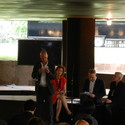
Julia Peyton-Jones, Director, and Hans Ulrich Obrist, Co-Director, Serpentine Gallery, said: “It is a great honour to be working with Herzog & de Meuron and Ai Weiwei. We are delighted that our annual commission will bring this unique architectural collaboration to Europe to mark the continuity between the Beijing 2008 and the London 2012 Games.”

The Serpentine Gallery Pavilion will operate as a public space and as a venue for Park Nights, the Gallery’s high-profile programme of public talks and events. Connecting to the archaeological focus of the Pavilion design Park Nights will culminate in October with the Serpentine Gallery Memory Marathon, the latest edition of the annual Serpentine Marathon series conceived by Hans Ulrich Obrist, now in its seventh year. The Marathon series began in 2006 with the 24-hour Serpentine Gallery Interview Marathon; followed by theExperiment Marathon in 2007; the Manifesto Marathon in 2008; the Poetry Marathon in 2009, the Map Marathon in 2010 and theGarden Marathon in 2011.
- © Daniel Portilla
- © Daniel Portilla
- © Daniel Portilla
- © Daniel Portilla
- © Daniel Portilla
- © Daniel Portilla
- © Daniel Portilla
- © Daniel Portilla
- © Daniel Portilla
- © Daniel Portilla
- © Daniel Portilla
- © Daniel Portilla
- © Daniel Portilla
- © Daniel Portilla
- © Daniel Portilla
- © Daniel Portilla
- © Daniel Portilla
- © Daniel Portilla
- © Daniel Portilla
- © Daniel Portilla
- © Daniel Portilla
- © Daniel Portilla
- © Daniel Portilla
- © Daniel Portilla
- © Daniel Portilla
- © Daniel Portilla
- © Daniel Portilla
- © Daniel Portilla
- © Daniel Portilla
- © Daniel Portilla


艾未未不能来参加有点遗憾,还被关在家里呢。
Actually he sent a video that was showed during the ceremony, where he thanked the opportunity of working in the pavilion. Plus, on BBC he explained “his condition” and how he had deal with the work abroad through virtual technologies.
You can check it here…
http://www.bbc.co.uk/news/entertainment-arts-16964055
真的吗?有限制他出境吗?Really,he’s been in limit exit?
so now, we are all waiting for iwan baan´s pictures of the pavillion to make it look really good.
…it’s a circle(?), but exposed conduit for lights hurts me eyes… kinda morbid and dark down there for a pavillion?
Hope they’ll find some fossils down there.
Maybe open some little holes in the pond, and let natural light penetrates into the bottom part is better than by using light bulbs.
This project is brilliant. It is both vintage H&deM and the best of their recent pursuits: with a touch of Wei Wei of course.
Those conduit lights – that is the vintage H&deM materiality – think Dominus Winery era. The highly complex geometries used to express the anthropological gesture could be understood a bit more current. This looks like a project one might expect to find in their Natural History manifesto. (I also see direct relationships to the Aargauer Kunsthaus and the Caixa Forum among others.)
Whenever I reach a point where I am about to write off H&deM (for example after their recent contribution to the Vitra campus I thought they might be too big and past their prime) they brilliantly prove what a fool I am. Cheers.
In my opinion, I fail to see what is so great about this dark dingy space in such a prominent area, it is a privileged missed opportunity to add to the previous great Serpentine pavillions of the past. The water idea is interesting, but why not have used a glass soffit in certain areas to allow light (and water patterns) to go through to the the seating area adding a peaceful vibe to this rest space. Instead, hoboes will end up sleeping, and peeing or worse under there probably. Looks like the Southbank brutalist dark spaces where people skate (without the skating opportunity).
Now the homeless have somewhere dry & dark to sleep at least…
Are those those the real foundations of the previous Pavilions?
as if london’s weather is so bright all the time that we need to shade ourselves even more in a subterranean world.. a little disappointed
I’m disappointed it’s not soil, and mud in the pit.:/
This is student work, the emperors new clothes, or a failure – at least to inspire – whatever the intellectual narratives as justification behind this compressed quasi-bomb-shelter. It is a paranoid form: a big toad-stool for frightened elves to hide under, with tiny toad-stools to sit on. How is it possible that a major element – the roof of water, an eminently transparent material, is treated as an opaque ‘glass ceiling’ – not utilized to transmit light into the space? So, we may enter from fear, but promise cannot descend because hope is blocked, inaccessible. We are relieved then, to exit this bunker having been protected really, from a missed opportunity to experience something that does what it more fully is (light defining space) – instead of being a timid gesture (with explosion proof bulbs). What did we gain by being there? Well, maybe a brief association with other cowering elves. What good is architecture as a clever political statement if it also doesn’t give access to a solution?
fatemeh